The useful question is never whether EZProxies is good. It is whether it fits the job you are about to run, on your target, this month. A proxy provider that suits one workload is wrong for the next one.
What is on file for EZProxies
You will find them at ezproxies.com.
We price the providers we can source and date, and EZProxies is not currently one of them. The rest of this page is about what to check when you read their pricing yourself.
The four figures worth copying down are the rate without a commitment, the smallest purchase allowed, what happens to unspent balance, and whether a failed request still costs money.
Their own description, read this week
Their homepage title, read on 9 September 2026: "EZProxies - Private and Shared Datacenter Proxies". The one-paragraph pitch on their own page: "Buy fast, reliable private and shared datacenter proxies with instant activation. HTTP and HTTPS proxies in US, Spanish, and Italian locations. IP whitelist and username/password authentication. 24/7 support."
Taken from the same page, on the same day:
The product lines named on that page are residential and datacenter. They advertise 20 countries or locations. Payment methods mentioned: PayPal, crypto and cards. Support is advertised as around the clock. We found no separate pricing page linked from the homepage, which usually means the price arrives by quotation.
Treat all of it as advertising, because it is. Its value is that it is dated and quotable, which is more than most comparison pages offer.
How long EZProxies has been trading
The domain was registered on 8 June 2006, through NameCheap, Inc, which makes it about 20 years old. The lookup behind those dates ran on 9 September 2026. As things stand the domain is held to 8 June 2027.
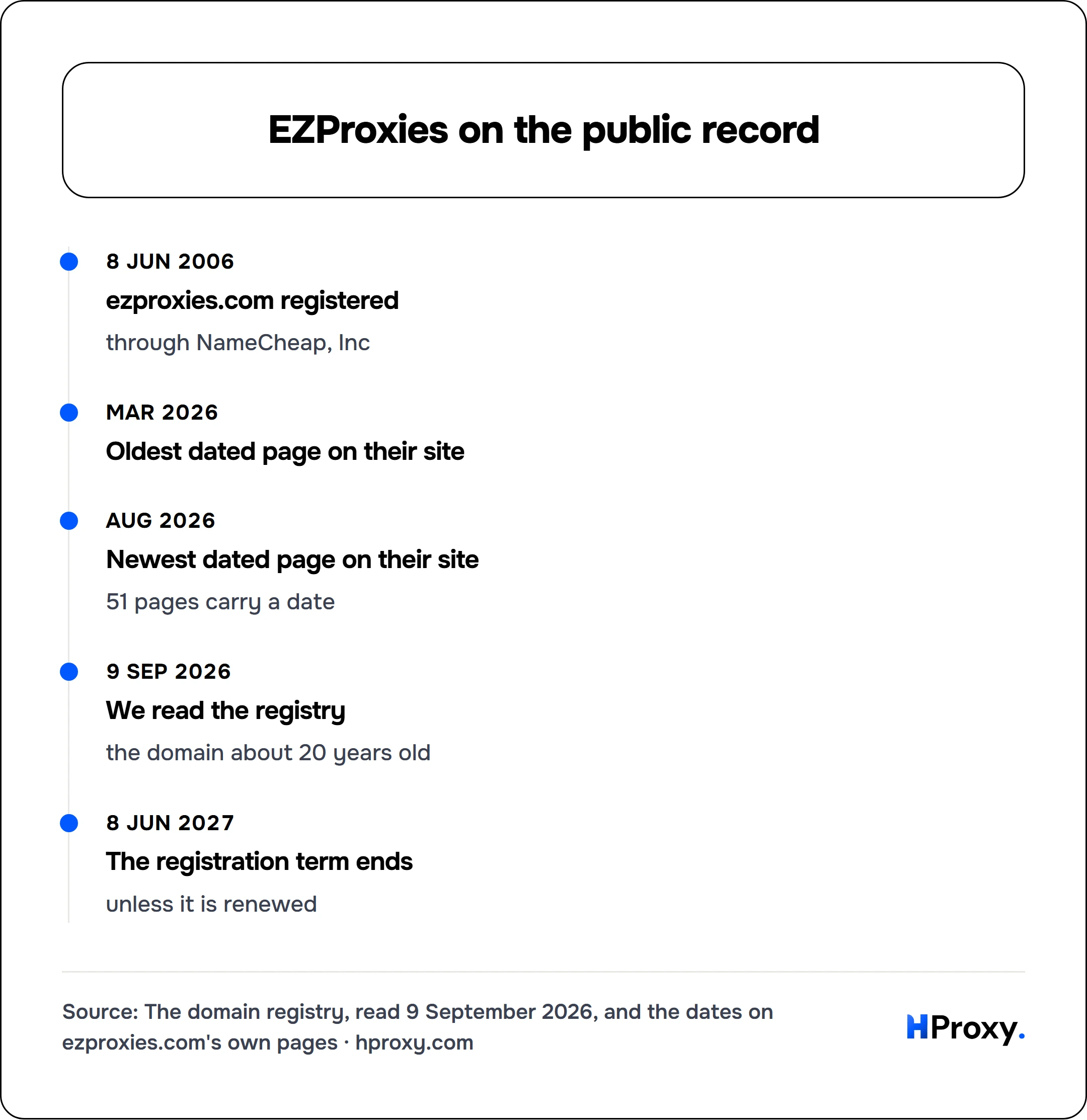
8 Jun 2006
ezproxies.com registered
through NameCheap, Inc
Mar 2026
Oldest dated page on their site
Aug 2026
Newest dated page on their site
51 pages carry a date
9 Sep 2026
We read the registry
the domain about 20 years old
8 Jun 2027
The registration term ends
unless it is renewed
None of it predicts success rate. It is here because domain age and archive depth are free to check, and a provider whose public record starts last quarter deserves a smaller first order.
Their published surface
We crawled 51 pages of their site on 19 June 2026 and found 6 blog pages and 6 use-case pages.
Site size is a signal about marketing budget rather than network quality, and the two are frequently unrelated. It is useful for a different reason: a provider with many pricing pages is usually segmenting hard, and a provider with none is selling by quotation.
How recently the site moved
Our crawl of their site found 51 pages carrying a date. The oldest is from March 2026 and the newest from August 2026. 51 of them carry a date inside the last twelve months.
Timestamps are not quality, and a company still publishing is at least a company still trading. That is worth more than it sounds in a market where providers disappear without notice.
What buyers type into Google about them
Worldwide, the brand carries about 10 searches a month: 10 a month for a review of them. Figures read from Google Keyword Planner on 9 September 2026.
The largest share is people checking whether to trust it, which is the honest starting point for a page like this one.
What a pricing page leaves out
Networks age, so re-test quarterly
Pools are rebuilt, suppliers change and detection improves. A provider that beat the field last spring may be mid-table now. Nothing in this market stays true long enough to buy once and stop measuring.
The reputation you inherit
A shared address arrives with a history you did not create and cannot see. For read-only work it rarely matters. For anything that keeps a session, it is the most common cause of unexplained failure.
The line item hidden in the success rate
Divide the spend by the successful responses, not by the requests sent. That single change reorders most price comparisons in this market, and your accounting will use it eventually anyway.
The rows that decide it
Compare on these rows and ignore the feature lists on both sites:
| Question to ask | EZProxies | HProxy |
|---|---|---|
| Entry price | Not verified by us, read their page | From $0.44/GB, pay as you go |
| Does unused balance expire? | Their terms page answers this | Never |
| Minimum commitment | Worth confirming in writing before you commit | None |
| Identity checks | Read their current terms | Card orders are screened, and verification is sometimes requested |
| Targeting | On their own terms page | Country, city and ISP |
| Free way to evaluate | Not published clearly, ask before paying | Free proxy list and proxy checker |
Treat the right-hand column as a claim by an interested party, because it is one. Every line in it is checkable on our own pages and in our own terms.
What to do instead of reading more comparisons
The steps below take about ten minutes and settle the question properly.
- Put a few dollars on each account. Trials are fine for a first look, but paid traffic is what you will actually be buying.
- Run them against the site you actually care about, using the code you actually run, within the same hour.
- Track the success rate and the bandwidth. A cheap gigabyte that fails half the time is not cheap.
- Run a sample of the addresses through an independent lookup, because advertised geography and actual geography differ more often than the market admits.
- Keep the winner, and repeat the whole thing quarterly, because pools age.
Where else buyers look
If this one does not fit, these are the nearest comparable providers we have written up, each on the same terms as this page.
What we sell, stated plainly
If you want our side of it: $0.44 per GB for residential, pay as you go, nothing expires, and the free tools stay free. We would rather you measured than believed us, which is why the test comes before this paragraph rather than after it.