A proxy provider comparison is only as good as its dates. Prices, pools and policies all move, so every number below carries the day it was read, and anything we could not read is marked as unverified rather than filled in.
The published numbers
Read from their own public pricing pages on 10 August 2026, and stated as advertised rather than as verified by us:
- Datacenter: $0.75 per IP on promotional sale price; the quantity or duration that unlocks it is not disclosed.
- ISP: from $1.50 per IP with no commitment, falling to $0.75 per IP on promotional sale price; the quantity or duration that unlocks it is not disclosed anywhere on the site.
- Mobile: from $5 per GB with no commitment, falling to $2.20 per GB on 500 GB single purchase ($1,100.00 total).
- Residential: from $2 per GB with no commitment, falling to $0.65 per GB on 5,000GB, at the sale rate.
- Scraping API: from $1 per 1,000 requests on 30,000 credits ($30.00 up front) - Web Scraper API.
Every one of those is a published rate rather than a measured outcome. That is not a criticism of Thordata: our own page is built from the same material. It is the reason the rest of this comparison is about what published rates leave out.
The site, as it reads today
The title tag on 9 September 2026 was "Thordata - High-Quality Proxy Service for Web Data Scraping".
Reading the same page for the things buyers actually ask about:
The product lines named on that page are residential, datacenter, ISP or static residential, mobile and a scraping or SERP API. They advertise 190 countries or locations. Payment methods mentioned: cards. The page offers some form of free trial. A refund or money-back term is mentioned. Their pricing page is titled "SERP API Pricing - Thordata".
All of the above is their copy, not our finding. A dated quotation is the weakest kind of evidence that is still evidence.
How long Thordata has been trading
The domain was registered on 23 March 2001, through Aceville Pte. Ltd, which makes it about 25 years old. We pulled that from the registry on 23 April 2026. The current registration term ends 23 March 2027.
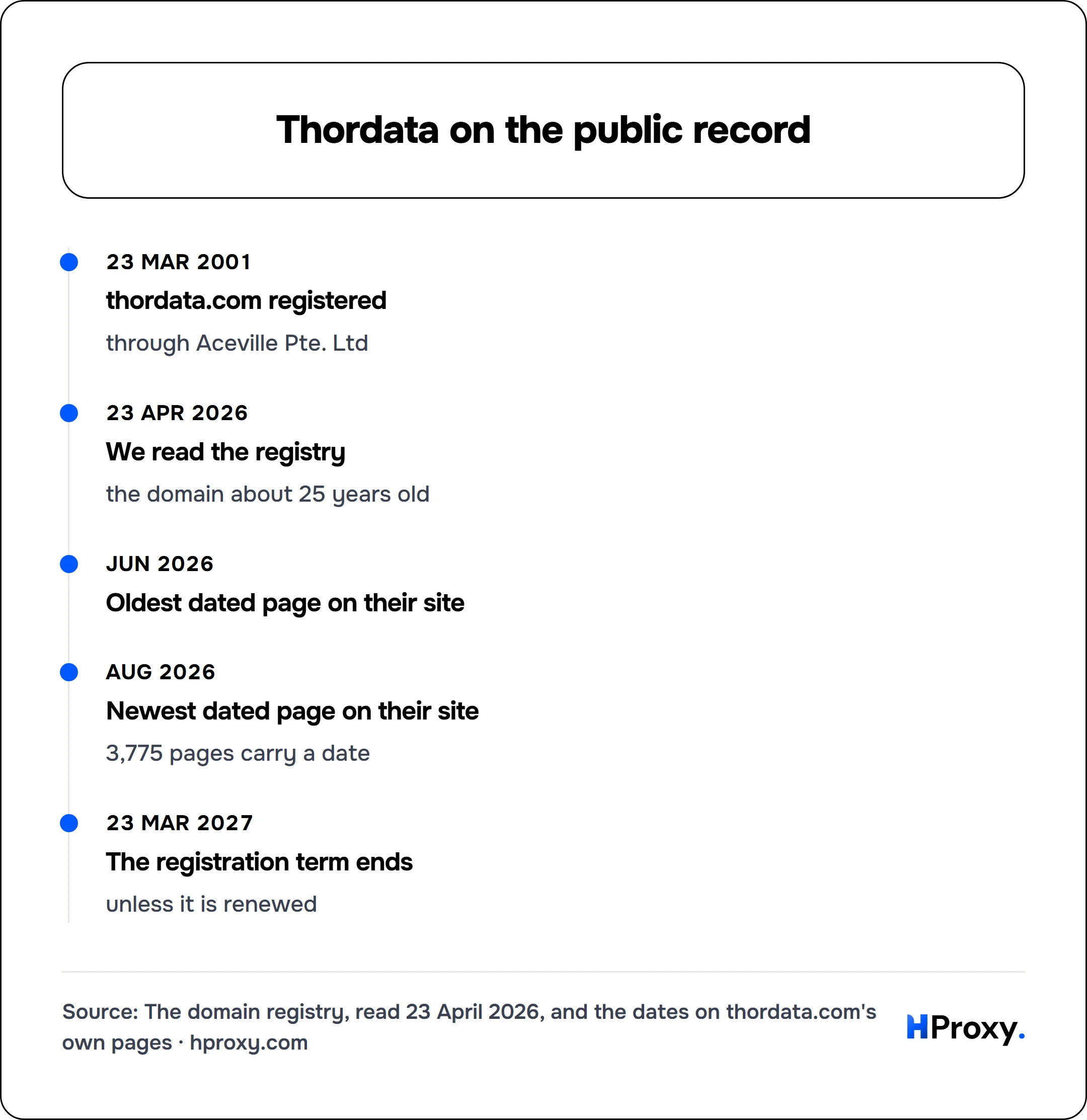
23 Mar 2001
thordata.com registered
through Aceville Pte. Ltd
23 Apr 2026
We read the registry
the domain about 25 years old
Jun 2026
Oldest dated page on their site
Aug 2026
Newest dated page on their site
3,775 pages carry a date
23 Mar 2027
The registration term ends
unless it is renewed
This proves nothing about the product. It is a cheap check against the one failure mode that costs buyers real money in this market, which is paying a provider that will not exist in six months.
On the record about the company itself: Operated by HK Hengsheng Runzhi Technology Co., Limited, a Hong Kong entity; Vendor-claimed scale: 100M+ residential IPs, 190+ countries, 430+ staff, 4,000+ enterprise customers.
What our crawl found
Our own crawl reached 3.775 of their pages, last run 18 June 2026. The mix was 189 blog pages, 156 pricing pages, 264 use-case pages and 46 integration pages.
The number is not a compliment or a criticism. It describes how much of their effort goes into being found, which is worth knowing when you are weighing a marketing claim against a measurement.
Whether anyone is still working on it
Our crawl of their site found 3,775 pages carrying a date, 189 of them articles. The oldest is from June 2026 and the newest from August 2026. 3,775 of them carry a date inside the last twelve months.
Read that as a liveness check rather than a review. It says the lights are on, and nothing about whether the proxies work on your target.
What people actually search about Thordata
Search volume around the name runs to 30 a month, split as 30 a month for a review of them. Figures read from Google Keyword Planner on 9 September 2026.
The biggest slice is people checking whether to trust it, so the useful thing to hand a reader is evidence rather than an opinion.
Advertisers bid up to $7.03 for one of those clicks, which is a useful proxy for what a customer in this market is worth and for how hard the results page is fought over.
What a pricing page leaves out
Why the pool number is the least useful figure
Nobody audits pool totals in this market, and the counting rules differ between vendors. Even an accurate figure describes addresses that exist, not addresses you will be routed through. Treat it as a marketing unit rather than a capability.
What the starting rate leaves out
Rates in this market are quoted from the bottom of the table. The relevant question is which row you land on at your volume, and whether reaching a cheaper row costs more in commitment than it saves per unit.
Concurrency limits decide throughput
Rate limits are often enforced per account rather than per plan, which means buying more traffic does not raise them. Confirm how yours scales before you assume a bigger plan runs faster.
The rows that decide it
Six questions, both answers, and an honest blank where we do not hold a current figure:
| Question to ask | Thordata | HProxy |
|---|---|---|
| Entry price | Published, see above, dated 10 August 2026 | From $0.44/GB, pay as you go |
| Does unused balance expire? | Read their current terms | Never |
| Minimum commitment | Lower rates require one, see above | None |
| Identity checks | Their terms page answers this | Card orders are screened, and verification is sometimes requested |
| Targeting | On their own terms page | Country, city and ISP |
| Free way to evaluate | Not published clearly, ask before paying | Free proxy list and proxy checker |
Read the table as a list of questions rather than a scoreboard. The answers on their side move, and the row that decides the outcome, success rate on your target, is not printable by anyone.
What to do instead of reading more comparisons
The steps below take about ten minutes and settle the question properly.
- Fund both accounts with the least money each will accept, and note what that minimum was, because it is part of the comparison.
- Aim both at the page that matters to you rather than a test endpoint, and keep every other variable fixed.
- Write down two numbers per provider: the share of requests that succeeded, and the traffic it cost.
- Take a handful of the addresses you were given and verify their country and type against a checker you do not control.
- Go with whichever performed, then measure again next quarter. Networks change underneath you.
Where else buyers look
If this one does not fit, these are the nearest comparable providers we have written up, each on the same terms as this page.
What we sell, stated plainly
Our position is narrow. Residential from $0.44 per GB, no subscription, no expiry on the balance, and a public record of what our free network actually does. A provider unwilling to be measured is telling you something, and so is one that asks to be.