Thunderbit (thunderbit.com) is an AI web scraper that runs as a Chrome extension. You describe the columns you want, its AI fills them, and the rows go to Excel, Google Sheets, Airtable or Notion. It bills by the output row. On 12 October 2026 Starter cost $15 a month for 500 rows and the Pro tiers ran from $38 for 3,000 to $249 for 20,000, with no refunds for unused credits. For one-off tables, Instant Data Scraper does a simpler version of the job free; for scheduled runs, Web Scraper, Browse AI and Octoparse sell other units. The comparison prices all four.
What Thunderbit charges
Its price page draws the plan cards from data it carries, and we read that data from our server.
Thunderbit's plans, 12 October 2026
| Plan | Price | Credits |
|---|---|---|
| Free | $0 | Up to 6 pages, 30 credits each |
| Starter | $15 a month, or $108 a year | 500 a month, or 5,000 a year |
| Pro 1 | $38 a month, or $288 a year | 3,000 a month, or 30,000 a year |
| Pro 2 | $75 a month, or $576 a year | 6,000 a month, or 60,000 a year |
| Pro 3 | $125 a month, or $1,152 a year | 10,000 a month, or 120,000 a year |
| Pro 4 | $249 a month, or $2,304 a year | 20,000 a month, or 240,000 a year |
The plan data in thunderbit.com/pricing, read from our server on 12 October 2026
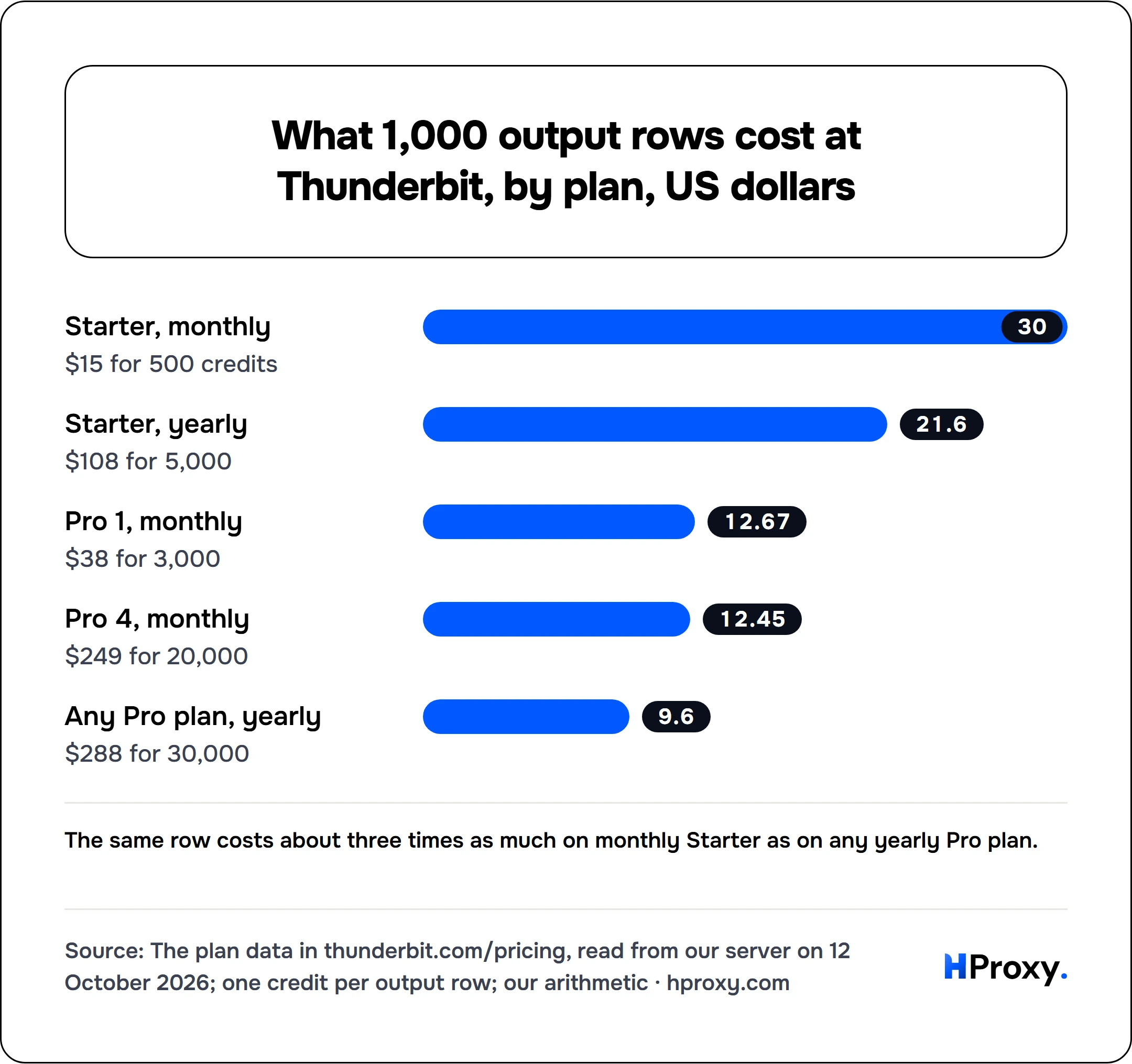
The pricing FAQ defines the unit: "A Credit is the basic usage unit in Thunderbit". An output row costs 1 credit, a row from a subpage 2, a message to the advanced model 1, and a successful data-enrichment query 30. Yearly billing takes 23% to 40% off and pays all credits upfront. On Starter and the two smaller Pro tiers a year brings ten months' worth of credits, 5,000 against 6,000 for twelve monthly payments; Pro 3 and Pro 4 give the full twelve.
The rules on money
"Thunderbit does not offer refunds for unused time or credits", says the FAQ. The refund page allows one exception: an annual plan, with no credits used, asked for within 48 hours of the first payment. A cancelled plan runs to the end of the period. A plan that runs out of credits must be upgraded or wait for the next cycle. The free plan lacks subpage, bulk and paginated scraping, and keeps data for 7 days, after which older data "will be hidden, but it will not be deleted". The free trial gives all Pro features for 7 days with 8 pages of scraping and unlimited credits.
What changed, and what it claims
In December 2024 the price page sold "steps" and "pages/month", with 33% off for a year. Archived copies of January and May 2026 show today's credit plans at today's prices; between May and October the trial shrank from 10 pages to 8.
The terms bind buyers to Thunderbit, Inc., with an agreement to arbitrate that can be refused within 30 days. Its about page says the company was founded in 2023, gives its headquarters as "Distributed" and claims "200,000+" active users and a Chrome rating of 4.3. The Chrome Web Store showed 100,000 users and 4.1 stars from 212 ratings on 12 October 2026, for version 4.6.6 of 10 August.
The alternatives side by side
Thunderbit and four alternatives, 12 October 2026
| Tool | Free | Paid from |
|---|---|---|
| Instant Data Scraper | The whole extension | No paid plan |
| Web Scraper | The extension | $50 a month billed yearly, 5,000 URL credits |
| Browse AI | 50 credits a month | $19 a month billed yearly, 12,000 credits a year |
| Octoparse | 10 tasks | $69 a month billed yearly, 100 tasks |
| Thunderbit | Up to 6 pages | $15 a month, 500 rows |
The Chrome Web Store and each maker's price page, read from our server on 12 October 2026
Instant Data Scraper: free, for a table on one page
Instant Data Scraper "uses AI to predict which data is most relevant on a HTML page" and saves it as XLS, XLSX or CSV. When the guess is wrong, the selection can be corrected by hand. Its listing says "This extension is completely FREE." On 12 October 2026 the Chrome Web Store counted 1,000,000 users and 4.9 stars from 7,800 ratings, for version 1.7.1 of 23 August 2026.
Web Scraper: a free extension, and a cloud for schedules
Web Scraper's extension is free and builds a scraper from selectors you point and click. It handles pages that load content with JavaScript or infinite scroll, and results download as CSV or XLSX. The store counted 900,000 users and 4.1 stars from 1,100 ratings. Its paid Web Scraper Cloud runs the same scrapers on a schedule. Billed yearly, Project costs $50 a month for 5,000 URL credits and 2 concurrent scrapers, Professional $100 for 20,000 and 3, and Scale from $200, each with a 7-day free trial.
Browse AI: robots on a schedule
Browse AI gives 50 credits a month free. Billed yearly, Personal costs $19 a month for 12,000 credits a year, Professional $69 for 60,000, and Premium starts at $500; yearly plans pay "all credits upfront". Its price page lists the credits but does not say what one credit buys, so its plans cannot be set against Thunderbit's rows.
Octoparse: a desktop app with tasks
Octoparse, from Octopus Data Inc., builds tasks in its desktop app and runs them on your computer or in its cloud on a schedule. Its free plan holds 10 tasks. Billed yearly, Standard costs $69 a month for 100 tasks and 3 concurrent cloud runs and Professional $249; Octoparse says yearly billing saves 16% against paying monthly. Every plan carries a 5-day money-back guarantee.
Where HProxy fits
Browser scrapers use your own connection. A scraper that runs for hours on one site, or in the cloud, needs addresses that are not blocked. Web Scraper Cloud sells residential proxies as an add-on for that reason. We sell residential traffic at $0.50 per GB with no plan, which Python scrapers and most scraping tools accept; our guide to scraping with Python shows the setup.
Which one to pick
- Instant Data Scraper for a table on one page, free.
- Web Scraper to build a scraper by pointing and clicking, free in the browser and from $50 a month on a schedule.
- Thunderbit to have AI fill columns you describe, at $9.60 to $30 per 1,000 rows depending on the plan.
- Browse AI for monitoring sites on a schedule with prebuilt robots.
- Octoparse for a desktop app with templates, with 5 days to ask for your money back.
What we could not find out
We bought nothing and ran no scraper, so we cannot compare how well each one reads a given site. Thunderbit's FAQ gives the free plan's 6 pages without saying over what period. Browse AI's price page does not define its credit, and Simplescraper's showed no prices without a browser. The December 2024 copy of Thunderbit's price page kept its prices in a script we could not read. We will check these prices again by 12 January 2027.
Sources
- Thunderbit: the plan data and FAQ answers inside thunderbit.com/pricing, its refund page, terms and about page, read from our server on 12 October 2026; its price page in the Internet Archive, December 2024, January 2026 and May 2026.
- The Chrome Web Store listings of Thunderbit, Instant Data Scraper and Web Scraper, 12 October 2026.
- The price pages of Web Scraper Cloud, Browse AI and Octoparse, 12 October 2026.
- Lists of AI scrapers by Browse AI, Proxidize, Caproxy, Tendem, Decodo, Geonix and Firecrawl, read 12 October 2026.
- Keyword Planner's monthly averages, worldwide, read 12 October 2026.
- Our residential price, read from our live price data.