Databay sits in a market where the advertised number and the number you pay are frequently different, because tiers, minimums and expiry all sit between them. Untangling that is most of the work here.
The record we hold
The domain is databay.com.
What we do not hold is a current, sourced price for Databay. Rather than print a figure we cannot stand behind, this page leaves it out and tells you what to look for when you read their page yourself.
Copy down the entry rate, the commitment attached to the cheapest rate, the minimum top-up and the expiry rule. Those four turn a marketing figure into something you can compare.
How Databay presents itself
Read 9 September 2026, the homepage titles itself "Paid Proxy Networks for Web Data Collection, Databay". The description they publish for search engines reads: "Compare four paid Databay proxy networks: Premium Residential, Residential Flex, Mobile, and Datacenter. Review current entry orders, targeting controls, setup, and product limits before buying."
Also on the page, stated plainly:
The product lines named on that page are residential, datacenter, mobile and SOCKS5. The page offers some form of free trial. Their pricing page is titled "Residential Proxy Pricing, Current 5 GB+ Plans - Databay".
Treat all of it as advertising, because it is. Its value is that it is dated and quotable, which is more than most comparison pages offer.
Longevity, on the public record
The domain was registered on 28 June 2022, through Cloudflare, Inc, which makes it about 4 years old. Registry data as of 9 September 2026. It is paid up until 28 June 2034.
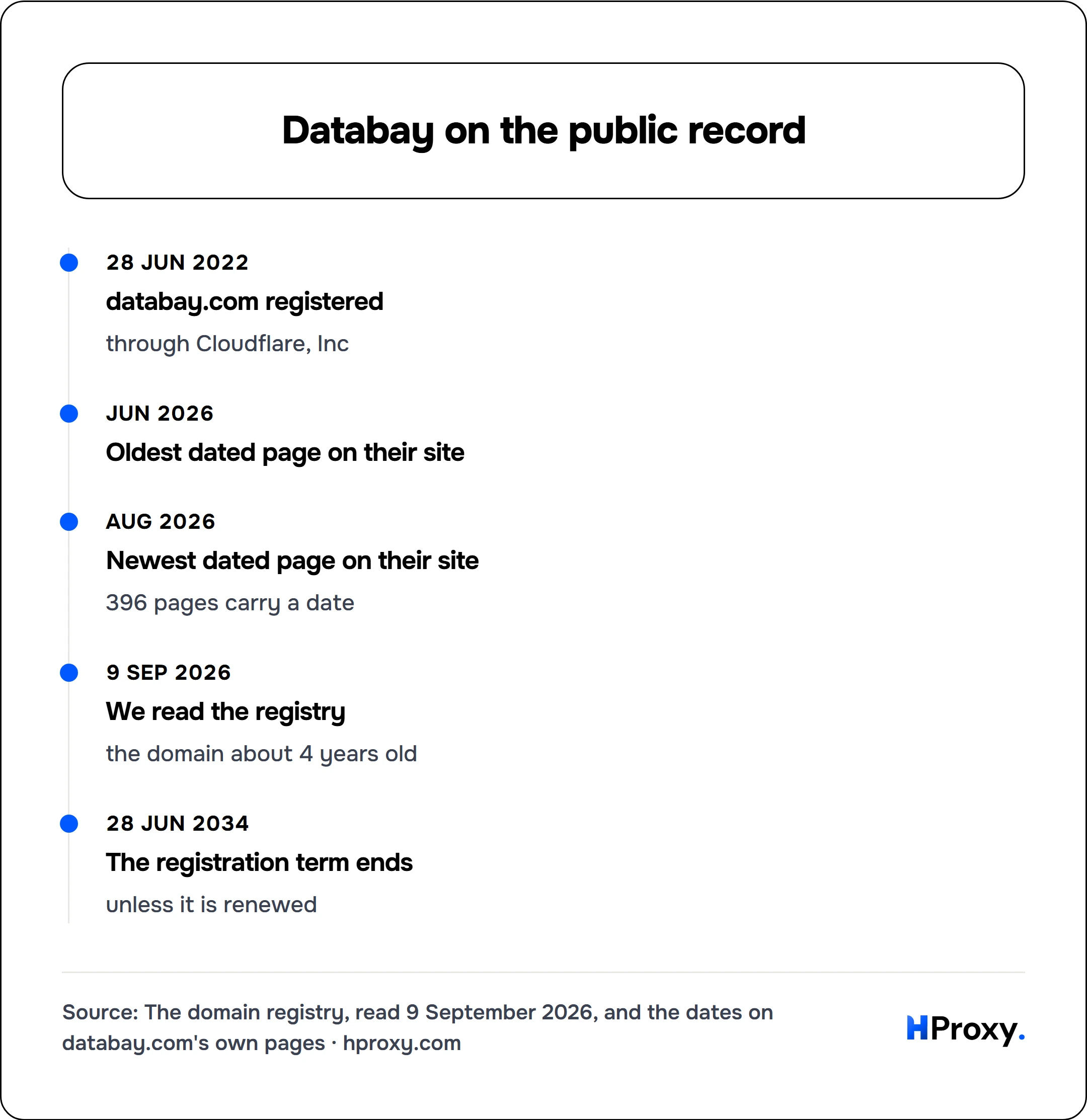
28 Jun 2022
databay.com registered
through Cloudflare, Inc
Jun 2026
Oldest dated page on their site
Aug 2026
Newest dated page on their site
396 pages carry a date
9 Sep 2026
We read the registry
the domain about 4 years old
28 Jun 2034
The registration term ends
unless it is renewed
Age is not quality. A long registration does not make a network good, and a new one does not make it bad. What it does rule out is the shortest-lived pattern in this market, which is a site that appears, sells, and is gone inside a year.
The shape of their site
We crawled 436 pages of their site and found 57 blog pages, 4 pricing pages, 196 location pages, 17 use-case pages and 9 integration pages.
Read it as a map of what they emphasise. It is our count, from our crawler, on the date shown, and it is the only figure on this page that neither of us can dispute.
What the timestamps show
Our crawl of their site found 396 pages carrying a date, 57 of them articles. The oldest is from June 2026 and the newest from August 2026. 396 of them carry a date inside the last twelve months.
Recent dates prove somebody is still at the keyboard. They prove nothing about the network, which is what the test at the end of this page is for.
The parts no marketing page answers
The reputation you inherit
An address you share carries the reputation of everyone else on it. That is acceptable for some work and fatal for anything involving a login. The price difference between shared and dedicated usually reflects exactly this.
Ask whether failed requests are billed
Divide the spend by the successful responses, not by the requests sent. That single change reorders most price comparisons in this market, and your accounting will use it eventually anyway.
Threads, not gigabytes, are often the ceiling
Rate limits are often enforced per account rather than per plan, which means buying more traffic does not raise them. Confirm how yours scales before you assume a bigger plan runs faster.
Side by side, with the blanks left blank
The rows that matter, with our own answers stated plainly:
| Question to ask | Databay | HProxy |
|---|---|---|
| Entry price | Not verified by us, read their page | From $0.44/GB, pay as you go |
| Does unused balance expire? | Check the current terms, this one moves | Never |
| Minimum commitment | Read their current terms | None |
| Identity checks | Worth confirming in writing before you commit | Card orders are screened, and verification is sometimes requested |
| Targeting | Not published clearly, ask before paying | Country, city and ISP |
| Free way to evaluate | On their own terms page | Free proxy list and proxy checker |
Every unfilled cell above is a question to put to them directly, in writing, before money changes hands. Vendors answer those questions readily; comparison sites guess at them.
A test worth more than this comparison
Do this once and you will never need a comparison page for this decision again.
- Start with the smallest purchase each vendor allows, so the test costs less than the decision it replaces.
- Use your own scraper and your own target. A benchmark against a neutral site measures nothing you will experience.
- Measure what came back correctly and what it consumed, then divide the spend by the successes.
- Push a sample of exit addresses through an independent checker and confirm the country and connection type are what was advertised.
- Buy the one that won on your target, and diarise a re-test in three months.
Who else is in this bracket
The same treatment, applied to the providers most often weighed against this one:
- ProxyFlash alternatives
- ProxyFog alternatives
- Proxyfreeonly alternatives
- ProxyFuel alternatives
- Proxygen alternatives
- Proxygraphy alternatives
Where HProxy sits in that test
Our own lane is easy to state. Residential starts at $0.44 per GB with country targeting, the balance is topped up when you want and does not expire, there is no subscription unless the optional discount suits you, and city and ISP targeting come with Residential Premium from $1.00 per GB. If the test above puts us second on your target, buy the winner.