ProxyHat is trading at proxyhat.com, run by an individual entrepreneur in Kazakhstan. It sells residential traffic by the gigabyte, from $10 for 1 GB down to $3.60 a GB at 500 GB, plus mobile, datacenter and static ISP proxies. Traffic never expires, and a Telegram bot hands out free traffic to test. The domain was registered in January 2026. The like-for-like prices are in the alternatives table.
Is ProxyHat legit? The record in one table
| what we read on 27 September 2026 | |
|---|---|
| website | proxyhat.com answers normally, behind Cloudflare |
| operator | an individual entrepreneur registered in Kazakhstan |
| address | Zhanaozen, Mangystau Region, Kazakhstan |
| governing law | Kazakhstan, with its courts only |
| domain | registered 9 January 2026, through NameCheap |
| products | residential, mobile, datacenter and static ISP proxies |
| card payments | sold and processed by Paddle as merchant of record |
| Trustpilot | a verification wall to our server, and no readable archived copy |
The terms name the operator and its address, and card payments run through Paddle. The business behind the current site is young: its terms took effect on 15 January 2026.
What ProxyHat sells, and what it costs
Residential and mobile traffic is sold by volume, "no fixed plans, no monthly commitments". The residential calculator on its pricing page reads as follows.
| traffic | price | per GB |
|---|---|---|
| 0.5 GB | $5 | $10.00 |
| 1 GB | $10 | $10.00 |
| 5 GB | $35 | $7.00 |
| 10 GB | $65 | $6.50 |
| 25 GB | $145 | $5.80 |
| 50 GB | $260 | $5.20 |
| 100 GB | $475 | $4.75 |
| 250 GB | $1,100 | $4.40 |
| 500 GB and more | $1,800 | $3.60 |
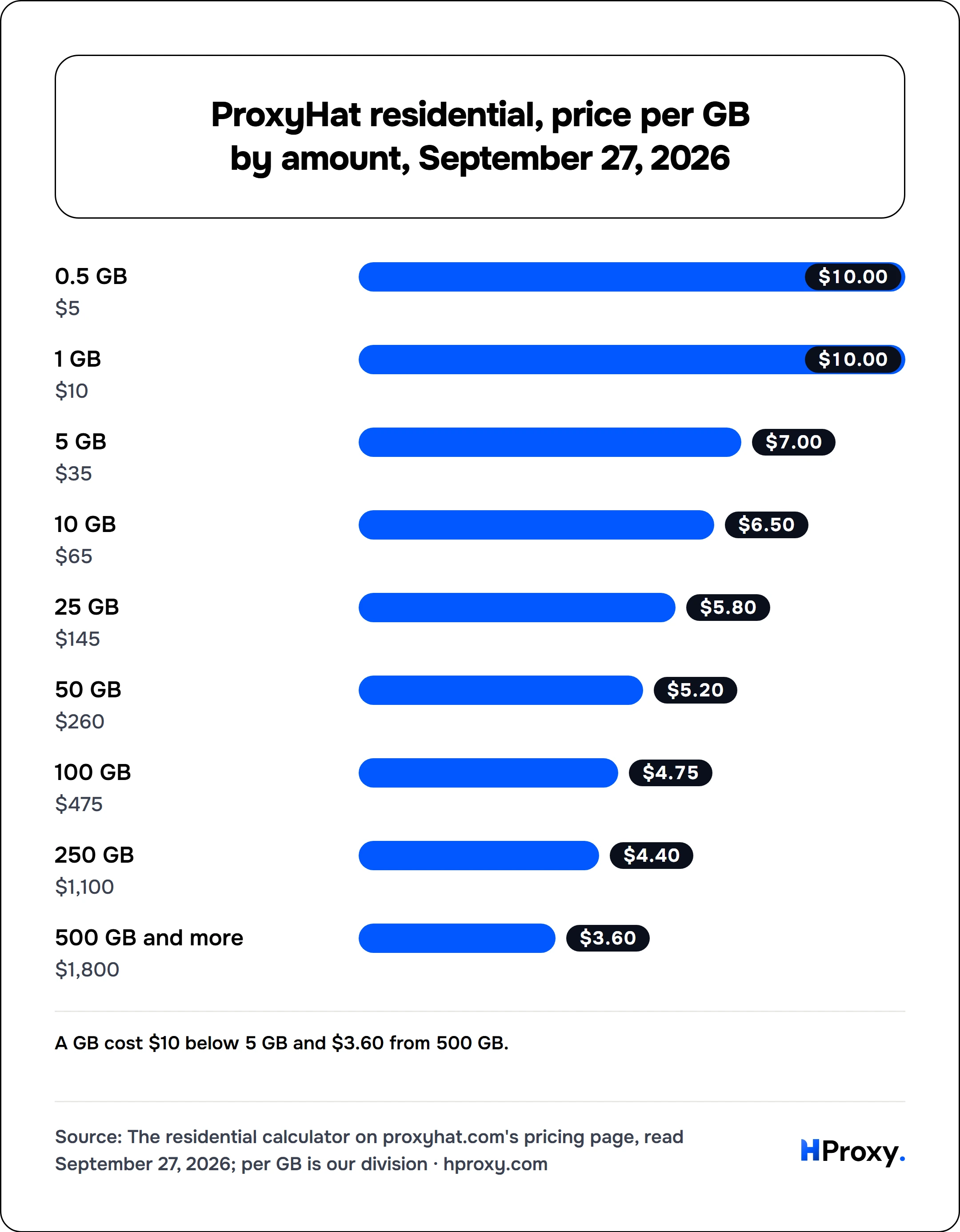
Source: the pricing page of proxyhat.com, read the same day. The per GB figures are our division. The mobile prices load in the browser; the structured data on the page lists mobile at $7.00 and datacenter at $2.00.
Static ISP proxies cost "From $9.99 per IP / 30 days", with unlimited traffic, in "66+ countries". They speak HTTP and SOCKS5, with UDP. The pool claims "50M+" IPs in "148+ countries", with targeting "by country, state, or city". An AI filter screens IPs before routing, and traffic that fails the filter "does not count toward your billing consumption".
It takes Visa, Mastercard, PayPal and SBP, a Russian fast payment system. It also takes Bitcoin, Ethereum, USDT, USDC, Litecoin, Solana, BNB and XRP.
The fine print that decides the cost
Refunds are narrow. The refund policy, effective 3 September 2026, refunds duplicate charges and undelivered service. A purchase with "not a single byte" used may be refunded within 14 days, "at our discretion, not automatically". Used traffic is not refunded, and faulty proxies are "replaced, not refunded".
City targeting is best effort. "Our geo guarantee is at country level: a specific city, region or ISP is provided on a best-effort basis."
One account per person. The terms prohibit multi-accounting and the abuse of free traffic. A chargeback suspends the account and any accounts linked to it "by device, network or identity signals".
Withdrawal rights end at delivery. At checkout, EU and UK buyers waive their 14-day right of withdrawal once delivery has begun.
Kazakh law. Disputes go "exclusively in the courts of the Republic of Kazakhstan", and a claim must be filed within one year.
Where the IPs come from
ProxyHat says: "All residential IPs are sourced through opt-in partnerships. No botnets, no malware, no compromised devices." It adds that device owners "explicitly consent to share their bandwidth". The pages we read name none of those partners.
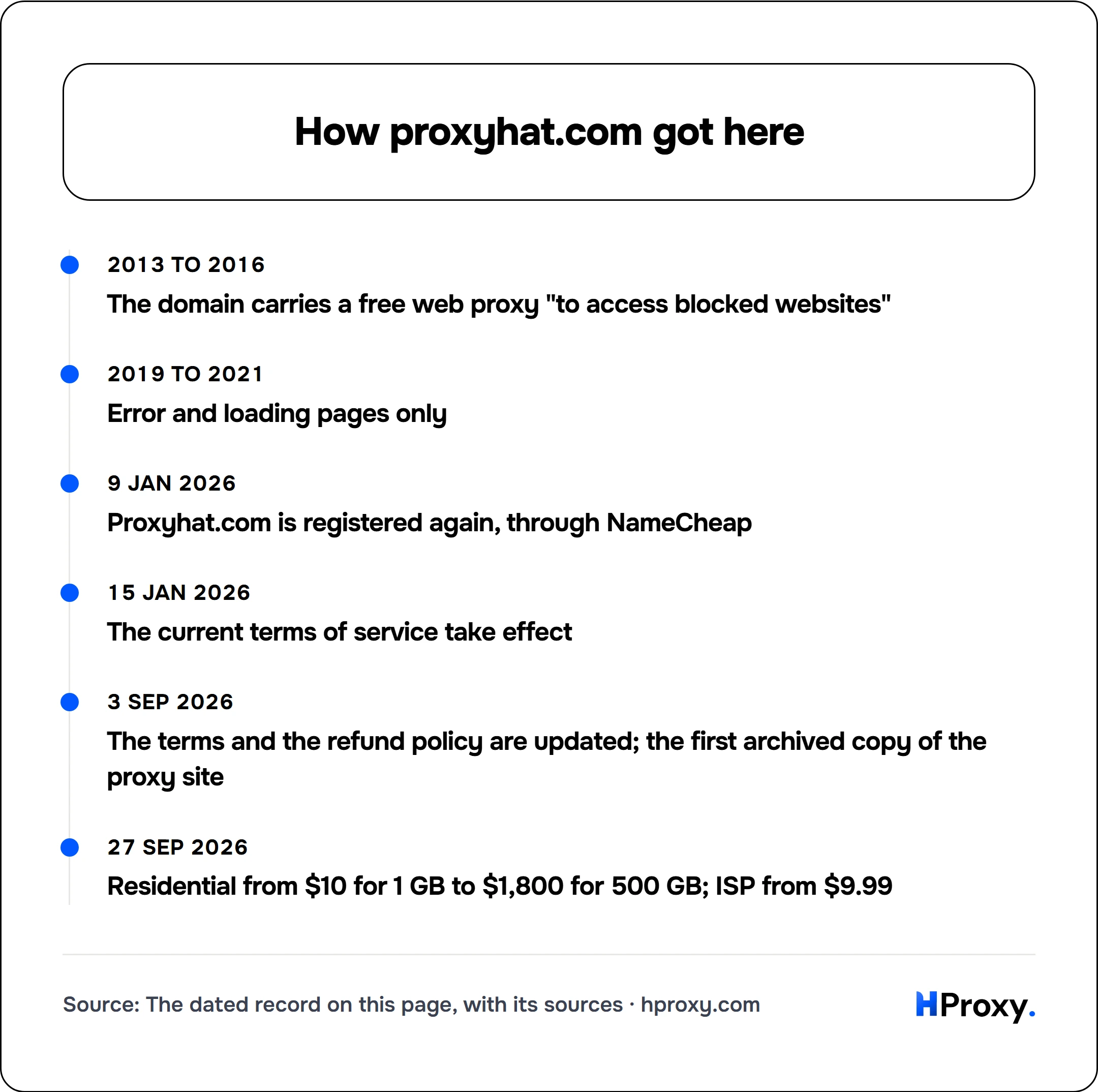
How proxyhat.com got here
| date | what the record shows |
|---|---|
| 2013 to 2016 | the domain carries a free web proxy "to access blocked websites" |
| 2019 to 2021 | error and loading pages only |
| 9 January 2026 | proxyhat.com is registered again, through NameCheap |
| 15 January 2026 | the current terms of service take effect |
| 3 September 2026 | the terms and the refund policy are updated; the first archived copy of the proxy site |
| 27 September 2026 | residential from $10 for 1 GB to $1,800 for 500 GB; ISP from $9.99 |
2013 to 2016
The domain carries a free web proxy "to access blocked websites"
2019 to 2021
Error and loading pages only
9 Jan 2026
Proxyhat.com is registered again, through NameCheap
15 Jan 2026
The current terms of service take effect
3 Sep 2026
The terms and the refund policy are updated; the first archived copy of the proxy site
27 Sep 2026
Residential from $10 for 1 GB to $1,800 for 500 GB; ISP from $9.99
Sources: the domain registry, the Internet Archive and the legal pages of proxyhat.com, read on the same day. Nothing links the free web proxy of 2013 to the business that registered the domain in 2026.
What customers say
Trustpilot answered our server with a verification wall, and its archived copies of the page are error pages, so we give no Trustpilot figure. We found no other public rating we could read.
ProxyHat alternatives for residential traffic
The fair comparison is a first gigabyte and the lowest rate each vendor prints, from each pricing page. ProxyHat was read on 27 September, the others a day earlier.
| provider | first gigabyte | lowest rate printed, and what it needs | unused traffic |
|---|---|---|---|
| ProxyHat | $10.00, or 0.5 GB for $5 | $3.60 a GB, 500 GB for $1,800 | never expires |
| Webshare | $3.50, 1 GB plan | $1.40 a GB, 3,000 GB at $4,200 a month | resets monthly |
| Rayobyte | $3.50, from 1 GB | $0.50 a GB, 5,000 GB or more by contact | kept on pay as you go |
| Evomi | $0.99, from 15 GB | $0.49 a GB, the 100 GB plan at $49 a month | kept on pay as you go |
| DataImpulse | $1.00, 5 GB for $5 | $0.80 a GB, 1 TB for $800 | kept |
| HProxy Residential Lite, country targeting | $0.50/GB, from 1 GB | $0.44/GB at 2,000 GB+ | kept, the balance never expires |
| HProxy Residential Premium, state, city and ISP targeting | $1.49/GB, from 1 GB | $1.00/GB at 1,000 GB+ | kept, the balance never expires |
ProxyHat includes state and city targeting, so its like-for-like row on our side is Premium, $1.49 per GB for a single gigabyte. Lite targets by country only. Both are on our price table.
For one fixed address, our static ISP proxies cost $2.70 per IP a month, from one address, also by the week.
Where ProxyHat is the better buy
A free test. Its Telegram bot hands out free traffic, and the smallest paid amount is 0.5 GB for $5.
Many payment methods. Cards, PayPal, SBP and eight cryptocurrencies are listed on its pricing page.
ISP proxies in many countries. Its static ISP proxies cover 66+ countries by its own count, with UDP over SOCKS5.
Where HProxy is the better fit
The price per gigabyte. A first gigabyte costs $0.50 per GB on Lite and $1.49 per GB on Premium. ProxyHat charges $10.00 for its first gigabyte and $3.60 a GB at 500 GB.
Refunds you can use. Our refund policy returns unspent balance and unrouted residential traffic to the original payment method within 14 days. ProxyHat refunds an unused purchase only at its discretion.
A company in the EU. HProxy is run by Obsidian UG in Herford, Germany, named with its register number in our imprint.
Clear payment. Our payment options page lists cards, 32 crypto assets and networks, Alipay, Pix and more.
Before you commit
Take the free traffic from its bot and put your real job through it. Run the same job through one gigabyte of our Premium traffic, and count the requests that came back correct on each side. Our proxy checker shows the country and network of each exit first.
The limits of this record
We did not measure the ProxyHat network, so nothing here grades speed or success. The pool size and the AI filter are its own claims.
The prices are as its calculator printed them on the day we read it, and the mobile prices were not printed. Its Trustpilot page refused our server. This page is due for a check by 27 December 2026.
Sources
Every source below was read on 27 September 2026, except the pricing pages of the alternatives, read a day earlier.
- ProxyHat: homepage, pricing page, residential, mobile, datacenter and ISP pages, AI filter page, legal hub, terms of service (effective 15 January 2026, updated 3 September 2026), refund policy (effective 3 September 2026) and privacy policy.
- Verisign, registry record for proxyhat.com.
- Internet Archive, captures of proxyhat.com from 5 February 2013 to 3 September 2026.
- Webshare, Rayobyte, Evomi and DataImpulse, residential pricing pages.
- HProxy, our own product catalog, price table, refund policy and payment options.