
Most pages titled "ProxyFlash alternative" are affiliate lists with the payout order baked in. This one is written by a rival, which is a different bias and an easier one to correct for, because you can check every number we print.
ProxyFlash on the record
The domain is proxyflash.ru.
ProxyFlash is not in our priced record, so nothing about their rate appears below. That gap is stated rather than filled, which is the only honest option available.
Copy down the entry rate, the commitment attached to the cheapest rate, the minimum top-up and the expiry rule. Those four turn a marketing figure into something you can compare.
What the advertised numbers cannot tell you
Ten million addresses, and none of them yours
Nobody audits pool totals in this market, and the counting rules differ between vendors. Even an accurate figure describes addresses that exist, not addresses you will be routed through. Treat it as a marketing unit rather than a capability.
Shared or dedicated changes everything
An address you share carries the reputation of everyone else on it. That is acceptable for some work and fatal for anything involving a login. The price difference between shared and dedicated usually reflects exactly this.
What a blocked response costs you
Some vendors bill every request, some bill only successful ones, and the difference is the whole comparison once a target starts blocking. A cheap rate with a fifty percent success rate is twice its advertised price.
What separates them, in a table
The table answers what we can answer and marks what we cannot:
| Question to ask | ProxyFlash | HProxy |
|---|---|---|
| Entry price | Not verified by us, read their page | From $0.44/GB, pay as you go |
| Does unused balance expire? | On their own terms page | Never |
| Minimum commitment | Their terms page answers this | None |
| Identity checks | Check the current terms, this one moves | Card orders are screened, and verification is sometimes requested |
| Targeting | Their terms page answers this | Country, city and ISP |
| Free way to evaluate | Check the current terms, this one moves | Free proxy list and proxy checker |
We would rather show an incomplete table than a confident wrong one. Anything we could not source is left for you to read at the source, with the date you read it.
How to settle it yourself in ten minutes
Run this before you commit any volume. It replaces every opinion on this page, including ours.
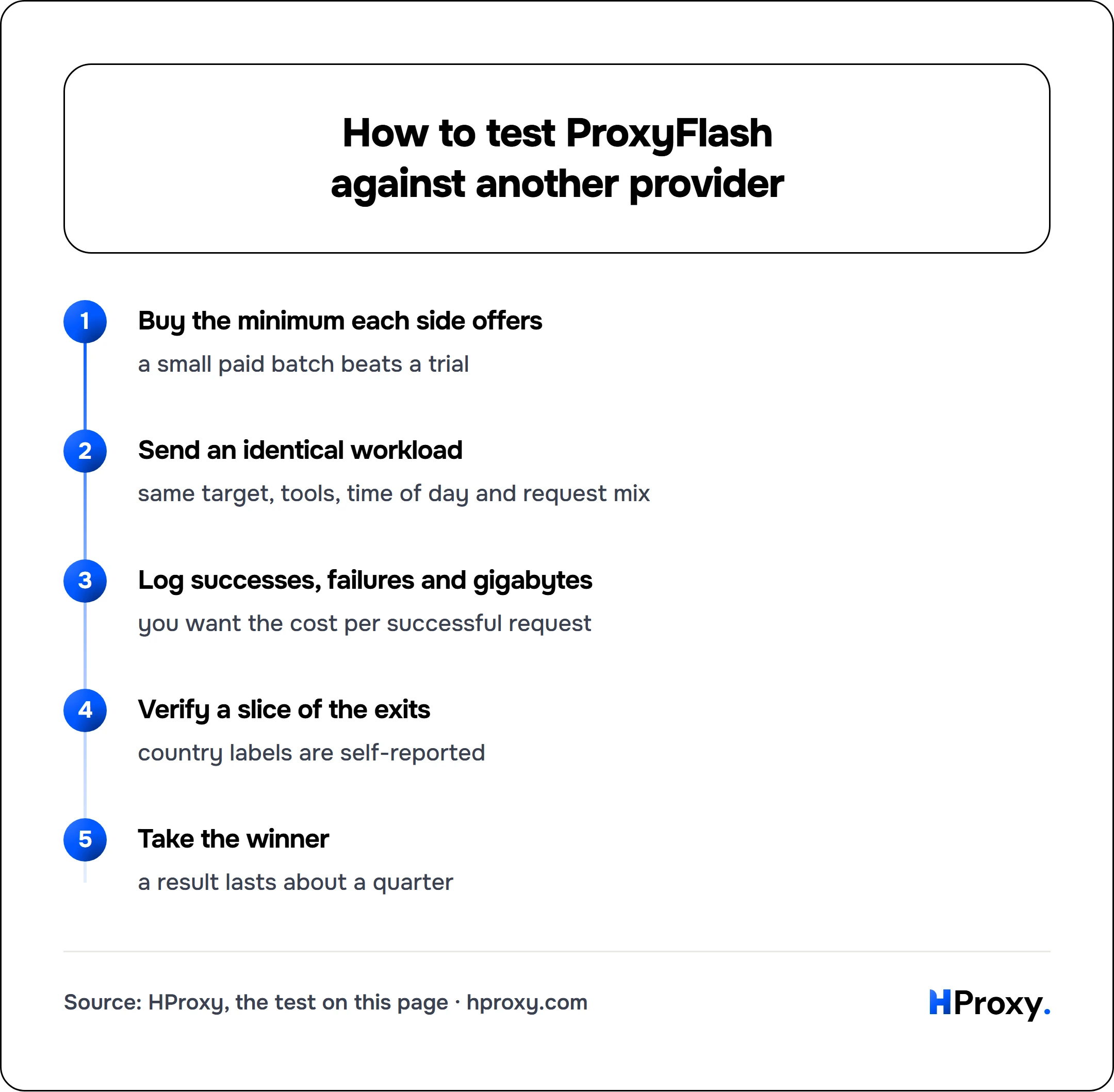
- Buy the minimum each side offers. Prefer a small paid batch over a trial, because trial traffic does not always ride the same pool.
- Send an identical workload through each: same target, same tooling, same time of day, same request mix.
- Log successes, failures and gigabytes used. Cost per successful request is the figure you are after.
- Verify a slice of the exits independently. Country labels in this market are self-reported and are not always right.
- Take the winner and set a reminder to run this again, since a result has a shelf life of about a quarter.
Buy the minimum each side offers
a small paid batch beats a trial
Send an identical workload
same target, tools, time of day and request mix
Log successes, failures and gigabytes
you want the cost per successful request
Verify a slice of the exits
country labels are self-reported
Take the winner
a result lasts about a quarter
Who else is in this bracket
The same treatment, applied to the providers most often weighed against this one:
- Xiaoxiangdaili (小象代理) alternatives
- Xiaoxiongip (小熊代理) alternatives
- Xiongmaodaili alternatives
- Xkdaili (星空代理) alternatives
- YiLu Proxy alternatives
- You Proxy alternatives
The competing offer, for completeness
HProxy suits buyers who want to add funds, send traffic and stop thinking about it. Residential from $0.44 per GB, no commitment, nothing expiring. Buyers who need procurement paperwork and a named account manager are better served elsewhere, and we would rather say so here than waste your afternoon.