Comparison

Leaving Proxywow: the numbers side by side

Weighing up Proxywow? What is actually published, what it does not tell you, and how to settle the decision on your own target for a few dollars.

HProxy Team··4 min read
HProxy.Comparison

Free proxies won't hold up here.

Shared datacenter IPs get flagged and dropped fast. When it has to hold, gaming, streaming, accounts, you need mobile and residential IPs that read as a real device, from $0.44/GB, pay as you go.

Residential proxies

The useful question is never whether Proxywow is good. It is whether it fits the job you are about to run, on your target, this month. A proxy provider that suits one workload is wrong for the next one.

What we know about Proxywow, and what we do not

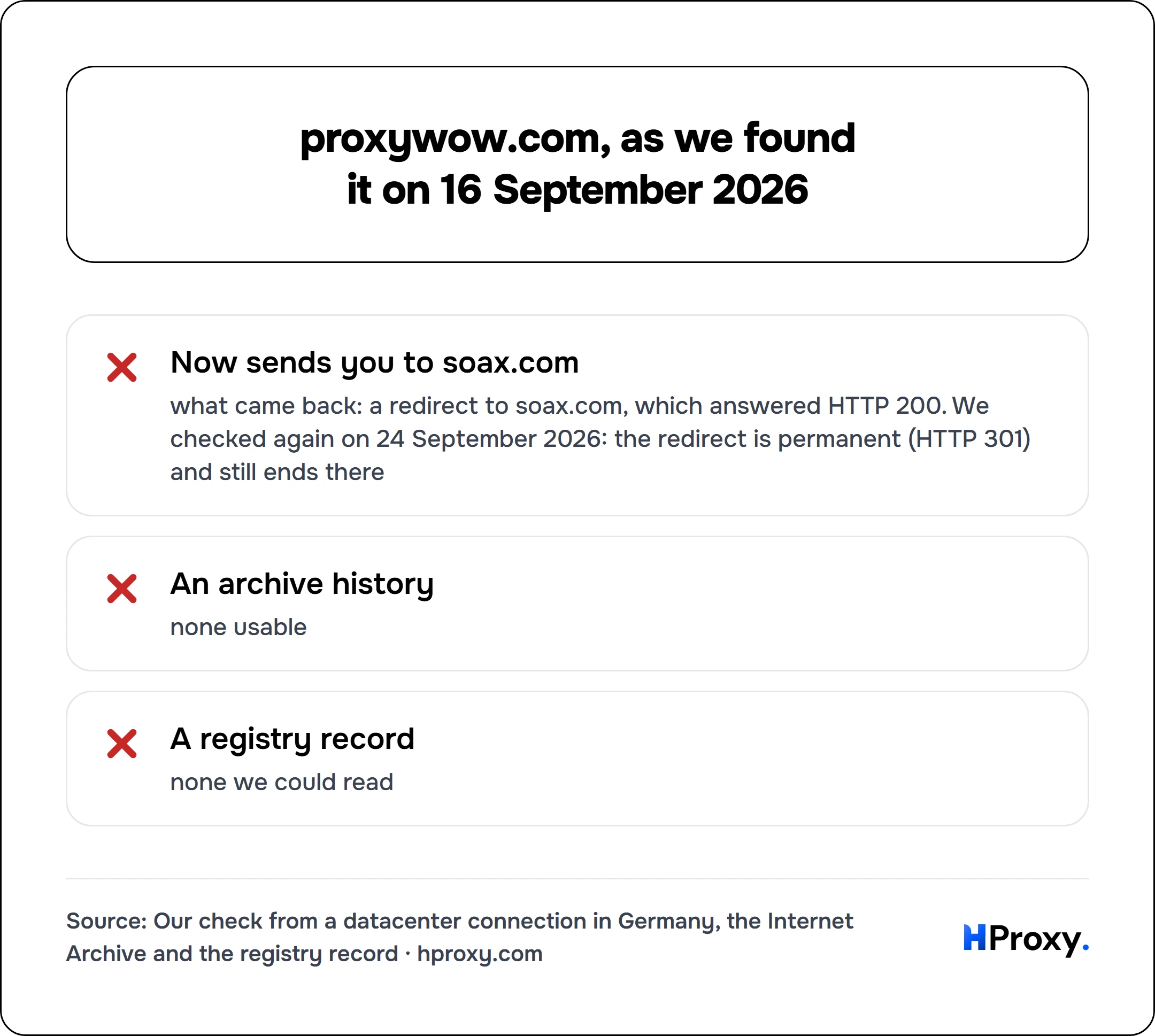
Their site is proxywow.com. Category, as we track it: proxy provider.

There is no price in this comparison because we do not have one we can date and attribute. What follows instead is the set of questions that decide the cost once you do read their page.

When you do read it, note four things: the rate you actually qualify for today, the minimum purchase, whether unused balance expires, and whether failed requests are billed. Those four decide the real cost more than the headline does.

The site, as it reads today

On 9 September 2026 the site introduced itself as "The web changes. Your access doesn't. , SOAX". Their meta description, the sentence Google shows under the link, says: "SOAX handles IP rotation and selection in one connected system, so requests travel a shorter path and your connection stays fast and reliable."

What else that page states, without interpretation:

The product lines named on that page are residential, mobile and SOCKS5. They advertise 195 countries or locations. Their pricing page is titled "Simple, predictable pricing that scales with you , SOAX".

All of the above is their copy, not our finding. A dated quotation is the weakest kind of evidence that is still evidence.

Age, and why it matters here

The domain was registered on 26 March 2018, through NameCheap, Inc, which makes it about 8 years old. We pulled that from the registry on 9 September 2026. The current registration term ends 26 March 2027.

None of it predicts success rate. It is here because domain age and archive depth are free to check, and a provider whose public record starts last quarter deserves a smaller first order.

The questions behind the numbers

Match the units before anything else

Work out what your job actually consumes, in gigabytes or in concurrent addresses, before you look at any price. Without that number, no two quotations in this market can be compared at all.

The day something goes wrong

Every provider works when nothing is wrong. The difference shows up on the day a subnet gets flagged or a gateway stops answering. Before committing volume, send one real question through the support channel and time the reply.

Why an old benchmark is wrong

Every review of this market, this one included, is a photograph of a moving thing. Read the date on any comparison you find, and discount it heavily once it is more than a few months old.

The comparison, honestly framed

Compare on these rows and ignore the feature lists on both sites:

Question to askProxywowHProxy
Entry priceNot verified by us, read their pageFrom $0.44/GB, pay as you go
Does unused balance expire?Their terms page answers thisNever
Minimum commitmentWorth confirming in writing before you commitNone
Identity checksRead their current termsCard orders are screened, and verification is sometimes requested
TargetingOn their own terms pageCountry, city and ISP
Free way to evaluateNot published clearly, ask before payingFree proxy list and proxy checker

Treat the right-hand column as a claim by an interested party, because it is one. Every line in it is checkable on our own pages and in our own terms.

The measurement that outranks every review

This costs less than a coffee and produces the only evidence that applies to your workload.

  1. Fund both accounts with the least money each will accept, and note what that minimum was, because it is part of the comparison.
  2. Aim both at the page that matters to you rather than a test endpoint, and keep every other variable fixed.
  3. Record the success rate and the data consumed for the identical batch on each side.
  4. Check some of the addresses yourself for country, ASN and type before you trust the label on the plan.
  5. Go with whichever performed, then measure again next quarter. Networks change underneath you.

The rest of the shortlist

Buyers comparing this name usually have two or three of these open in other tabs:

Where we fit

For completeness: residential from $0.44 per GB, city and ISP targeting included, no monthly minimum, and a balance that stays where you left it. We are a good fit for uneven workloads and a poor one for anybody who wants a signed enterprise agreement.

Frequently asked questions

Why look for a Proxywow alternative at all?
The usual reasons any buyer compares two providers: the pricing model stopped fitting the usage pattern, a target started blocking, a specific country underperformed, a balance expired, or support went quiet. None of those is visible from a marketing page, which is why a small paid test on your own target settles it faster than any review.
What does Proxywow advertise?
We do not hold a current, sourced price for Proxywow, so this page does not print one. Read their own pricing page for the rate, the minimum and the commitment, and note the date you read it, because all three move.
How do I compare two providers fairly?
Match the units first, because residential is billed per gigabyte, datacenter and ISP per address, and mobile per day or per port. Then compare the rate you can actually reach today rather than the volume tier behind a commitment. Finish by measuring the success rate on your own target, since a cheap request that fails costs more than a dearer one that works.
Is a cheaper provider usually worse?
Not reliably. Price in this market reflects the supply model and the sales overhead as much as the network. What price does not tell you is the success rate on your target, and that is the figure that decides whether the cheaper option was cheap or expensive. Measure before assuming either way.
Does a bigger pool mean better results?
No. Your job meets only the exits it draws, in the countries it needs, against one target's defences. Freshness and rotation policy move the outcome far more than the headline total, and pool totals across this market are counted generously and rarely audited.

Proxies that don't die mid-job

Residential, ISP, datacenter and mobile, verified by the same engine that runs tens of millions of checks. They read as a real device and hold up under load. Pay as you go, and your balance never expires. $0.44/GB is the 2,000 GB+ rate; a single gigabyte is $0.50/GB, with no minimum order.

129M+ proxy checks run · 100+ countries · HTTP / HTTPS / SOCKS · re-checked every few minutes · no signup