
The market Zeus Proxy trades in has a wide honesty range. Some vendors publish every tier, some publish a starting rate that nobody reaches, and a few publish nothing at all. Knowing which kind you are looking at is half the decision.
What we can and cannot tell you about Zeus Proxy
The company behind the name sits at zeusproxy.com.
Zeus Proxy is not in our priced record, so nothing about their rate appears below. That gap is stated rather than filled, which is the only honest option available.
Note the price, the unit it is quoted in, the minimum, and the expiry. Unit and expiry are where most comparisons in this market quietly go wrong.
What the registration record shows
The domain was registered on 27 August 2025, through GMO Internet Group, Inc. d/b/a Onamae.com, which makes it about 1 year old. That record was read from the registry on 23 April 2026. The Internet Archive holds 12 snapshots of the site, the earliest from September 2009. The registry shows it renewed to 27 August 2026.
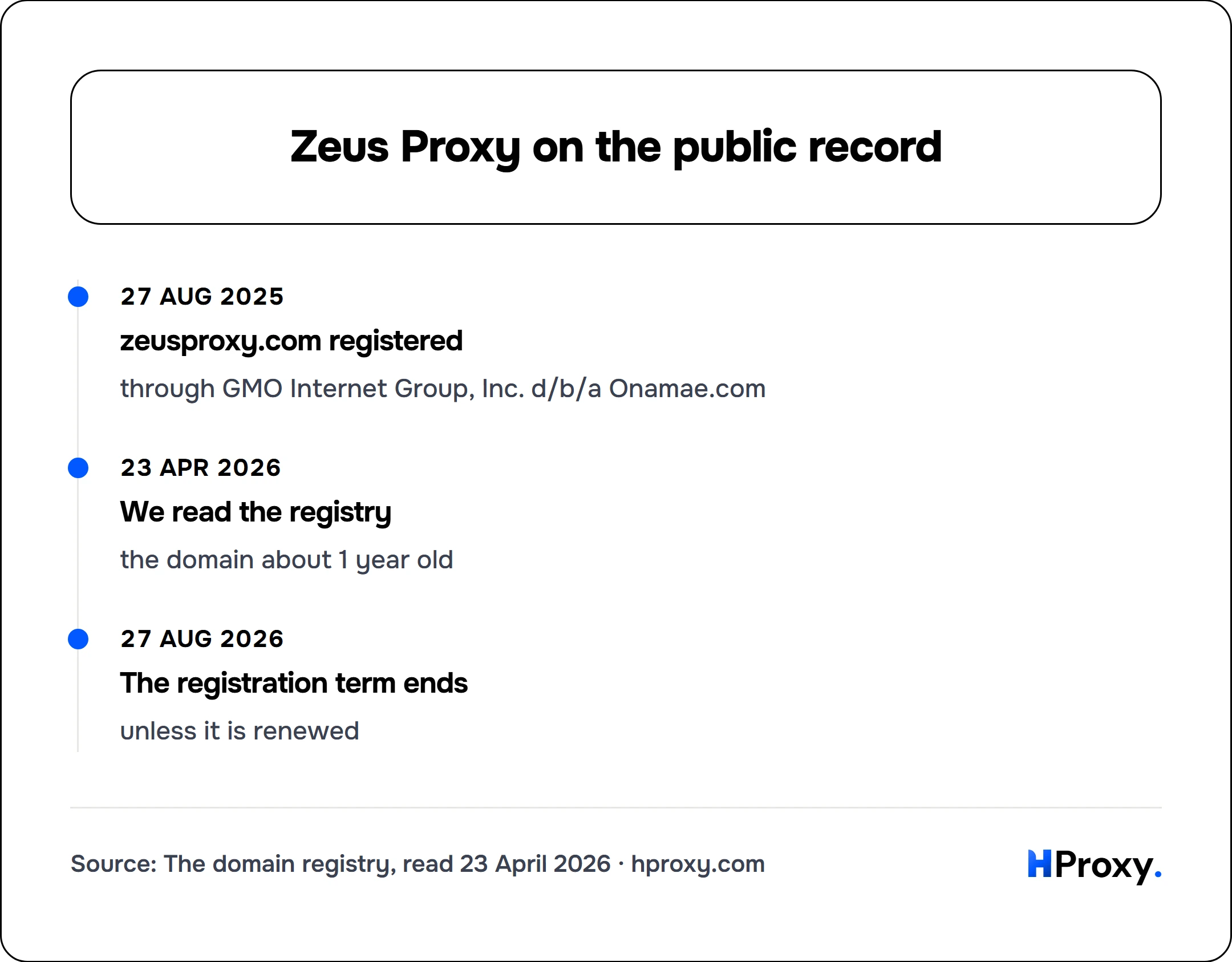
27 Aug 2025
zeusproxy.com registered
through GMO Internet Group, Inc. d/b/a Onamae.com
23 Apr 2026
We read the registry
the domain about 1 year old
27 Aug 2026
The registration term ends
unless it is renewed
Read that as a floor rather than a recommendation. Longevity says somebody has kept paying the registrar, and in a market with this much churn that is worth ten seconds of your attention.
The parts no marketing page answers
What happens when it breaks at two in the morning
Support quality is invisible until it is the only thing that matters. A cheap provider that takes three days to answer a routing problem has cost you more than the saving, and no pricing page reveals that.
Why an old benchmark is wrong
Pools are rebuilt, suppliers change and detection improves. A provider that beat the field last spring may be mid-table now. Nothing in this market stays true long enough to buy once and stop measuring.
What actually caps your throughput
Rate limits are often enforced per account rather than per plan, which means buying more traffic does not raise them. Confirm how yours scales before you assume a bigger plan runs faster.
Side by side, with the blanks left blank
This is the shortest table that still decides the purchase:
| Question to ask | Zeus Proxy | HProxy |
|---|---|---|
| Entry price | Not verified by us, read their page | From $0.44/GB, pay as you go |
| Does unused balance expire? | On their own terms page | Never |
| Minimum commitment | Read their current terms | None |
| Identity checks | Worth confirming in writing before you commit | Card orders are screened, and verification is sometimes requested |
| Targeting | Their terms page answers this | Country, city and ISP |
| Free way to evaluate | Check the current terms, this one moves | Free proxy list and proxy checker |
Nothing in that table settles the decision on its own. It narrows the field to two or three, and then measurement finishes the job.
The ten minute version of this decision
For a few dollars you can get a verdict specific to your job, which no comparison page can honestly promise you.
- Buy the minimum each side offers. Prefer a small paid batch over a trial, because trial traffic does not always ride the same pool.
- Send an identical workload through each: same target, same tooling, same time of day, same request mix.
- Measure what came back correctly and what it consumed, then divide the spend by the successes.
- Push a sample of exit addresses through an independent checker and confirm the country and connection type are what was advertised.
- Keep whichever pool won on your job. Re-run this whenever success rate drops or the bill moves.
Others in this market
Nearest alternatives by product shape rather than by who pays us, since nobody does:
- Whoerip alternatives
- WonderProxy alternatives
- XenProxy alternatives
- Xiaoxiangdaili (小象代理) alternatives
- Xiaoxiongip (小熊代理) alternatives
The competing offer, for completeness
We are the pay as you go option in this market. Residential from $0.44 per GB, ISP and datacenter per address, mobile alongside them, all from one balance with nothing to forfeit. That model wins on irregular volume and loses on very large steady volume, which is worth knowing before you test.