"Your IP has been temporarily blocked" means a site has stopped answering requests from your internet address for a set time. An automatic rule made that call by counting what arrives from the address. The usual triggers are too many requests in a short time and repeated failed logins. Abuse by someone else on the same address can set it off too. Most of the blocks in this guide end on their own. The 4chan FAQ gives 15 minutes for a pending ban request, and the Sucuri firewall lifts its blocks after 30 minutes. Wait before you try again, because Cloudflare warns that repeated tries can make the block last longer.
We read the platforms' own help pages and the standards behind the message on 10 October 2026. We also sent one request each to six sites from our own server in a data center. The answers are further down.
Where does the message appear?
The words change from site to site. Google suggests Escape from Tarkov, DeepL, 4chan, YouTube and Sucuri when people type the message. The table adds Cloudflare's rate limit page, which says the same thing in other words.
| Where you see it | The words on screen | The cause the platform names | How long, and what to do |
|---|---|---|---|
| Escape from Tarkov site, profile page or launcher | "Our systems have detected unusual traffic from your computer network", "Error 1020", "Suspicious behavior" or "Connection blocked. Contact tech support. Error code: 1230-02" | "Suspicious traffic from your network or multiple requests to the site" | No time given. Email Battlestate support with the subject "IP unblock" |
| Translation tools built on DeepL's web app | "Too many requests, your IP has been blocked by DeepL temporarily" | The tool's own words for an HTTP 429 answer from DeepL | No time given. Update the tool and slow it down |
| 4chan, when you post | "Posting from your IP range has been temporarily blocked", as people search it | A pending ban request on your IP, or a range blocked "due to repeated abuse" | 15 minutes for a pending ban request. Range blocks are "often temporary", so wait |
| Sites behind Cloudflare | "Error 1015: You are being rate limited" | A rate limiting rule the site owner set | Set by the owner. Wait, since tries in a short time "may extend the block" |
| Sites behind the Sucuri firewall | "Your IP address was temporarily blocked by our IDS", as people search it | The firewall's rules | 30 minutes. A support ticket with your IP is faster |
| YouTube, in download tools | "This content isn't available, try again later" | The session went over YouTube's request limit, says the yt-dlp project | Up to an hour, says yt-dlp. Then leave 5 to 10 seconds between downloads |
The words name your IP, yet the address is not always the cause. The DeepL row is the clearest case, and the next section explains it.
Why did my IP get blocked?
Four causes sit behind the message, and the fix depends on which one hit you.
You sent too many requests in a short time
This is a rate limit. HTTP has a status code for it, 429 Too Many Requests, defined in RFC 6585. The server may add a Retry-After header, which gives the wait in seconds or as a date. Each site sets its own limit. The Stack Exchange API drops requests from an IP that sends more than 30 a second. The ban lasts "30 seconds to a few minutes typically". Nominatim, the OpenStreetMap search service, allows one request per second at most.
Too many failed logins came from your address
RFC 6269 calls this the penalty box. A server that sees too many requests from one address may deny it for a set time, or ask for a CAPTCHA. The same document names the side effect. On a shared address, one person's failed logins can lock out others on their first attempt.
Someone else on your address set it off
Your public address may not be yours alone. A home or office network usually reaches the internet through one public address, which is how NAT works (RFC 3022). Internet providers short of IPv4 addresses put many customers on one shared address, as RFC 6269 describes. A VPN works the same way. Proton VPN's help page says each of its servers has one IP address, used by everyone on that server. When anyone on the address trips a rule, everyone on it is blocked. Our explainer on CGNAT covers the provider side.
The cause is not the address at all
Some messages blame the IP when the cause lies elsewhere. RFC 6585 notes that a server may identify the user by login credentials or a cookie, not only by address. The DeepL tools show this best. PyDeepLX and DeepLX print the DeepL sentence whenever DeepL's web app answers HTTP 429. DeepLX's maintainers write in their code that an outdated version gets that answer "on every request", "from any IP". One user reported in April 2025 that the block stayed with and without a VPN. It held "at all hours of the day, even with days in between". Nominatim's policy, for its part, does not accept the default User-Agent that HTTP libraries send.
Can a site block an address on its first request?
Yes. On 10 October 2026 we sent one request to each of six sites from our server in a data center. The requests went three seconds apart, with no retries. Two of the six refused the very first request. Stack Overflow answered 403 with a Cloudflare challenge. Reddit answered 403 with its "blocked by network security" page and a Retry-After of 0. Each site got a single request from our test, so our pace did not cause it. Other programs on the same server may have reached those sites that day. One request also cannot show whether the network or our client set it off. Neither page said "temporarily blocked".
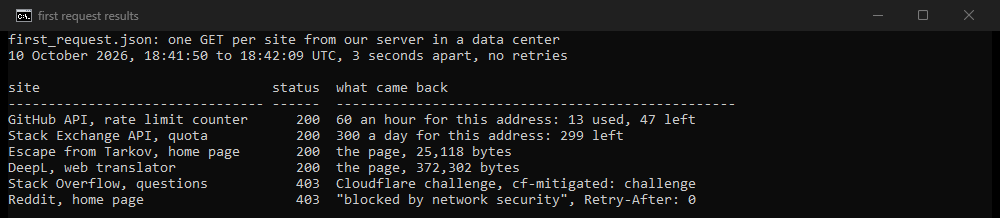
The two APIs showed limits that belong to the address. GitHub counts requests without a login against the address they come from, 60 an hour. Its counter for our server showed 13 already used by other programs on the same machine, our own earlier lookups among them. Stack Exchange gave our request without a key a quota of 300 a day. A shared address shares its limits, so anything else on it spends the same budget. Our guide to Reddit's network security block covers that page in full.
How do I fix it?
Work down this list in order: each step either clears the block or tells you which cause you have.
1. Stop and wait
Close the tab or stop the script, and leave it for the time the site gives. Cloudflare warns that repeated tries in a short time "may extend the block". If the answer carries a Retry-After header, it says how long to wait. GitHub asks clients not to retry before the time in its x-ratelimit-reset header.
2. Test another connection
Open the same page over another connection, such as mobile data. If it loads there, the block sits on the address of your usual network. If it fails on every connection, the block follows something else: your account, a cookie or the app. A new address will not help in that case.
3. Switch off the VPN or proxy
If you browse through a VPN or a free proxy, switch it off and reload. Its address carries what every other user did through it. On 4chan, switching off is the only option, because its FAQ says posting from proxies or VPNs is not allowed.
4. Fix the tool or script
If a script, a bot or a translation tool shows the message, the fix is in the tool. Stay under the published rate, such as one request per second for Nominatim. Wait as long as Retry-After asks. Send a User-Agent that names your application. Update the tool, since DeepLX's maintainers say an outdated version gets this answer on every request. For larger jobs, our checklist on avoiding IP bans while scraping covers pacing in depth.
5. Ask the site to lift it
Some sites unblock by hand. Battlestate Games asks Escape from Tarkov players to email support@battlestategames.com with the subject "IP unblock". The email needs a short description, a screenshot of the error and your public IP address. Sucuri lifts its blocks sooner through a support ticket that includes your current address. For a Cloudflare 1015, write to the site itself, since Cloudflare says the site owner sets those rules. Our IP checker shows the public address a site sees.
6. Ask your provider for a new address
Restarting the router helps only if your provider then hands out a different address. If your connection gets its address by DHCP, the standard tells the provider's server to prefer the device's current address. Its second choice is the previous one. A restart may bring the same address back. Your provider can tell you whether your address changes, and how to get a new one.
What if none of that works?
Then the block is probably not on your address. The sign is a block that follows you from network to network. Write to the site's support with the exact message, the time you saw it and your public IP address. Battlestate asks for the same details. A new address does not lift a restriction on an account. Using one to get around a ban can also break a site's rules, as it does on 4chan.
What can an address of your own fix?
| Cause | Does an address used only by you help? |
|---|---|
| Someone else on a shared address tripped the rule | Yes. From then on, only your own traffic counts against it |
| Your own pace hit a rate limit | No. A new address meets the same limit at the same pace |
| Too many failed logins | No. Wait out the penalty box |
| Your account, a cookie or an outdated tool | No. The block does not follow the address |
| Posting on 4chan | No. 4chan does not allow posting through proxies or VPNs |
An address nobody else uses fixes the first cause and none of the others. That is the case where a proxy is the honest answer: work that keeps landing on shared or flagged addresses. Our ISP proxies can be held as a dedicated static IP on an internet provider's network. Read what a clean IP is first, so you know what to check before you rely on one.
What this page could not check
We set off no block on purpose, so every length above is the platform's own statement, not our timing. We did not see the Tarkov, DeepL tool, 4chan, Sucuri or YouTube messages ourselves. The YouTube figures come from the yt-dlp project, not from Google. Battlestate gives no length for its blocks, and DeepL publishes no rate for its web app. Our first-request test covers one server, one day and six sites, one request each. Several help pages we used carry no date, and platforms change these rules without notice. We will read every source on this page again by 10 January 2027.
Sources
- Battlestate Games, developer post on unusual traffic and IP unblocks, Escape from Tarkov discussions on Steam, 27 October 2025: steamcommunity.com.
- Cloudflare Docs, "Error 1015", last updated 14 May 2026: developers.cloudflare.com.
- Sucuri Docs, "My Site is Offline (not loading)", read 10 October 2026: docs.sucuri.net.
- DeepL API documentation, "Error handling", read 10 October 2026: developers.deepl.com.
- OwO-Network, PyDeepLX source code (PyDeepLX.py, changed 1 March 2025) and DeepLX source code (translate/translate.go, changed 10 October 2026), GitHub, read 10 October 2026.
- 4chan, Frequently Asked Questions, read 10 October 2026 (4chan.org/faq).
- yt-dlp project, YouTube extractor source code and the Extractors wiki page, GitHub, read 10 October 2026.
- Stack Exchange API documentation, "Throttles", read 10 October 2026: api.stackexchange.com.
- GitHub Docs, "Rate limits for the REST API", read 10 October 2026: docs.github.com.
- OpenStreetMap Foundation, Nominatim Usage Policy, read 10 October 2026: operations.osmfoundation.org.
- Proton VPN, support article on CAPTCHAs over a VPN, read 10 October 2026 (protonvpn.com).
- RFC 6585, Additional HTTP Status Codes, April 2012: rfc-editor.org/rfc/rfc6585.
- RFC 9110, HTTP Semantics, section 10.2.3 (Retry-After), June 2022: rfc-editor.org/rfc/rfc9110.
- RFC 6269, Issues with IP Address Sharing, June 2011: rfc-editor.org/rfc/rfc6269.
- RFC 3022, Traditional IP Network Address Translator, January 2001: rfc-editor.org/rfc/rfc3022.
- RFC 2131, Dynamic Host Configuration Protocol, March 1997: rfc-editor.org/rfc/rfc2131.
- Our own measurement: one request each to six sites from our server, 10 October 2026, logged in the research folder for this page.