Most pages titled "TrustProxy alternative" are affiliate lists with the payout order baked in. This one is written by a rival, which is a different bias and an easier one to correct for, because you can check every number we print.
TrustProxy on the record
The domain is trustproxy.io.
A price is missing here on purpose. We have not captured a sourced rate for TrustProxy recently enough to publish one, and a stale number in this market is a wrong number.
Look for the tier you would actually land in, not the one at the bottom of the table, and find the expiry and failed-request clauses before the rate impresses you.
How TrustProxy presents itself
Read 9 September 2026, the homepage titles itself "TrustProxy, Buy Residential, Datacenter and Mobile Proxies". In the description they hand to search engines: "Buy premium residential, datacenter, mobile and sneaker proxies from $1.75/GB. 195+ countries, 99.9% uptime, SOCKS5 and HTTP. Scrape and automate without IP blocks."
Reading the same page for the things buyers actually ask about:
The product lines named on that page are residential, datacenter, ISP or static residential, mobile and SOCKS5. They advertise 195 countries or locations. Payment methods mentioned: crypto and Wise or Payoneer. Support is advertised as around the clock. Their pricing page is titled "Proxy Pricing, Plans from $1.75/GB , TrustProxy".
That is the vendor speaking, not us. We print it because a claim with a date attached is at least falsifiable.
Longevity, on the public record
The domain was registered on 14 June 2024, through NameCheap, Inc, which makes it about 2 years old. Registry data as of 23 April 2026. It is paid up until 14 June 2026.
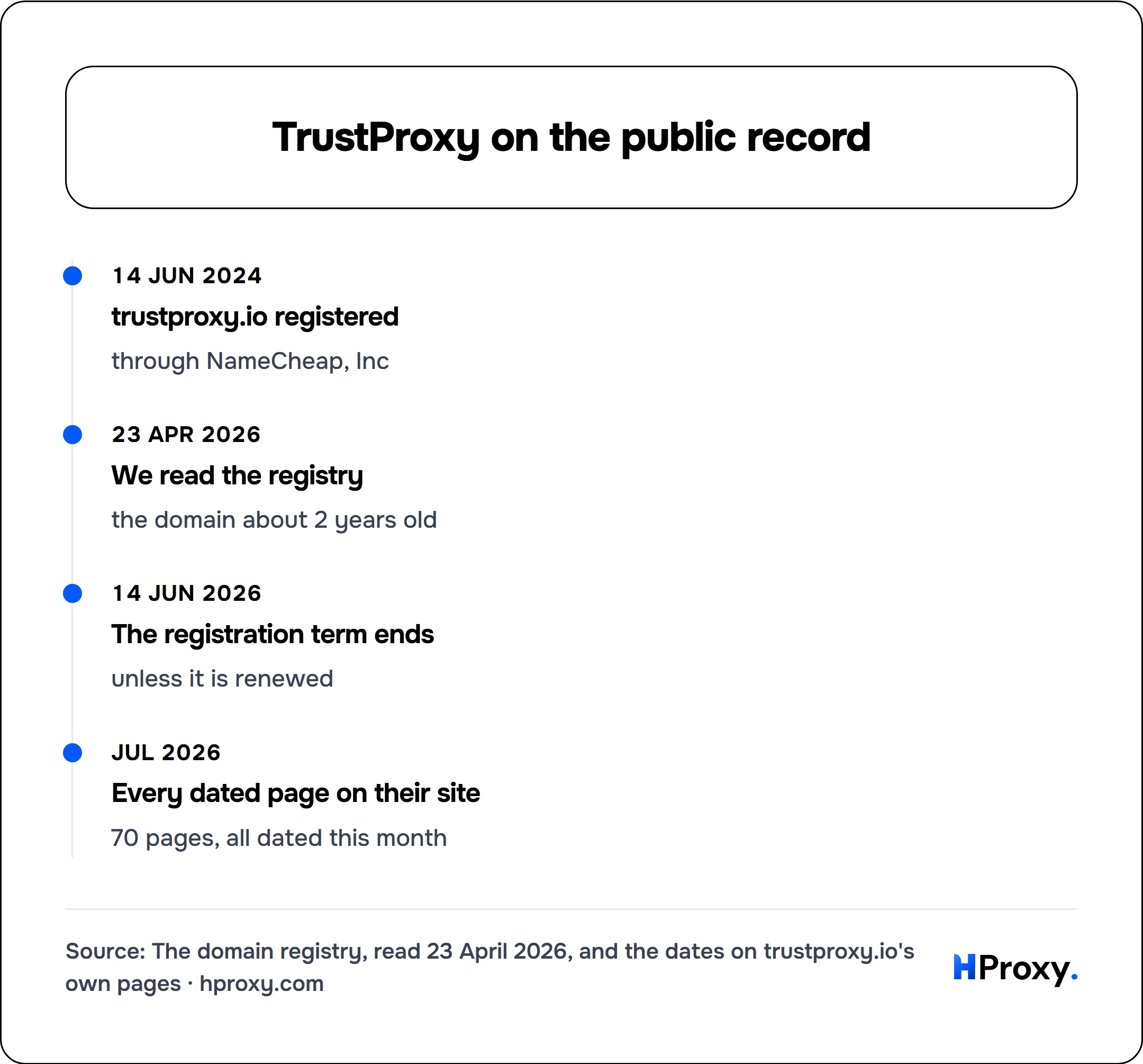
14 Jun 2024
trustproxy.io registered
through NameCheap, Inc
23 Apr 2026
We read the registry
the domain about 2 years old
14 Jun 2026
The registration term ends
unless it is renewed
Jul 2026
Every dated page on their site
70 pages, all dated this month
Age is not quality. A long registration does not make a network good, and a new one does not make it bad. What it does rule out is the shortest-lived pattern in this market, which is a site that appears, sells, and is gone inside a year.
How much site there is
Our own crawl reached 70 of their pages, last run 19 June 2026. The mix was 25 blog pages, 1 pricing page and 25 location pages.
Read it as a map of what they emphasise. It is our count, from our crawler, on the date shown, and it is the only figure on this page that neither of us can dispute.
Signs of life
Our crawl of their site found 70 pages carrying a date, 25 of them articles. The oldest is from July 2026 and the newest from July 2026. 70 of them carry a date inside the last twelve months.
Recent dates prove somebody is still at the keyboard. They prove nothing about the network, which is what the test at the end of this page is for.
Where published figures stop being useful
Ten million addresses, and none of them yours
The number that matters is how many usable exits you can reach in the one country your job needs, this week. A pool total averages that away, which is why two providers with similar totals produce opposite results on the same site.
The entry price is not the effective price
Divide what you spent in a month by what you actually used, and you have the only rate worth quoting. It usually sits well above the figure on the homepage, because tiers, minimums and unused allocation all sit between the two.
Threads, not gigabytes, are often the ceiling
A plan with generous traffic and a low thread limit is a slow plan. Find both numbers before you size anything, because the smaller of the two is your actual ceiling.
A comparison that admits what it cannot say
The table answers what we can answer and marks what we cannot:
| Question to ask | TrustProxy | HProxy |
|---|---|---|
| Entry price | Not verified by us, read their page | From $0.44/GB, pay as you go |
| Does unused balance expire? | Check the current terms, this one moves | Never |
| Minimum commitment | Read their current terms | None |
| Identity checks | Worth confirming in writing before you commit | Card orders are screened, and verification is sometimes requested |
| Targeting | Read their current terms | Country, city and ISP |
| Free way to evaluate | Worth confirming in writing before you commit | Free proxy list and proxy checker |
We would rather show an incomplete table than a confident wrong one. Anything we could not source is left for you to read at the source, with the date you read it.
The ten minute version of this decision
For a few dollars you can get a verdict specific to your job, which no comparison page can honestly promise you.
- Start with the smallest purchase each vendor allows, so the test costs less than the decision it replaces.
- Use your own scraper and your own target. A benchmark against a neutral site measures nothing you will experience.
- Measure what came back correctly and what it consumed, then divide the spend by the successes.
- Push a sample of exit addresses through an independent checker and confirm the country and connection type are what was advertised.
- Keep whichever pool won on your job. Re-run this whenever success rate drops or the bill moves.
The other names that come up
Other providers in the same bracket, priced and dated the same way:
- Privateproxy alternatives
- Privateproxyreviews alternatives
- Promptcloud alternatives
- Prosox alternatives
Where HProxy sits in that test
Our own lane is easy to state. Residential starts at $0.44 per GB with country targeting, the balance is topped up when you want and does not expire, there is no subscription unless the optional discount suits you, and city and ISP targeting come with Residential Premium from $1.00 per GB. If the test above puts us second on your target, buy the winner.