There are two honest ways to compare proxy providers. Read both pricing pages carefully and match the units, or run the same batch through both and count. This page does the first and tells you how to do the second.
What is on file for PrivateProxy
Their site is privateproxy.me. Category, as we track it: proxy provider.
There is no price in this comparison because we do not have one we can date and attribute. What follows instead is the set of questions that decide the cost once you do read their page.
Check the reachable rate, the minimum, the expiry terms and the failure billing, and date your note. A price without those four attached is not a price.
The site, as it reads today
The title tag on 9 September 2026 was "Private Proxy - Buy Private Proxies, PrivateProxy.me". In the description they hand to search engines: "Buy Private Proxy for as little as $5. Residential, Datacenter and ISP from a trusted provider. Free trial, 99.9% uptime, 24/7 support."
Also on the page, stated plainly:
The product lines named on that page are residential, datacenter, ISP or static residential, mobile, SOCKS5 and a scraping or SERP API. They advertise 45 countries or locations. Payment methods mentioned: crypto. The page offers some form of free trial. Support is advertised as around the clock. Their pricing page is titled "PrivateProxy Dashboard".
Treat all of it as advertising, because it is. Its value is that it is dated and quotable, which is more than most comparison pages offer.
Their published surface
A crawl of 501 pages on 19 June 2026 returned 237 blog pages, 1 pricing page, 6 location pages and 15 use-case pages.
The number is not a compliment or a criticism. It describes how much of their effort goes into being found, which is worth knowing when you are weighing a marketing claim against a measurement.
How recently the site moved
Our crawl of their site found 501 pages carrying a date, 237 of them articles. The oldest is from February 2022 and the newest from August 2026. 351 of them carry a date inside the last twelve months.
Read that as a liveness check rather than a review. It says the lights are on, and nothing about whether the proxies work on your target.
What people actually search about PrivateProxy
Search volume around the name runs to 20 a month, split as 20 a month for a review of them. Figures read from Google Keyword Planner on 9 September 2026.
The biggest slice is people checking whether to trust it, so the useful thing to hand a reader is evidence rather than an opinion.
What a pricing page leaves out
Why 195 countries tells you nothing
Ask for the pool size in your country rather than in total, and expect the answer to be vague. Where it is not published, the ten minute test at the end of this page settles it for a few dollars.
Per gigabyte against per address
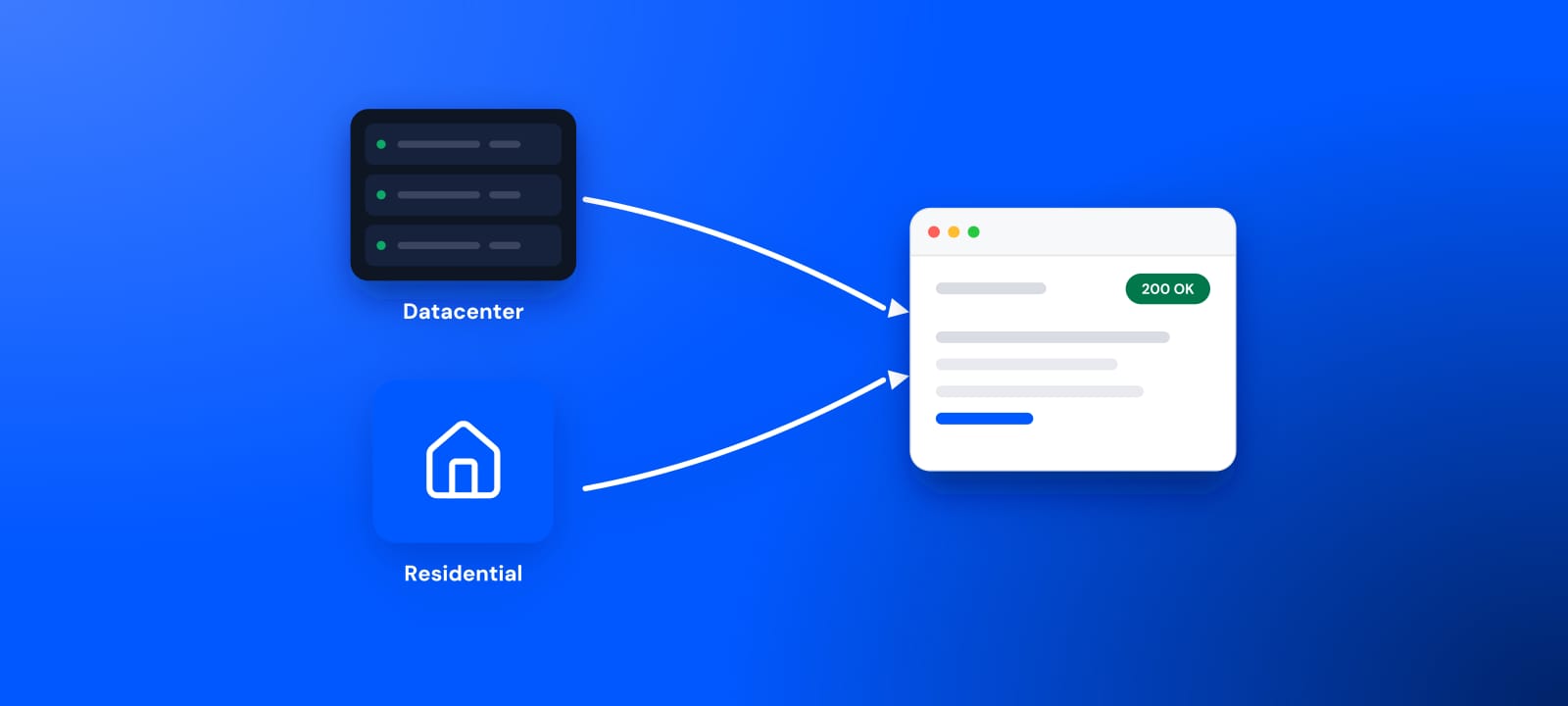
Residential is normally billed per gigabyte, datacenter and ISP per address, mobile per day or per port. Setting one against another produces a number that means nothing. Convert both sides into the unit your own workload consumes.
Networks age, so re-test quarterly
Pools are rebuilt, suppliers change and detection improves. A provider that beat the field last spring may be mid-table now. Nothing in this market stays true long enough to buy once and stop measuring.
The rows that decide it
Set the two side by side on the questions that decide the outcome, rather than on feature counts:
| Question to ask | PrivateProxy | HProxy |
|---|---|---|
| Entry price | Not verified by us, read their page | From $0.44/GB, pay as you go |
| Does unused balance expire? | Read their current terms | Never |
| Minimum commitment | Check the current terms, this one moves | None |
| Identity checks | Their terms page answers this | Card orders are screened, and verification is sometimes requested |
| Targeting | Check the current terms, this one moves | Country, city and ISP |
| Free way to evaluate | Their terms page answers this | Free proxy list and proxy checker |
Six rows is enough. Longer comparison tables in this market are usually padded with features nobody chooses on, which makes them look thorough and read as noise.
What to do instead of reading more comparisons
The steps below take about ten minutes and settle the question properly.
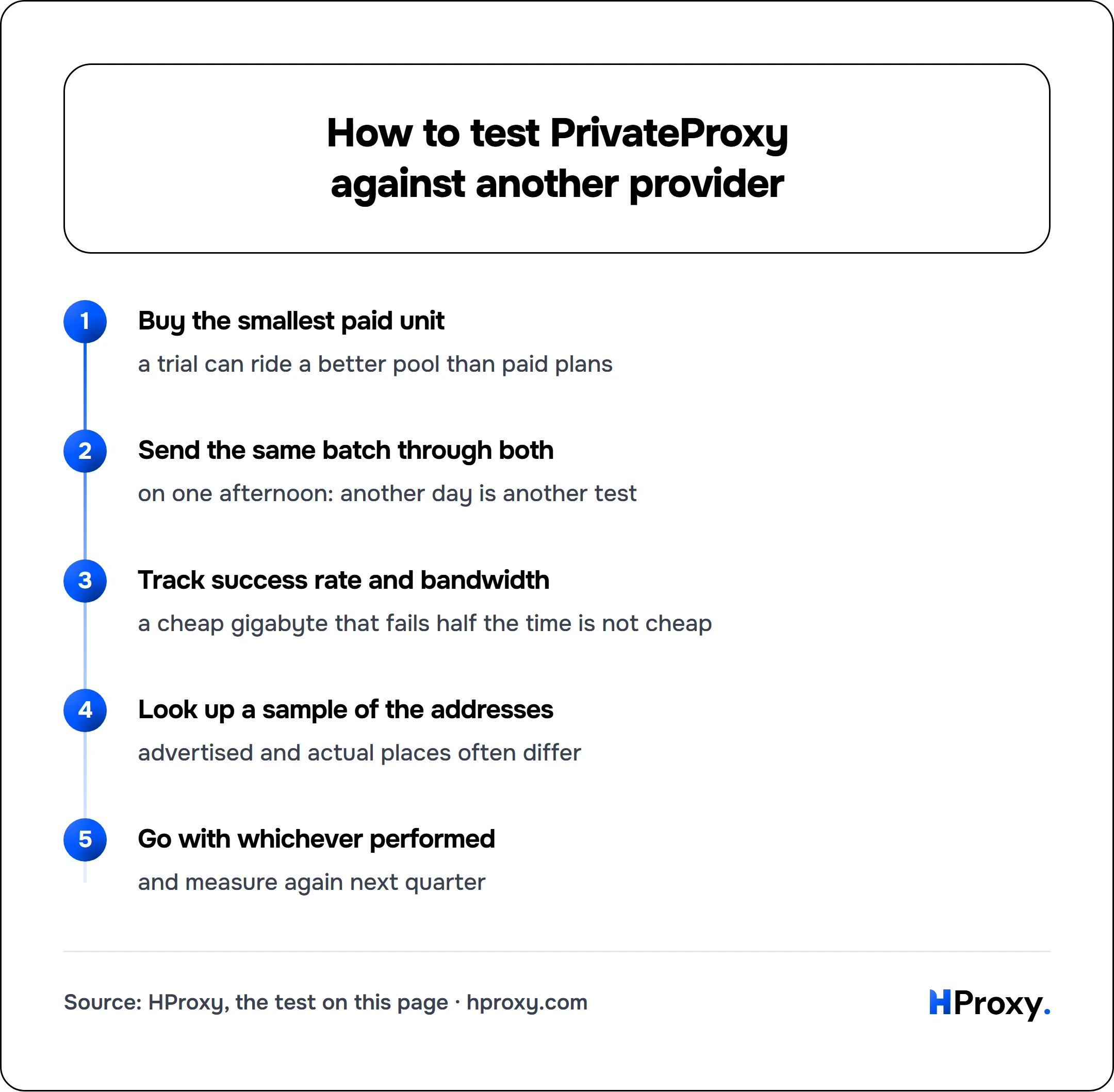
- Take the smallest paid unit each provider will sell you. A free trial works for a first pass, though trials sometimes ride better pools than paid plans do.
- Fire the same batch through both on one afternoon. Different days are different conditions, and that ruins the comparison.
- Track the success rate and the bandwidth. A cheap gigabyte that fails half the time is not cheap.
- Run a sample of the addresses through an independent lookup, because advertised geography and actual geography differ more often than the market admits.
- Go with whichever performed, then measure again next quarter. Networks change underneath you.
Buy the smallest paid unit
a trial can ride a better pool than paid plans
Send the same batch through both
on one afternoon: another day is another test
Track success rate and bandwidth
a cheap gigabyte that fails half the time is not cheap
Look up a sample of the addresses
advertised and actual places often differ
Go with whichever performed
and measure again next quarter
Where else buyers look
If this one does not fit, these are the nearest comparable providers we have written up, each on the same terms as this page.
- Mimvp alternatives
- Mitmproxy alternatives
- Mobile-Proxy.club alternatives
- MobileHop alternatives
- Mobileproxies alternatives
- MobileProxy.space alternatives
Where we fit
The offer, stated once: residential from $0.44 per GB, pay per gigabyte, no subscription, balance does not expire, and free tools that stay usable without an account. Everything above this paragraph applies whether or not you choose us.