IPOasis (ipoasis.com) sells residential traffic by the GB, from $3.20 a GB for 5 GB down to $0.78 at 5,000 GB, as read on 27 September 2026. Its traffic never expires, and its residential line includes city and ASN targeting. It also sells mobile traffic, static residential IPs and datacenter proxies. Its terms rule out refunds of any kind. The alternatives table prices five sellers, read the same day.
The record, with dates
| date | what happened |
|---|---|
| 13 April 2023 | The domain ipoasis.com is registered. |
| March 2025 | A partner page credits it with "over 92 million" IPs. |
| 27 September 2026 | Our check: live, claiming 80M+ IPs, with the prices below. |
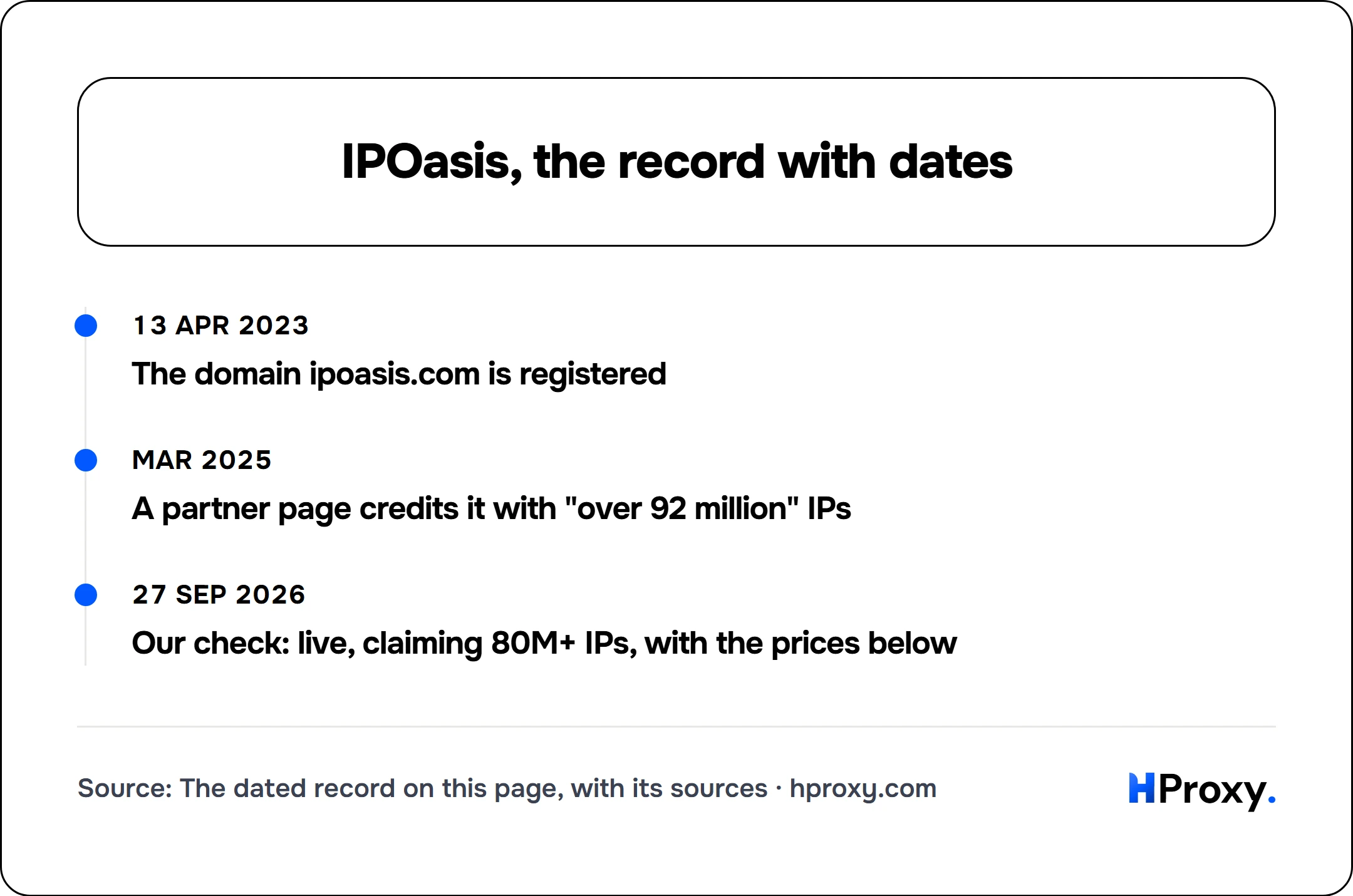
13 Apr 2023
The domain ipoasis.com is registered
Mar 2025
A partner page credits it with "over 92 million" IPs
27 Sep 2026
Our check: live, claiming 80M+ IPs, with the prices below
Sources: the Verisign registry, a BitBrowser partner page and our own check.
What it sells, and what it costs
| product | unit | price |
|---|---|---|
| residential | per GB | $3.20 a GB for 5 GB, $1.90 at 100 GB, $0.78 at 5,000 GB |
| mobile | per GB | $3.80 a GB for 1 GB, $1.99 at 100 GB, $0.88 at 5,000 GB |
| static residential | per IP, 30 days | $3.99 (Broadcast), $5.49 (Native) |
| datacenter | per IP or per GB | $5.00 |
New users get a 24-hour offer after sign-up: 2 GB of residential traffic at $1.99 a GB. In between, residential costs $2.90 a GB at 10 GB, $1.50 at 500 GB, $0.99 at 1,000 GB and $0.90 at 2,000 GB.
It claims 80M+ residential IPs in 195+ locations, and prints counts per country, such as 4,850,953 in the United States and 8,903,165 in India. It pays through cards, WeChat Pay, Alipay and USDT.
The fine print
- No refunds. "We have a strict no-refund policy for final sales under all conditions." The terms add that seeking a refund "will be considered a violation".
- No expiry. "Traffic never expires, no subscription."
- No China use. The service "is not intended for network access within mainland China".
- The company. The terms name no company and no governing law. The about page speaks of nearly 400 staff and offices in five cities.
Where IPOasis is the stronger choice
- City and ASN targeting inside the residential price: $0.99 a GB at 1,000 GB.
- Mobile at volume: $0.88 a GB at 5,000 GB.
- Payment by WeChat Pay, besides cards, Alipay and USDT.
- A cheap first test for new users: 2 GB at $1.99 a GB.
Where HProxy is different
| IPOasis, 27 September 2026 | HProxy | |
|---|---|---|
| smallest residential purchase | 5 GB at $3.20 a GB (2 GB at $1.99 for new users) | 1 GB of Lite at $0.50/GB |
| city targeting, a few GB | $3.20 a GB for 5 GB | Premium at $1.49 for one GB |
| city targeting at volume | $0.99 a GB at 1,000 GB | Premium at $1.00 per GB at 1,000 GB+ |
| country targeting at volume | $0.90 a GB at 2,000 GB | $0.44/GB at 2,000 GB+ |
| does traffic expire | never | never: the balance does not expire |
| refunds | none, under any condition | a public refund policy |
| one static IP | $3.99 or $5.49 for 30 days | static ISP at $2.70/IP per month |
| mobile | $3.80 a GB for 1 GB | $1.50 per GB, 1 GB minimum |
Both sellers keep traffic without expiry. The clearest difference is the refund rule: IPOasis has none, and we publish ours.
Five alternatives, priced the same day
Every rate below comes from each vendor pricing page, read from our server on 27 September 2026. A rate you cannot reach is not a price.
| provider | entry rate | lowest published rate | worth knowing |
|---|---|---|---|
| DataImpulse | $1 per GB: 5 GB for $5, for new users | $0.80 per GB at 1 TB for $800 | Traffic never expires. State, city, ZIP and ASN filters count at double the rate. |
| Evomi | $0.99 per GB pay as you go, from 15 GB | $0.49 per GB on the 100 GB plan at $49 a month | Pay-as-you-go data has no expiry. |
| Webshare | $3.50 for 1 GB a month, half a $7 list price | $1.40 per GB: 3,000 GB for $4,200 a month | Monthly traffic does not roll over. |
| SOAX | $5 per GB on the free Sandbox plan, tier 1 | from $0.85 per GB on the $3,000 a month plan | Credits on Sandbox and monthly plans expire after 60 days. |
| HProxy | $0.50/GB for 1 GB of Lite, country targeting | $0.44/GB at 2,000 GB+ | City and ISP targeting on Premium: $1.49 for one GB. |
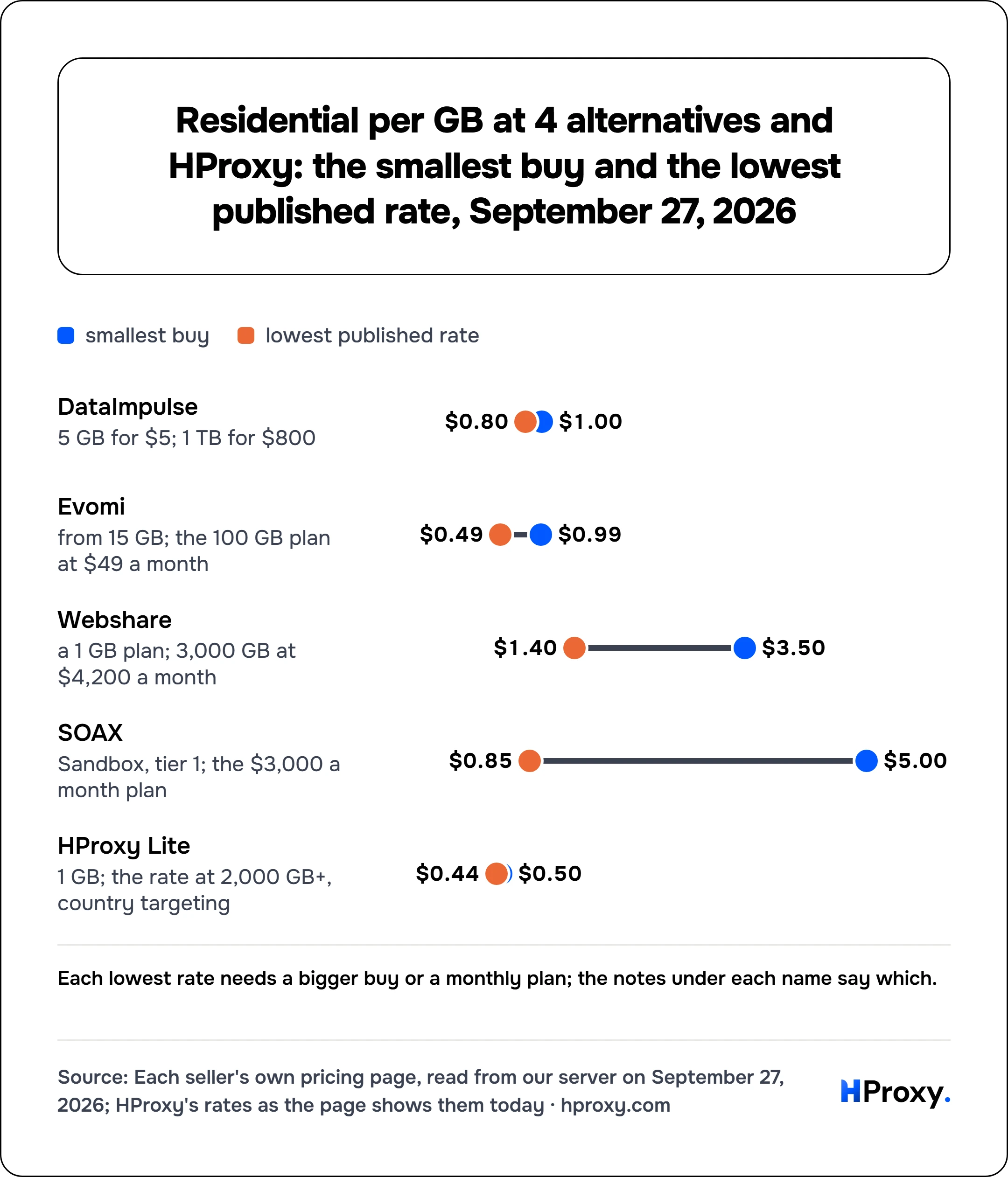
- smallest buy
- lowest published rate
Which one to pick
- You buy a terabyte or more with city targeting: IPOasis at $0.99 a GB is a fair price, if you accept that no refund is possible.
- You want to start with one GB: a seller that sells 1 GB, such as our Lite at $0.50/GB.
- You need city or ISP targeting from one GB: our Premium pool at $1.49 for one GB.
- You want a refund policy in writing before you pay: check it first; IPOasis has none.
Whichever seller you pick, test what you get with our free proxy checker. It checks HTTP and SOCKS proxies with no sign-up.
The limits of this record
We did not buy from IPOasis, so nothing here measures its network. Its pool size and country counts are its own claims. The pages do not explain what separates Broadcast from Native static IPs, or how the free trial works. One banner says "From $25/GB" for premium mobile, which does not match the offers above. The Internet Archive did not answer our history queries today. This page is due for a check by 27 December 2026.
Sources
Read on 27 September 2026, from our server:
- IPOasis: the homepage, the four price pages and their structured offers, the terms and the about page.
- Verisign, registry record for ipoasis.com.
- BitBrowser and Undetectable pages about IPOasis.
- DataImpulse, Evomi, Webshare and SOAX pricing pages, the DataImpulse targeting docs and the Webshare help center.
- HProxy, our product catalogue and our legal and payment pages.