Networking
Everything tagged Networking.
9 articles
Topic Networking
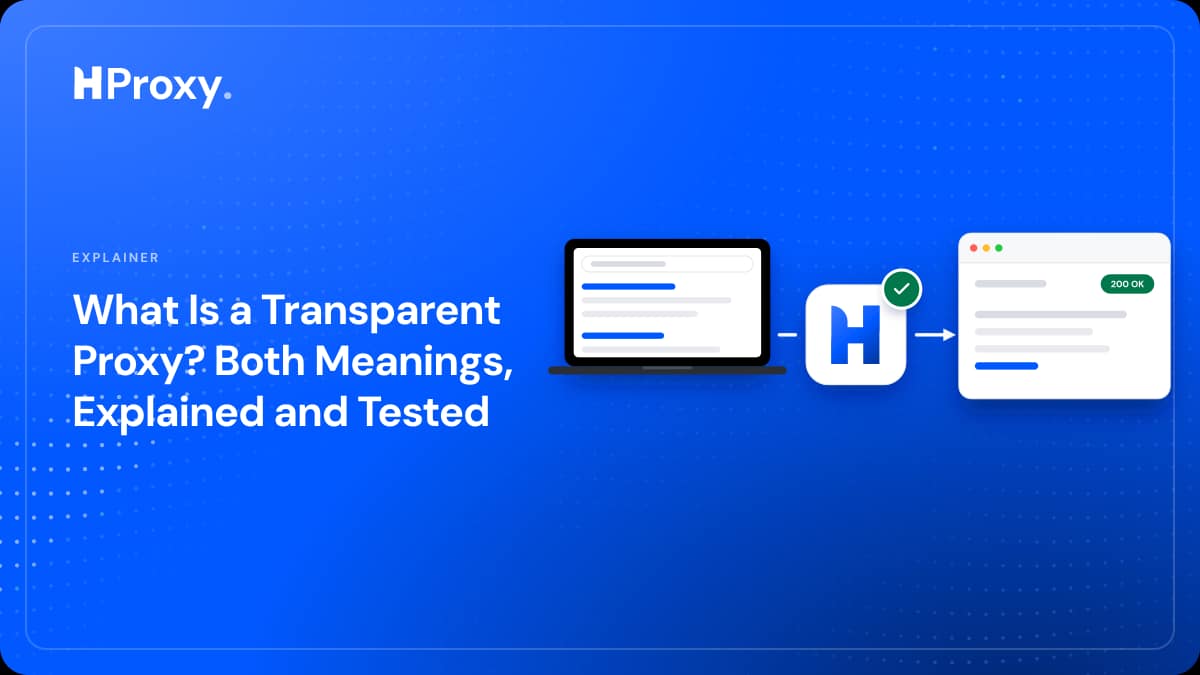
Explainer
What Is a Transparent Proxy? Both Meanings, Explained and Tested
A transparent proxy is either a proxy your network puts in your path or a proxy that passes your address on. How each works, how to tell, and a local test.
October 23, 2026 · 9 min read
Explainer
Public vs private IP address: the difference and what a proxy changes
A private IP works only inside its own network, and a public IP is the one websites see. The ranges, three edge cases from our test, and what a proxy changes.
October 10, 2026 · 9 min read
Guide
"Proxy Error: The Proxy Server Received an Invalid Response From an Upstream Server" (Apache 502)
Apache's mod_proxy reporting that the server behind it did not answer properly. What each Reason line means, why your own proxy settings are irrelevant, and the admin fixes.
August 24, 2026 · 9 min read
Explainer
What Is CGNAT? Carrier-Grade NAT and Why Strangers Share One IP
CGNAT lets an internet provider share one public IPv4 address among many subscribers. How it works, the 100.64.0.0/10 range, and what it means for proxies.
July 21, 2026 · 9 min read
Explainer
IPv4 vs IPv6 Proxies: Which One Actually Reaches Your Target
IPv4 vs IPv6 proxies: why IPv4 is scarce and trusted, why IPv6 is cheap and abundant, the reach gotcha that catches people, and how sites block a whole IPv6 subnet at once.
July 18, 2026 · 6 min read
Explainer
What Is a Backconnect Proxy? One Gateway, a Whole Pool Behind It
A backconnect proxy is one gateway in front of a pool of exit IPs. How it works, how it rotates or holds a session, and what sellers' pool sizes really count.
July 18, 2026 · 8 min read

Explainer
What Is a Proxy? How a Proxy Server Works, the Types and What a Site Sees
What is a proxy? A server that sends your requests for you, so the site sees its IP. How it works, the types, what a site sees, and what each costs per GB.
July 18, 2026 · 9 min read
Explainer
Forward vs Reverse Proxy: Same Word, Opposite Jobs
A forward proxy is chosen by the client and speaks for it. A reverse proxy is set up by a website and speaks for its servers. The standard, real headers and data.
July 17, 2026 · 10 min read
Explainer
What Is an ASN? The Number That Tells Websites Who Owns Your IP
An ASN is the number that names one network on the internet. What it means, who assigns it, how to look one up for any IP, and why websites check it.
July 17, 2026 · 11 min read
Proxies that don't die mid-job
Residential, ISP, datacenter and mobile, verified by the same engine that runs tens of millions of checks. They read as a real device and hold up under load. Pay as you go, and your balance never expires. $0.44/GB is the 2,000 GB+ rate; a single gigabyte is $0.50/GB, with no minimum order.
129M+ proxy checks run · 100+ countries · HTTP / HTTPS / SOCKS · re-checked every few minutes · no signup
HProxy.
Honest guides and comparisons on proxies, scraping and staying unblocked, from the team that runs the network.