Choosing a proxy provider on price alone is the most common and most expensive mistake in this market, because a cheap request that fails costs more than a dearer one that works. That framing runs through the whole page.
Everything we can stand behind
You will find them at smartproxies.com.
We have no verified current rate for SmartProxies (separate) on file. Printing a guess would make this page worse than useless, so the price row below is empty and the reading list is not.
When you do read it, note four things: the rate you actually qualify for today, the minimum purchase, whether unused balance expires, and whether failed requests are billed. Those four decide the real cost more than the headline does.
Their own description, read this week
The title tag on 9 September 2026 was "Decodo - All-in-One Proxy and Web Scraping Platform". Their own summary of the product runs: "125M+ residential, mobile, ISP and datacenter proxies, plus a powerful Web Scraping API. Collect public web data at scale with 99.99% uptime. Start with Decodo today."
Reading the same page for the things buyers actually ask about:
The product lines named on that page are residential, datacenter, ISP or static residential, mobile, SOCKS5 and a scraping or SERP API. They advertise 195 countries or locations. The page offers some form of free trial. A refund or money-back term is mentioned. Their pricing page is titled "Buy Proxies: Residential, Datacenter, ISP and Mobile, Decodo".
Treat all of it as advertising, because it is. Its value is that it is dated and quotable, which is more than most comparison pages offer.
How far back the record goes
The domain was registered on 20 June 2015, through GoDaddy.com, LLC, which makes it about 11 years old. We pulled that from the registry on 23 April 2026. The current registration term ends 20 June 2026.
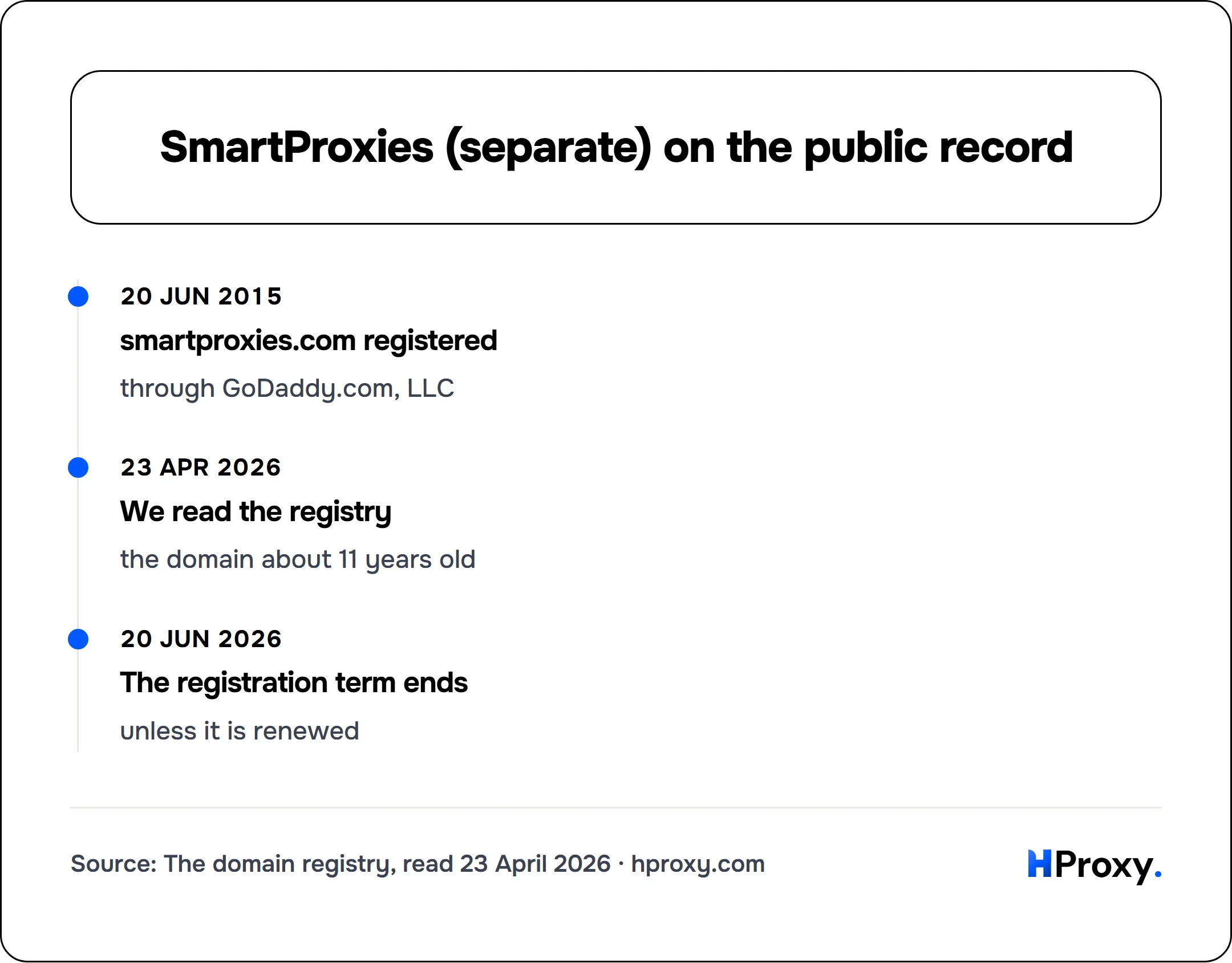
20 Jun 2015
smartproxies.com registered
through GoDaddy.com, LLC
23 Apr 2026
We read the registry
the domain about 11 years old
20 Jun 2026
The registration term ends
unless it is renewed
This proves nothing about the product. It is a cheap check against the one failure mode that costs buyers real money in this market, which is paying a provider that will not exist in six months.
The questions behind the numbers
Why 195 countries tells you nothing
Country totals are counted generously across this whole market. A country with a handful of addresses counts the same as one with hundreds of thousands. If your work depends on one location, test that location before you switch.
Per gigabyte against per address
Half this market prices bandwidth and half prices addresses. A per-address plan is cheap for heavy traffic through few exits and ruinous for light traffic through many, and the reverse holds for per-gigabyte plans.
Concurrency limits decide throughput
A plan with generous traffic and a low thread limit is a slow plan. Find both numbers before you size anything, because the smaller of the two is your actual ceiling.
The comparison, honestly framed
Set the two side by side on the questions that decide the outcome, rather than on feature counts:
| Question to ask | SmartProxies (separate) | HProxy |
|---|---|---|
| Entry price | Not verified by us, read their page | From $0.44/GB, pay as you go |
| Does unused balance expire? | Their terms page answers this | Never |
| Minimum commitment | On their own terms page | None |
| Identity checks | Not published clearly, ask before paying | Card orders are screened, and verification is sometimes requested |
| Targeting | On their own terms page | Country, city and ISP |
| Free way to evaluate | Not published clearly, ask before paying | Free proxy list and proxy checker |
The useful part of that table is the left column. Take those six questions to any provider in this market and the answers will sort them faster than any review.
The test that beats this page
It is a small amount of money for an answer that is actually about your target.
- Fund both accounts with the least money each will accept, and note what that minimum was, because it is part of the comparison.
- Aim both at the page that matters to you rather than a test endpoint, and keep every other variable fixed.
- Write down two numbers per provider: the share of requests that succeeded, and the traffic it cost.
- Take a handful of the addresses you were given and verify their country and type against a checker you do not control.
- Keep the winner, and repeat the whole thing quarterly, because pools age.
Comparable providers
We hold the same record for these, and the same honest limits apply to each:
- Anonymitynetwork alternatives
- Anonymous Proxies alternatives
- AnonymousProxy alternatives
- Anyip alternatives
Our own position
Residential starts at $0.44 per GB with country targeting, the balance never expires, there is no minimum commitment and no sales call, and city and ISP targeting come with Residential Premium from $1.00 per GB. We publish our free side openly, 129,131,311 verification checks and counting, because a network that is confident has no reason to fear measurement.