ScraperAPI sells credits, and the site you point it at decides how many a request costs. A plain page is one credit, Google is 25, LinkedIn is 30, and an ultra premium rendered request is 75. So the same plan holds 100,000 requests or 1,333, depending on the job. This page converts every published plan into money per thousand real requests, using their own figures. Everything below was read from their pricing page and documentation on 9 September 2026.
We sell competing proxies and scraper endpoints, so weigh our reading accordingly. The weights below are theirs, and the division is ours.
The short version
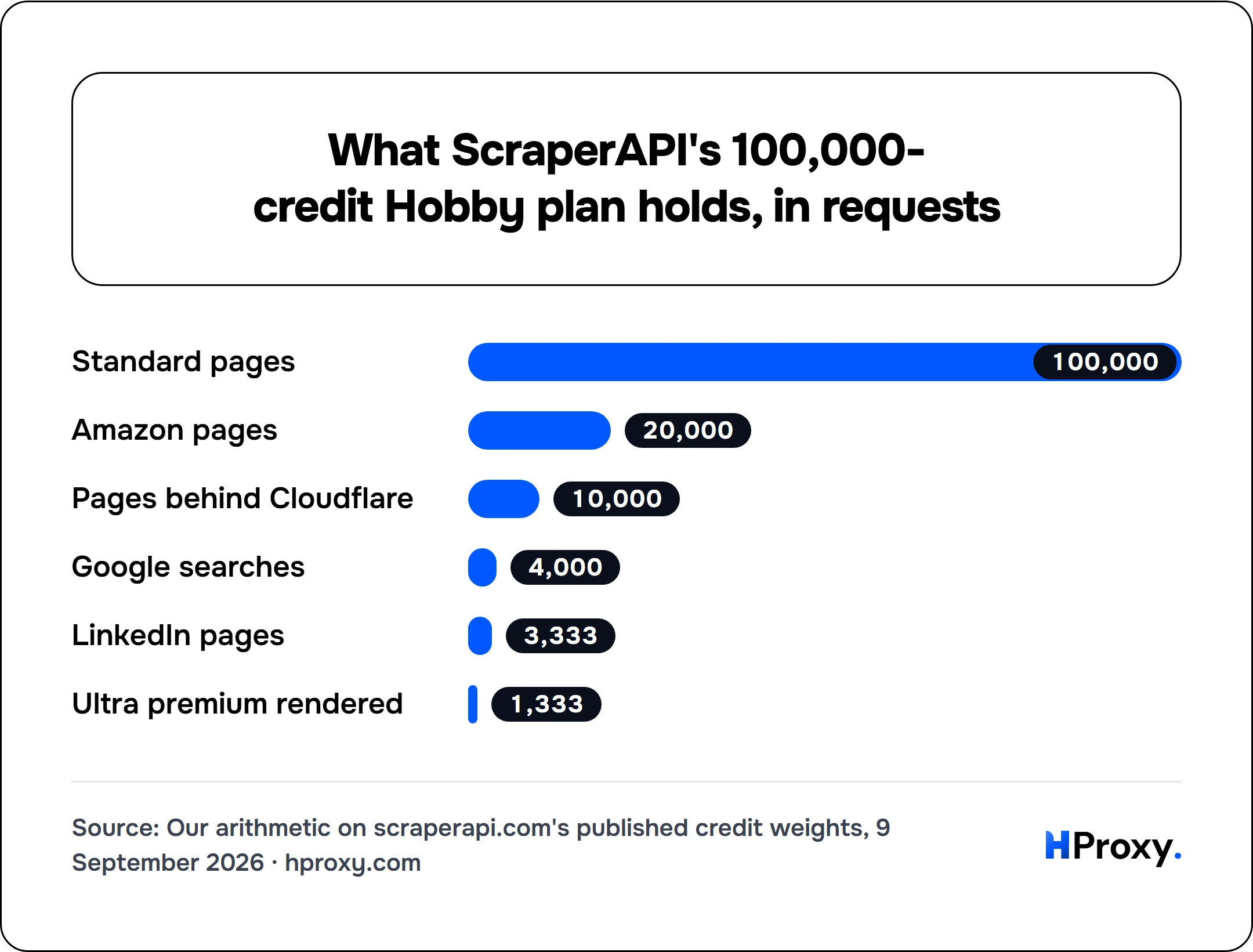
The $49 Hobby plan advertises 100,000 API credits. That is 100,000 plain pages, 4,000 Google searches, 3,333 LinkedIn pages, or 1,333 ultra premium rendered requests. Credits do not roll over, and the three smallest paid plans have no pay-as-you-go option, so running out means upgrading. Their documentation also states that a 404 is billed, and so is a request you cancel before 70 seconds.
What ScraperAPI publishes
These are the advertised plans, read from the pricing page on 9 September 2026. The fifth column is our own division, and it prices a credit rather than a request.
ScraperAPI plans and the price of one credit
| Plan | Per month | Billed annually | Credits | Per 1,000 credits | Threads |
|---|---|---|---|---|---|
| Free | $0 | n/a | 1,000 | free | 5 |
| Hobby | $49 | $44.10 | 100,000 | $0.490 | 20 |
| Startup | $149 | $134.10 | 1,000,000 | $0.149 | 50 |
| Business | $299 | $269.10 | 3,000,000 | $0.100 | 100 |
| Scaling | $475 | $427.50 | 5,000,000 | $0.095 | 200 |
| Professional | $975 | $877.50 | 10,500,000 | $0.093 | 300 |
| Advanced | $1,975 | $1,777.50 | 21,500,000 | $0.092 | 500 |
| Enterprise | custom | custom | 22,000,000+ | not published | 500+ |
scraperapi.com pricing page, read 9 September 2026, with our own division
The discount ladder ends earlier than the plan list suggests. A credit falls from $0.490 to $0.100 between Hobby and Business, which is a real five to one improvement.
After that it barely moves. Advanced costs about six and a half times Business, and takes 8 percent off the credit.
So the useful advice is short. Climb to Business if your volume supports it, then stop looking for a discount. The tiers above Business buy concurrent threads rather than a cheaper credit.
The credit weights, published in full
ScraperAPI documents its weights clearly, which is more than several rivals manage. Two separate things add credits: the site you request, and the parameters you send.
Credits consumed per request
| What the request is | Credits |
|---|---|
| Standard page | 1 |
| Amazon, Walmart, eBay | 5 |
| Google or Bing, including subdomains | 25 |
| 30 | |
| Cloudflare, Turnstile, DataDome or PerimeterX bypass | 10 |
| premium=true | 10 |
| render=true | 10 |
| screenshot=true | 10 |
| ultra_premium=true | 30 |
| premium=true and render=true | 25 |
| ultra_premium=true and render=true | 75 |
docs.scraperapi.com credits and requests costs, read 9 September 2026
Several useful parameters are free, and the documentation names them. Country targeting, session numbers, device type, output format, header passthrough and automatic parsing all cost nothing extra.
The important line is the domain list. Some weights are chosen by the target rather than by you, which is the harder case. A Google URL costs 25 credits before you have set a single option on it.
What that does to the money
Multiply the credit price by the weight and the real rate appears. This is the table the pricing page does not contain:
Cost per 1,000 requests, by target and plan
| What you are scraping | Credits | Hobby $49 | Business $299 | Advanced $1,975 |
|---|---|---|---|---|
| Standard page | 1 | $0.49 | $0.10 | $0.09 |
| Amazon, Walmart or eBay | 5 | $2.45 | $0.50 | $0.46 |
| Behind Cloudflare or DataDome | 10 | $4.90 | $1.00 | $0.92 |
| Google or Bing search | 25 | $12.25 | $2.49 | $2.30 |
| Premium proxies with rendering | 25 | $12.25 | $2.49 | $2.30 |
| 30 | $14.70 | $2.99 | $2.76 | |
| Ultra premium with rendering | 75 | $36.75 | $7.48 | $6.89 |
our own arithmetic on advertised figures, 9 September 2026
The range on a single plan is 75 to one. Nothing about the plan changed between the first row and the last, only the target.
One comparison is worth making across vendors. A Google search costs $2.49 per thousand here at Business volume, against $5.50 in our SerpApi teardown.
What 100,000 credits actually holds
Restate the same arithmetic as request counts and the Hobby plan card reads very differently:
The 100,000 credit Hobby plan, in requests
| What you scrape | Credits each | Requests the plan holds |
|---|---|---|
| Standard pages | 1 | 100,000 |
| Amazon pages | 5 | 20,000 |
| Pages behind Cloudflare | 10 | 10,000 |
| Google searches | 25 | 4,000 |
| LinkedIn pages | 30 | 3,333 |
| Ultra premium rendered | 75 | 1,333 |
our own arithmetic on advertised figures, 9 September 2026
The free plan gives 1,000 credits a month with five concurrent connections. Against LinkedIn that is 33 requests, which is not a test of anything.
The seven day trial is more useful, at 5,000 credits with no card required. Spend those on your actual target rather than on a plain page.
The two billing rules that surprise people
Their documentation is unusually specific about what gets charged, and it names two cases. Charges apply to successful requests with 200 and 404 status codes. They also apply to requests cancelled from your side before 70 seconds have passed.
Read that twice, because it contains two charges most buyers would call failures.
A 404 is billed at the full weight of that request. On LinkedIn that is 30 credits for a page that no longer exists.
The second rule is rarer and sharper. If your own client gives up before 70 seconds, that request is still billed. A 30 second timeout in your HTTP library therefore produces charges with no data attached.
Anyone with an aggressive client timeout should either raise it past 70 seconds or budget for the waste. We found no vendor that publishes this rule more plainly, and we found none that removes it either.
The cost controls are genuinely good
Two features here deserve credit, and both are unusual in this market. Neither appears on the plan cards.
The max_cost parameter caps the credits any single scrape may consume. Their documentation states that a request exceeding it returns a 403 with an explanatory message.
The Domain Multiplier in the dashboard reports the credit cost of any URL before you scrape it, and the /account/urlcost endpoint does the same in code. That is the tool every vendor with a weight table should ship, and most do not.
Used together, they turn an unpredictable bill into a bounded one. Set max_cost below the ultra premium weight and no single request can quietly cost 75 credits.
The minimum, the commitment and the expiry
The smallest paid plan is $49 a month, and there is no commitment. Cancelling is free at any time, and the page states a seven day no-questions-asked refund policy.
Annual billing is advertised at 10 percent off across every tier. That is a smaller discount than the two months free offered by several rivals.
Credits do not roll over. The pricing FAQ states that the credit balance resets when the subscription renews.
Running out is handled differently by tier, and the split matters. Pay-as-you-go is stated to be available only on Scaling, Professional, Advanced and Enterprise plans.
So a Hobby customer who exhausts 100,000 credits has one option: upgrade to Startup at $149. There is no way to buy a few thousand more credits at that level.
That gap deserves its own arithmetic, because there is no bridge across it. A Hobby customer needing 10,000 more credits cannot buy them, and must move up instead. The upgrade costs $100 more a month, so those 10,000 credits cost $10.00 per thousand. The Hobby rate is $0.490 per thousand, so the marginal credits cost about twenty times it. Nothing is wasted if the larger allowance gets used, and most of it will not be.
Concurrency behaves better. Exceeding the thread limit returns a 429 with no extra charge attached. The request is turned away rather than queued, which is the honest behaviour.
The comparison, converted to one number
Every row is money for one thousand successful requests, at the Business tier rate.
Cost per 1,000 requests at Business volume
| What you are buying | Published as | Per 1,000 requests |
|---|---|---|
| Standard page | 1 credit | $0.10 |
| E-commerce page | 5 credits | $0.50 |
| Google search | 25 credits | $2.49 |
| LinkedIn page | 30 credits | $2.99 |
| Ultra premium rendered | 75 credits | $7.48 |
| HProxy scraper API | per 1,000 successful calls | published on our scrapers page |
vendor pricing page and our own arithmetic, 9 September 2026
Our unit is one successful call from a balance that does not expire. There is no plan to size and no weight table to read. Against an undefended page ScraperAPI is cheaper per request than we are, and saying so costs us nothing.
Who this pricing suits
ScraperAPI suits high volume work on standard pages, where a credit is simply a request. At $0.10 per thousand that rate is very hard to beat anywhere. It suits anyone who will reach the Business tier, because that is where the discount ladder finishes.
It suits SERP and social work at scale reasonably well too. A Google search at $2.49 per thousand undercuts several dedicated search APIs at comparable volume.
It suits small volume on expensive targets poorly. On Hobby, a LinkedIn page costs $14.70 per thousand and an ultra premium rendered request costs $36.75.
It also suits unpredictable months poorly. Credits reset at renewal, and the three smallest paid plans cannot buy extra credits at all.
The same conversion for rival vendors sits in our ZenRows teardown and the Firecrawl teardown. The wider market spread is in what scraping APIs really charge.
What we could not verify
The pay-as-you-go rate is described as fixed and predictable, but no per-credit figure is published. We could not price an overflow credit on the plans that allow one.
Enterprise pricing is custom and unpublished. The credits documentation adds that accounts on discounted custom deals pay a higher credit cost on Ultra Premium domains, to meet a minimum of $3 per thousand requests without rendering and $7 with it.
The credit weights for residential and mobile proxies are not listed separately in the documentation we read. The premium and ultra premium parameters appear to cover that ground, so we assumed nothing further.
Prices and weights both move, and domain weights move most. Every figure here was read on 9 September 2026, so check the live pages before committing.
Sources
- ScraperAPI, pricing page, read 9 September 2026. Plan names, monthly and annual prices, credit allowances and concurrent thread limits.
- ScraperAPI, pricing page FAQ, read 9 September 2026. The free plan of 1,000 credits, the seven day trial of 5,000 credits, and the refund policy.
- ScraperAPI, pricing page FAQ, read 9 September 2026. The statement that the credit balance resets when the subscription renews.
- ScraperAPI, pricing page FAQ, read 9 September 2026. Pay-as-you-go availability limited to Scaling, Professional, Advanced and Enterprise.
- ScraperAPI documentation, API status codes, read 14 September 2026. The 429 response for too many simultaneous requests, and the rule that only 200 and 404 responses are charged.
- ScraperAPI documentation, credits and requests costs, read 9 September 2026. Every credit weight quoted in the tables above.
- ScraperAPI documentation, credits and requests costs, read 9 September 2026. The billing rule covering 200 and 404 responses and requests cancelled before 70 seconds.
- ScraperAPI documentation, cost control, read 9 September 2026. The max_cost parameter and the 403 response when a request exceeds it. Credits documentation, read 14 September 2026: the Domain Multiplier and the custom-deal minimum of $3 and $7 per thousand.
- Our own arithmetic on those published figures, 9 September 2026, shown in every table above.