SerpApi sells monthly bundles, and the price of one search depends on which bundle you sit in. The identical Google query costs $25.00 per thousand on the entry plan and $1.96 per thousand on the largest. This page converts all ten published tiers into that one number, using figures read on 9 September 2026.
We sell a competing search endpoint, so weigh our reading accordingly. The plan prices below are theirs, and the arithmetic is ours, shown in full to check.
The short version
SerpApi has the cleanest billing rule in this market: only successful searches count, and cached, errored and failed searches do not. What it does not have is a price per search. Ten tiers run from $25 to $106,050 a month, and converted to cost per thousand searches they span $25.00 down to $1.96. Every plan from Free to Infrastructure holds exactly five hours of its own guaranteed throughput, which is the constraint most buyers discover after paying.
What SerpApi publishes
These are the advertised plans, in their own units, read from the pricing page on 9 September 2026. The final column is ours, and it is simply the monthly price divided by the searches included.
SerpApi plans, converted to cost per 1,000 searches
| Plan | Per month | Searches | Per 1,000 | Throughput/hr |
|---|---|---|---|---|
| Free | $0 | 250 | free | 50 |
| Starter | $25 | 1,000 | $25.00 | 200 |
| Developer | $75 | 5,000 | $15.00 | 1,000 |
| Production | $150 | 15,000 | $10.00 | 3,000 |
| Big Data | $275 | 30,000 | $9.17 | 6,000 |
| Searcher | $725 | 100,000 | $7.25 | 20,000 |
| Volume | $1,475 | 250,000 | $5.90 | 50,000 |
| Infrastructure | $2,750 | 500,000 | $5.50 | 100,000 |
| Cloud 1M | $3,750 | 1,000,000 | $3.75 | 110,000 |
| Cloud 54M | $106,050 | 54,000,000 | $1.96 | 640,000 |
serpapi.com pricing page, read 9 September 2026, with our own division
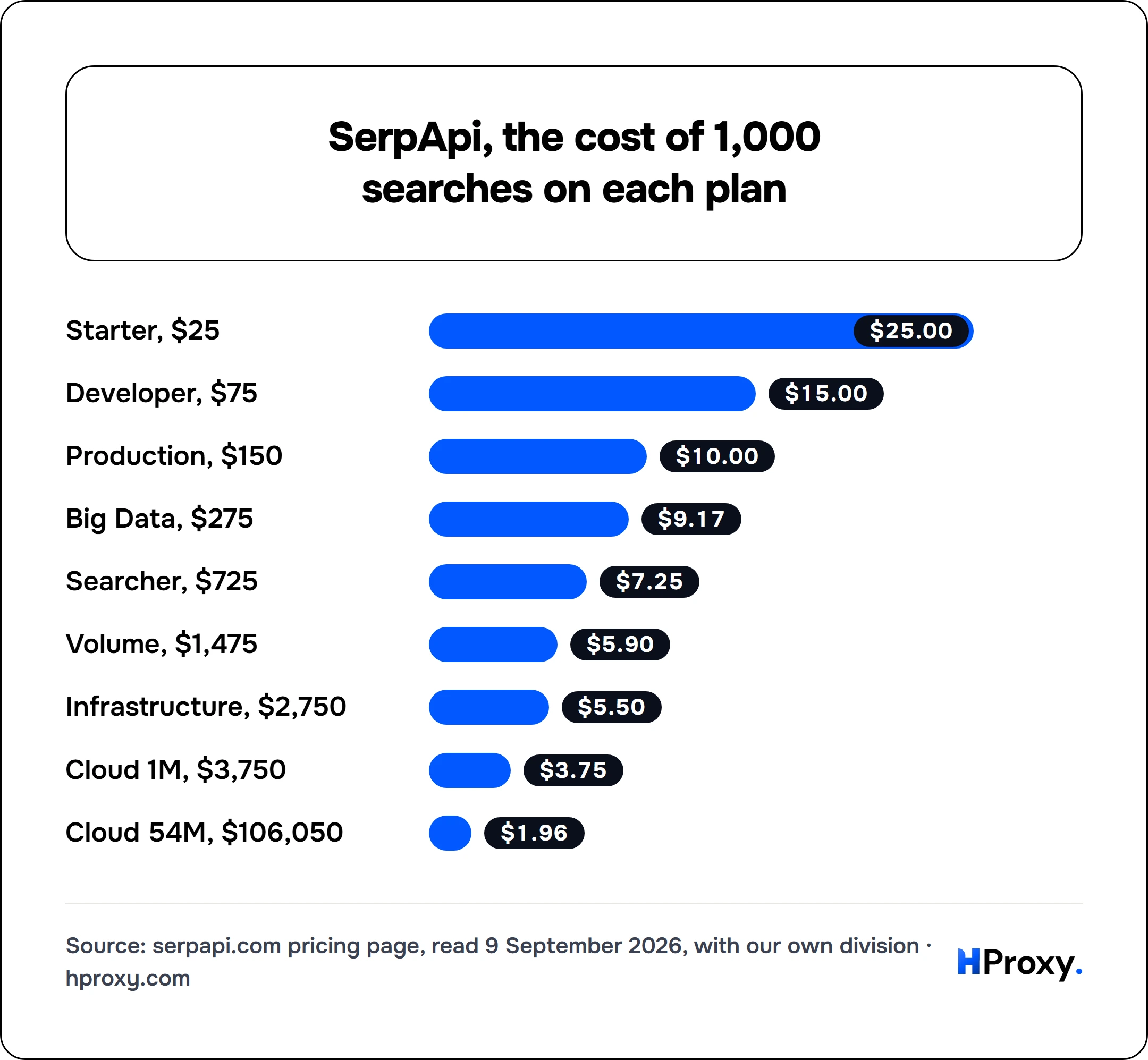
The last column of that table is the whole argument. One Google search costs $25.00 per thousand on Starter and $1.96 per thousand on Cloud 54M. That is a factor of almost 13 for identical work, decided by which bundle you bought.
Note what the $1.96 rate requires: 54 million searches a month, and $106,050 to buy them. That is a volume tier, not a price, and any honest comparison labels it as one.
The ladder is not smooth
Read the per-thousand column from top to bottom and the steps are uneven. Some cost a great deal of money for very little rate improvement.
The Big Data plan is the clearest example. It costs $275 a month against Production at $150, which is 83 percent more money for twice the searches. The rate moves from $10.00 to $9.17 per thousand, a gain of about 8 percent.
The step above it behaves very differently. Searcher costs $725 for 100,000 searches, which is $7.25 per thousand, a further cut of 21 percent. Growing past Production is therefore usually worth doing in one move rather than two.
What the entry tier really buys
The Starter plan is $25 a month and includes 1,000 successful searches. Converted, that is $25.00 per thousand, and it is the most expensive rate SerpApi publishes.
Moving one step up changes the arithmetic sharply. Developer costs three times as much money and gives five times as many searches. The rate falls from $25.00 to $15.00 per thousand, a drop of 40 percent for one step.
The bundle shape has a second effect that no vendor prints. A plan you do not fully consume raises the price of every search you did use:
What under-use does to the Starter rate
| Searches actually used | You paid | Effective cost per 1,000 |
|---|---|---|
| 1,000, the full allowance | $25 | $25.00 |
| 600 | $25 | $41.67 |
| 400 | $25 | $62.50 |
| 100 | $25 | $250.00 |
our own arithmetic on advertised plan figures, 9 September 2026
Nobody plans to use a quarter of their allowance, but projects stall and targets change. The month bills anyway.
The practical lesson is one number to carry into any vendor conversation. Divide the monthly plan price by the searches it includes, then divide again by your expected use rate. That second division is the one most buyers skip, and it is where the real rate hides. Ask every vendor for that number and watch how many pricing pages cannot produce it.
The five hour rule nobody mentions
Each plan carries a guaranteed throughput, stated as successful searches per hour. Divide the monthly allowance by that throughput and the same answer appears every time.
Free holds 250 searches at 50 an hour, and Starter holds 1,000 at 200 an hour. Both work out at exactly five hours of the plan's own throughput. Production, Big Data, Searcher, Volume and Infrastructure all give exactly five hours as well.
That consistency is a design decision, and it has a practical consequence. Your monthly allowance is five hours of full-rate work, spread across a month.
If your nightly crawl must finish inside an hour, throughput decides your plan, not volume. Buyers who size by monthly searches alone meet that ceiling in production, the expensive place.
Sizing therefore inverts the usual method, and the rule is short. Take the busiest hour your job will ever have, measured in searches. The smallest plan that fits is the one whose throughput matches that hour. Its monthly allowance will then be five times that hour, needed or not.
Two buyers, same volume, five times the price
Two buyers make the point, and both of them run 12,000 searches a month. The first spreads that work across the month, so Production at $150 covers it comfortably. Twelve thousand searches against a $150 plan is an effective rate of $12.50 per thousand.
The second buyer needs all 12,000 inside a single hour, and Production guarantees only 3,000. That buyer must climb to Searcher at $725 a month to get 20,000 an hour. The same 12,000 searches now cost an effective $60.42 per thousand, nearly five times more.
Same volume and same engine, with the shape of the work deciding the price. No pricing page shows that, because no pricing page knows what your schedule looks like.
The minimum, the commitment and the expiry
The minimum spend is $25 a month, and there is no pay-as-you-go option on the page. Below that sits a free tier of 250 searches a month, useful for testing and nothing else.
The free tier deserves one honest paragraph of its own. It gives 250 searches a month at 50 an hour, which is enough to test a parser. It is not enough to benchmark a target, because 250 results will not reveal a rate limit. Anyone comparing search APIs should budget the smallest paid month on each instead.
The commitment is genuinely light: month to month terms, cancel anytime, and a full refund within seven days. That refund lapses once more than 20 percent of the plan's searches are used.
Downgrading is handled well too: remaining searches from the previous plan are added to an Extra Credits balance.
The expiry rule is the gap. The pricing page does not state what happens to unused searches when the month renews. That is the most important term on any bundle-priced product, and we could not find it stated.
What is metered on top
Very little, and that is the honest good news. We found no credit multiplier table, no rendering surcharge, no premium domain list and no per-engine pricing.
The one exception is the speed modes, and they are priced unusually. The page lists Ludicrous Speed at two times base price and Ludicrous Speed Max at four. Those multiply the whole plan, not the searches that needed the speed.
Run the numbers on the Production plan to see the effect:
- Production is $150 a month for 15,000 searches, which is $10.00 per thousand.
- With Ludicrous Speed the plan becomes $300, so the rate becomes $20.00 per thousand.
- With Ludicrous Speed Max the plan becomes $600, so the rate becomes $40.00 per thousand.
Speed is therefore the most expensive option here, and it is bought a month at a time. A job that needs low latency for one week pays for four.
The billing rule other vendors should copy
One sentence on the SerpApi pricing page is worth more than the rest of it combined. Only successful searches are counted toward your monthly searches, and cached, errored and failed searches are not.
That rule is rare in this market. Most scraping APIs bill for a 404 at the full multiplier, and some bill for a 410 as well. We documented that behaviour across three vendors in why 250,000 credits is not 250,000 requests.
A stale URL list is expensive under those rules and free under this one. Anyone scraping a list they did not build themselves should weigh that term heavily.
The plans also include a stated legal shield of up to two million dollars of coverage. It is described as covering the scraping and parsing of search engine data. We have not tested that term and make no claim about how it applies.
The comparison, converted to one number
Every row is money for one thousand successful searches, at the advertised rate.
Cost per 1,000 successful searches
| What you are buying | Published as | Per 1,000 searches |
|---|---|---|
| SerpApi entry plan | $25/mo for 1,000 | $25.00 |
| SerpApi mid plan | $150/mo for 15,000 | $10.00 |
| SerpApi at 500,000 a month | $2,750/mo | $5.50 |
| SerpApi volume tier | $106,050/mo for 54M | $1.96 |
| SerpApi with Ludicrous Speed | 2x the plan price | double the row above it |
| HProxy Google search endpoint | per 1,000 successful calls | published on our scrapers page |
vendor pricing page and our own arithmetic, 9 September 2026
Our unit is one successful call, drawn from a balance that does not expire. There is no plan to size in advance, which removes the under-use problem shown above.
Who this pricing suits
SerpApi suits steady, high volume search work that lands in a predictable band each month. At Volume and above, the per-thousand rate is competitive and the throughput is serious. It suits anyone scraping a list of uncertain quality, because failed searches cost nothing.
It suits low or irregular volume poorly, because the $25 floor punishes a quiet month. The bundle shape punishes it a second time, and the entry rate is the worst on the ladder. It suits burst work poorly too, because five hours of throughput caps every plan below Cloud.
Anyone deciding between search APIs should read the same page for the rival. We did the same exercise for compute-unit billing in the Apify pricing teardown. The wider market spread sits in what scraping APIs really charge.
What we could not verify
The pricing page does not say what happens to unused searches at monthly renewal. It describes an Extra Credits balance created on downgrade, and nothing about the ordinary case. We asked the page directly and it does not answer, so we make no claim either way.
We did not find any annual billing discount advertised, though several vendors here offer one. The absence may be a real difference, or it may simply be unlisted.
The Cloud tiers between one million and 54 million were read as a range. We quote the two ends and did not interpolate the plans between them.
Prices move, and search API prices move often, so every figure here carries its date. All of them were read on 9 September 2026, so check the live page before committing.
Sources
- SerpApi, pricing page, read 9 September 2026. Plan names, monthly prices, included searches and throughput per hour.
- SerpApi, pricing page, read 9 September 2026. The statement that only successful searches are counted, and that cached, errored and failed searches are not.
- SerpApi, pricing page, read 9 September 2026. Speed mode multipliers of two times and four times base price.
- SerpApi, pricing page, read 9 September 2026. Month to month terms, the seven day refund rule and the 20 percent usage limit on it.
- SerpApi, pricing page, read 9 September 2026. The Extra Credits balance created when downgrading a plan.
- Our own arithmetic on those published figures, 9 September 2026, shown in every table above.