Firecrawl prices in credits, and for the operations most people buy, one credit is one page. That makes the conversion unusually easy, and the honest answer is that Firecrawl is cheap per page. The trap sits elsewhere, in what happens when your estimate is wrong in either direction. Every figure below was read from their pricing page and documentation on 9 September 2026.
We sell a competing scraper API, so weigh our reading accordingly. The published numbers are theirs, and the arithmetic is ours.
The short version
One credit is one page, and plan credits run from $3.20 per thousand pages on Hobby down to $0.60 on Scale. Top-up credits cost far more: $2.50 per thousand on Standard against $0.83 inside the plan, a factor of three. Credits below the Scale tier do not roll over. So guessing low costs three times the rate, and guessing high forfeits what you paid for.
What Firecrawl publishes
These are the advertised plans, read from the pricing page on 9 September 2026. The prices shown are per month billed annually, and the final column is our own division.
Firecrawl plans, converted to cost per 1,000 pages
| Plan | Per month, billed annually | Credits | Per 1,000 pages | Scrapes per minute |
|---|---|---|---|---|
| Free | $0 | 1,000 | free | 10 |
| Hobby | $16 | 5,000 | $3.20 | 100 |
| Standard | $83 | 100,000 | $0.83 | 500 |
| Growth | $333 | 500,000 | $0.67 | 5,000 |
| Scale | $599 | 1,000,000 | $0.60 | 10,000 |
| Enterprise | custom | custom | not published | not published |
firecrawl.dev pricing page and docs rate limits page, read 9 September 2026
Those are low numbers by the standards of this market. For comparison, the same arithmetic put Apify between $5.00 and $10.00 per thousand pages in our Apify pricing teardown.
The page states an annual discount of 16.7 percent on Hobby through Growth, and 20 percent on Scale. Hobby is also listed at $19 a month when billed monthly. We used the annual figures the page displays and did not derive the other monthly prices.
The free tier is 1,000 credits a month at ten scrapes a minute, with no card required. That is enough to test a parser against a handful of real targets. It is not enough to measure whether the service holds up under a production crawl.
What a credit actually buys
The credit table is short, which is the point. Most vendors need a page of multipliers, and this one needs six rows.
Credits consumed per operation
| Operation | Credits |
|---|---|
| Scrape | 1 per page |
| Crawl | 1 per page |
| Map | 1 per page |
| Search | 2 per 10 results |
| Interact | 2 per browser minute |
| Monitor | 1 per page per check, 7 on the deterministic-extraction engine |
| Agent | 5 daily runs free, then dynamic pricing |
firecrawl.dev pricing page, read 9 September 2026
A scrape, a crawl and a map all cost exactly one credit per page. That makes cost per page and cost per credit the identical figure, which almost no rival can claim.
Two rows are priced by time or by batch rather than by page. Interact bills two credits for each browser minute, so a slow session costs more. Agent runs are described only as dynamic pricing, and we could not convert that.
The top-up costs three times the plan
Firecrawl sells extra credits in $5 increments once a plan runs dry. How many credits that $5 buys depends on the plan you already hold.
Plan credits against top-up credits
| Plan | $5 top-up buys | Top-up per 1,000 | Plan per 1,000 | Top-up costs |
|---|---|---|---|---|
| Hobby | 1,000 credits | $5.00 | $3.20 | 1.6x the plan rate |
| Standard | 2,000 credits | $2.50 | $0.83 | 3.0x the plan rate |
| Growth | 2,500 credits | $2.00 | $0.67 | 3.0x the plan rate |
| Scale | 5,000 credits | $1.00 | $0.60 | 1.7x the plan rate |
our arithmetic on advertised figures, 9 September 2026
On Standard and Growth, an overflow credit costs three times a plan credit. The pricing page presents top-ups as a convenience that keeps requests working, and it does keep them working. It also quietly triples the rate on the pages that ran past your estimate.
This inversion is worth stating plainly, because it is the opposite of how volume pricing normally behaves. Buying more usually costs less per unit. Here, buying more in the wrong way costs three times more.
Guess high and you forfeit it instead
The other jaw of the same trap is the rollover rule. The pricing page states that Hobby, Standard and Growth credits do not roll over. Only Scale keeps unused credits, and then for one month.
So the plan punishes an estimate that is too low and an estimate that is too high. Run the Standard plan under-consumed and the real rate climbs:
What under-use does to the Standard rate
| Pages actually scraped | You paid | Effective cost per 1,000 |
|---|---|---|
| 100,000, the full allowance | $83 | $0.83 |
| 50,000 | $83 | $1.66 |
| 30,000 | $83 | $2.77 |
| 10,000 | $83 | $8.30 |
our own arithmetic on advertised plan figures, 9 September 2026
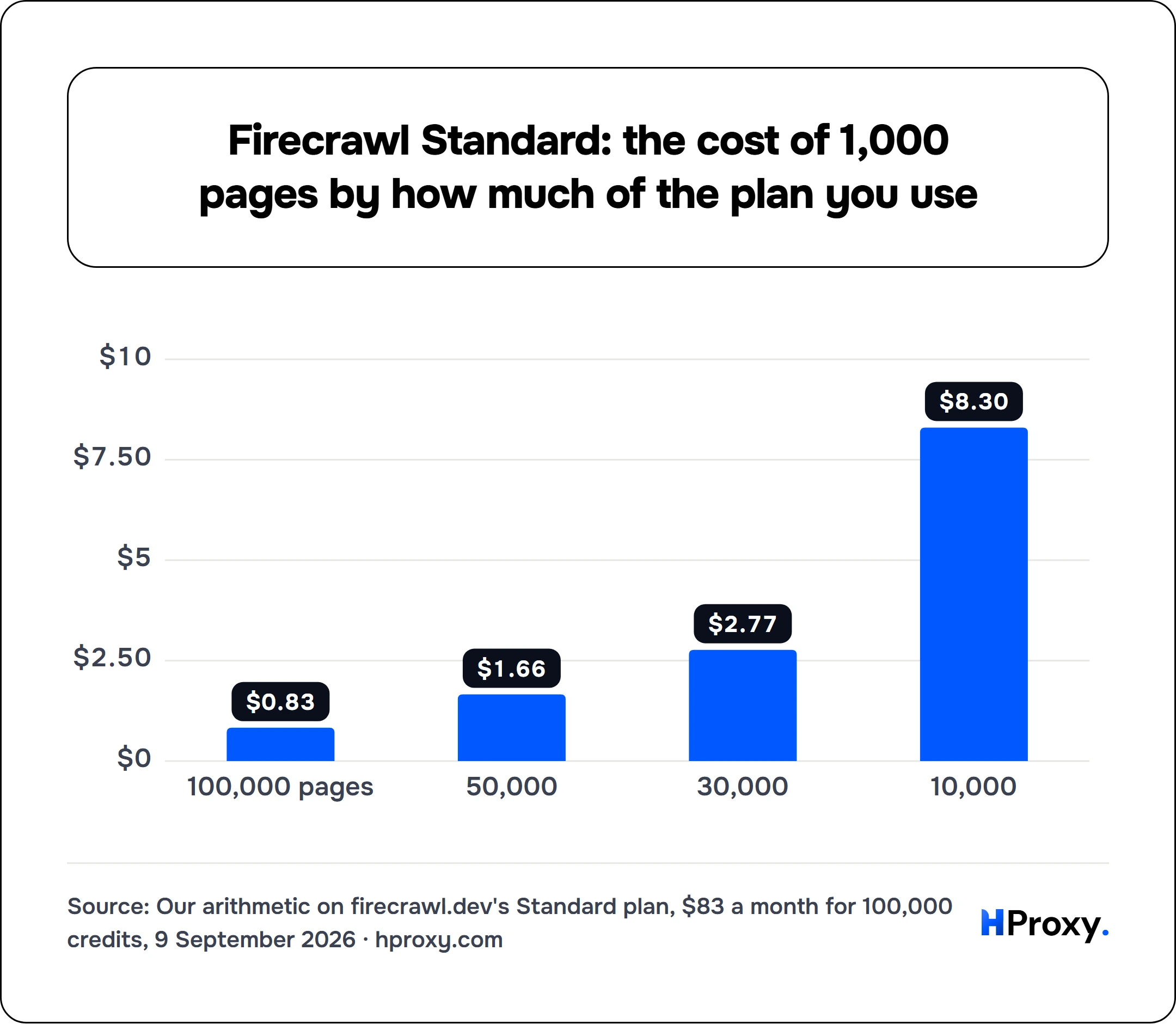
At 10,000 pages a month, the Standard plan costs more per page than Hobby does. Sizing the plan is therefore the single largest decision on this pricing page.
A worked example makes the sizing problem concrete, using two ordinary months of work. A team scrapes 40,000 pages in one month and 90,000 pages in the next. Both months sit inside the Standard allowance, so each of them costs the same $83. Across 130,000 pages that is $166, which is an effective rate of $1.28 per thousand. The advertised Standard rate is $0.83, so the real cost is 54 percent higher. Nothing went wrong in that example, and no credit was wasted on a failure.
Where Hobby stops making sense
The gap between Hobby and Standard is unusually wide. Hobby holds 5,000 credits for $16, and Standard holds 100,000 for $83.
Anyone landing between those two numbers has a choice. Stay on Hobby and buy top-ups at $5 per thousand, or move up to Standard and accept unused credits.
The crossover is easy to calculate. Hobby costs $16 plus $5 for every extra thousand pages, and Standard costs $83 flat:
- Set $16 plus $5 per extra thousand equal to $83.
- That leaves $67, which buys 13,400 extra pages.
- Add the 5,000 already included and the crossover is about 18,400 pages.
Above roughly 18,400 pages a month, Standard is cheaper than Hobby plus top-ups. Below it, Hobby with top-ups wins, even at the worse per-credit rate.
What is metered on top
Remarkably little, and the proxy rule is the reason to say so loudly. Their proxy documentation states that enhanced proxy requests cost the same as basic requests, at one credit each.
It goes further. An escalated retry is not charged separately, so a request that ends on enhanced still costs one credit.
That single rule separates Firecrawl from most of this market, as our credit study showed. Rivals charge ten to twenty five credits for the same premium proxy request. Here the answer is one.
The failure rule is precise rather than generous, and the distinction matters. A scrape that returns no result is not charged. A page returning an error status such as 403 or 404 is still returned to you and costs one credit.
So a stale URL list still costs money here, at one credit per dead link. That is far better than the full multiplier some rivals charge, and it is not free.
Rate limits are the real ceiling
Credits decide the price and rate limits decide whether the job finishes. The two are sized very differently across the plans.
Hobby allows 100 scrapes a minute and 5 concurrent browsers. Standard allows 500 a minute and 25 browsers. Growth allows 5,000 a minute and 50 browsers, and Scale allows 10,000 and 100 or more.
Going past the per-minute limit returns a 429 response. Jobs beyond the browser limit wait in a queue. Once that queue is full, new jobs are rejected with a 429 until existing ones complete. A crawl sized by credits alone can therefore stall on concurrency long before the credits run out.
The comparison, converted to one number
Every row is money for one thousand successfully fetched pages.
Cost per 1,000 pages
| What you are buying | Published as | Per 1,000 pages |
|---|---|---|
| Firecrawl Hobby | $16/mo for 5,000 credits | $3.20 |
| Firecrawl Standard | $83/mo for 100,000 credits | $0.83 |
| Firecrawl Scale | $599/mo for 1,000,000 credits | $0.60 |
| Firecrawl top-up on Standard | $5 for 2,000 credits | $2.50 |
| Firecrawl Standard at 30% use | $83/mo, 30,000 pages used | $2.77 |
| HProxy scraper API | per 1,000 successful calls | published on our scrapers page |
vendor pricing page and our own arithmetic, 9 September 2026
Our unit is one successful call from a balance that does not expire, with no allowance to size. The products differ, though: Firecrawl fetches any page as markdown, and we return structured data.
Who this pricing suits
Firecrawl suits anyone who can predict their monthly page count within a reasonable band. At full consumption the Standard rate is genuinely low, and the credit table is honest. It suits anyone tired of multiplier tables, because the premium proxy costs the same as the basic one.
It suits unpredictable volume poorly, and the reason is structural rather than accidental. Every plan below Scale forfeits unused credits, and the middle top-up rate is triple. An estimate that is wrong in either direction is expensive here.
It also suits very small jobs poorly, and the gap in the ladder is the reason. Below about 10,000 pages a month, Standard is worse per page than Hobby itself. Hobby in turn caps at 5,000 credits, so neither plan fits that band well.
The market context sits in what scraping APIs really charge. The remaining questions sit in how to read a proxy pricing page.
What we could not verify
The pricing page displays annual figures, and no monthly billed price was stated for Standard, Growth or Scale. Hobby alone was listed at $19 a month when billed monthly. We used the annual figures rather than deriving the others from the stated discount.
Agent runs are described as five daily runs free with dynamic pricing, and no rate is published. We could not convert that into money and did not try.
The documentation notes that JSON extraction and Interact cost more credits than a basic scrape. The pricing page lists Interact at two credits per minute, and no JSON extraction figure is published.
Prices move, and this vendor is young enough that they move often. Every figure here was read on 9 September 2026, so check the live page before committing.
Sources
- Firecrawl, pricing page, read 9 September 2026. Plan names, annual monthly-equivalent prices, credit counts, and the annual discount percentages.
- Firecrawl, pricing page, read 9 September 2026. Credits consumed per operation for scrape, crawl, map, search, interact, monitor and agent.
- Firecrawl, pricing page, read 9 September 2026. The pay-as-you-go increments of $5, and the credits each increment buys on each plan.
- Firecrawl, pricing page, read 9 September 2026. The statement that Hobby, Standard and Growth credits do not roll over, and that Scale keeps them one month.
- Firecrawl, pricing page, read 9 September 2026. The billing rule for failed requests, including the 403 and 404 case.
- Firecrawl documentation, proxy types page, read 9 September 2026. Enhanced proxy requests cost one credit, and an escalated retry is not charged separately.
- Firecrawl documentation, rate limits page, read 9 September 2026. Requests per minute and concurrent browser limits per plan.
- Our own arithmetic on those published figures, 9 September 2026, shown in every table above.