Typing "residential proxy free trial" drops you into a landscape where four different things wear the same name, and knowing which one you are looking at decides whether the trial tells you anything. This page sorts the four shapes honestly, including where our own model sits and why we run a permanent free tier plus a $2 entry instead of a classic trial.
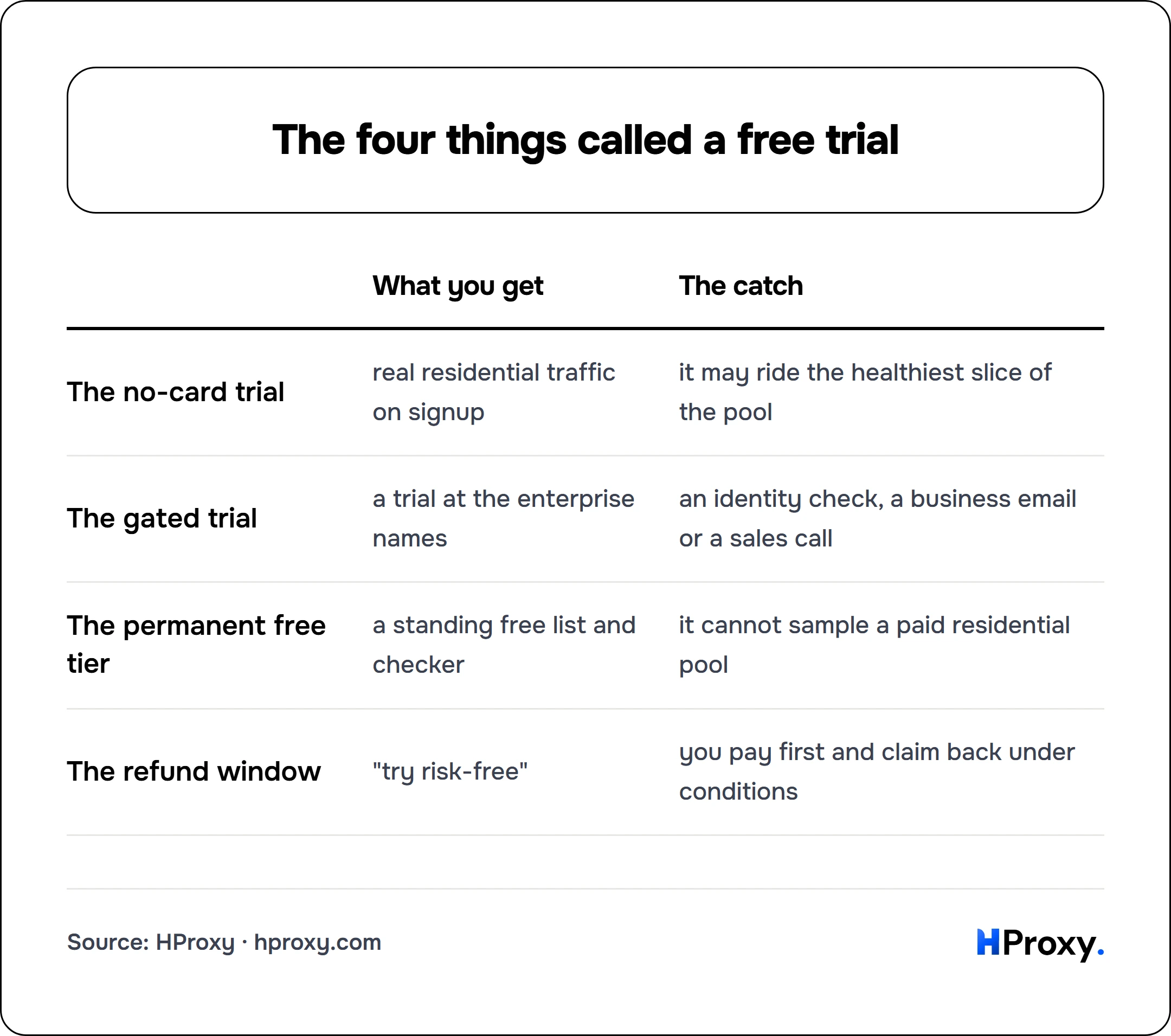
The four things called a free trial
The genuine no-card trial. A few providers hand out real residential traffic on signup without a payment method; PlainProxies, for example, advertises exactly that. It is the most buyer-friendly shape, with one caveat worth knowing: trial allocations sometimes ride the healthiest slice of a pool, so a spotless trial is a good sign rather than a guarantee of paid-tier behavior.
The gated trial. Common at the enterprise names: the trial exists, behind an identity check, a business email, or a sales conversation. That gate is a legitimate anti-abuse choice, and it prices the trial in friction instead of money. Whether that trade suits you depends on how much paperwork your test is worth.
The permanent free tier. Not a window, a standing offer. Ours is the free proxy list, re-verified every few minutes, plus the proxy checker, no account required for either. A free tier cannot sample a paid residential pool, but it proves everything upstream of it: your code path, your rotation logic, your parser, your tooling. Most trial failures people blame on providers are plumbing failures a free tier would have caught for nothing.
The refund window in trial clothing. "Try risk-free" sometimes means "pay first, claim back within N days under conditions." Read the conditions before treating it as a trial; a refund policy with usage caps and method exclusions is a purchase with an exit clause, not a test.
| What you get | The catch | |
|---|---|---|
| The no-card trial | real residential traffic on signup | it may ride the healthiest slice of the pool |
| The gated trial | a trial at the enterprise names | an identity check, a business email or a sales call |
| The permanent free tier | a standing free list and checker | it cannot sample a paid residential pool |
| The refund window | "try risk-free" | you pay first and claim back under conditions |
What a trial can and cannot tell you
Any trial, whichever shape, answers exactly one question well: does this pool perform on YOUR target this week? So spend it only on that. Point your real tool at your real target, a few dozen requests, record success rate and gigabytes consumed, and push a sample of exits through an independent checker to confirm country and network type. The full judging method, minimums, expiry lines, checkout friction, sourcing, is in best place to buy residential proxies.
What no trial tells you: how the pool behaves at your real volume over weeks, what support is like when something breaks, and whether the pricing fine print bites later. Those come from the first paid month, which is why the size of the first paid step matters more than the existence of a trial.
Our version, stated plainly
We chose a different pair of answers. The permanent free tier above replaces the trial for everything that does not need the paid pool. And the paid test costs $2, the wallet minimum, paid by card, PayPal, Alipay or crypto with no call, buying real gigabytes at $0.44 per GB on the pool you would actually use. Whatever the test does not burn stays in the balance forever, because it never expires. That is the whole pitch: we would rather sell you a $2 experiment you keep the change from than perform a trial whose conditions you have to lawyer. If the experiment says another provider wins on your target, the market map treats the alternatives honestly, and two dollars was a cheap way to find out.