We keep a record of what providers in this market charge and what happens to them over time. This page is the part of that record covering ProxyLite, written up for somebody deciding today.
The record we hold
The domain is proxylite.com.
What we do not hold is a current, sourced price for ProxyLite. Rather than print a figure we cannot stand behind, this page leaves it out and tells you what to look for when you read their page yourself.
Read their page for the reachable rate rather than the headline, the minimum spend, the expiry clause and the billing treatment of blocked requests. Write down the date, because all four move.
What is on their front page
As of 9 September 2026 the tab reads "ProxyLite - Residential Proxies and Web Scraping". Their own summary of the product runs: "72M+ Global IPs with Proxylite, an award-winning proxy service provider offering top-notch data collection, extraction, and multi-accounting infrastructure."
Taken from the same page, on the same day:
The product lines named on that page are residential, datacenter, ISP or static residential, SOCKS5 and a scraping or SERP API. They advertise 190 countries or locations. Their pricing page is titled "Cheapest Residential Proxy - Buy Residential IP - ProxyLite".
All of the above is their copy, not our finding. A dated quotation is the weakest kind of evidence that is still evidence.
The domain record
The domain was registered on 25 December 2010, through NameCheap, Inc, which makes it about 15 years old. That record was read from the registry on 9 September 2026. The registry shows it renewed to 25 December 2026.
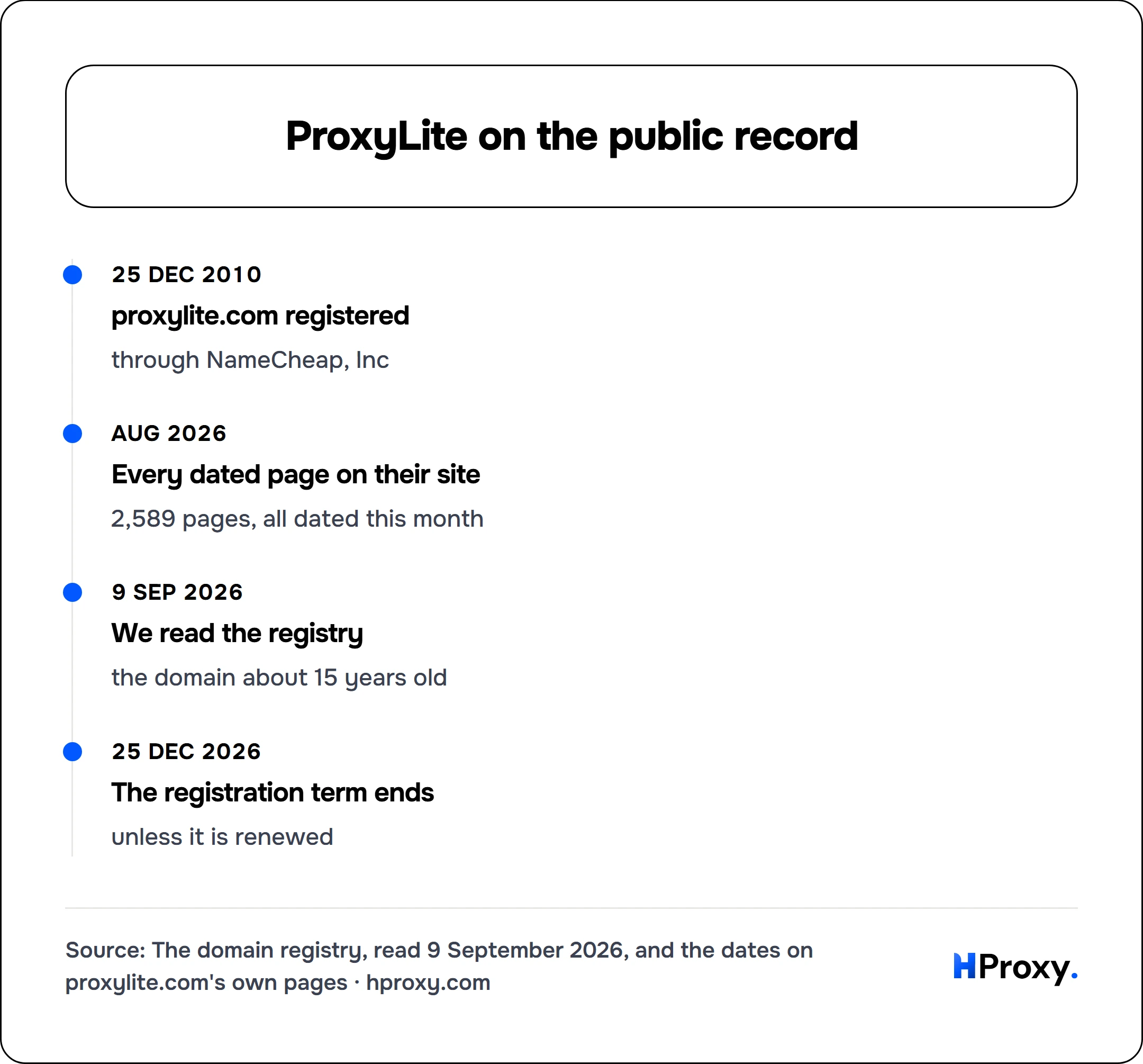
25 Dec 2010
proxylite.com registered
through NameCheap, Inc
Aug 2026
Every dated page on their site
2,589 pages, all dated this month
9 Sep 2026
We read the registry
the domain about 15 years old
25 Dec 2026
The registration term ends
unless it is renewed
Age is not quality. A long registration does not make a network good, and a new one does not make it bad. What it does rule out is the shortest-lived pattern in this market, which is a site that appears, sells, and is gone inside a year.
How much site there is
A crawl of 2.589 pages returned 167 blog pages, 8 location pages and 168 use-case pages.
Read it as a map of what they emphasise. It is our count, from our crawler, on the date shown, and it is the only figure on this page that neither of us can dispute.
Signs of life
Our crawl of their site found 2,589 pages carrying a date, 167 of them articles. The oldest is from August 2026 and the newest from August 2026. 2,589 of them carry a date inside the last twelve months.
Recent dates prove somebody is still at the keyboard. They prove nothing about the network, which is what the test at the end of this page is for.
The parts no marketing page answers
The reputation you inherit
Ask how many accounts can sit on one address at once. Where the answer is unlimited or unspecified, price the plan as shared regardless of what the product is called.
Ask whether failed requests are billed
On a hard target, failures are the majority of your traffic. Whether those failures are billed decides the real cost, and the clause covering it is rarely on the pricing page.
Threads, not gigabytes, are often the ceiling
A plan with generous traffic and a low thread limit is a slow plan. Find both numbers before you size anything, because the smaller of the two is your actual ceiling.
Side by side, with the blanks left blank
The rows that matter, with our own answers stated plainly:
| Question to ask | ProxyLite | HProxy |
|---|---|---|
| Entry price | Not verified by us, read their page | From $0.44/GB, pay as you go |
| Does unused balance expire? | Worth confirming in writing before you commit | Never |
| Minimum commitment | Not published clearly, ask before paying | None |
| Identity checks | On their own terms page | Card orders are screened, and verification is sometimes requested |
| Targeting | Not published clearly, ask before paying | Country, city and ISP |
| Free way to evaluate | Check the current terms, this one moves | Free proxy list and proxy checker |
Two notes on that table. The rows we left for you to check are not evasions: those terms change, and printing a stale figure is exactly the failure this page is trying to avoid. And no table can hold the number that should decide your purchase, which is the success rate on your own target.
The ten minute version of this decision
For a few dollars you can get a verdict specific to your job, which no comparison page can honestly promise you.
- Start with the smallest purchase each vendor allows, so the test costs less than the decision it replaces.
- Use your own scraper and your own target. A benchmark against a neutral site measures nothing you will experience.
- Measure what came back correctly and what it consumed, then divide the spend by the successes.
- Push a sample of exit addresses through an independent checker and confirm the country and connection type are what was advertised.
- Buy the one that won on your target, and diarise a re-test in three months.
Others in this market
Nearest alternatives by product shape rather than by who pays us, since nobody does:
- CliProxy alternatives
- Clouding alternatives
- Cookie Proxies alternatives
- Cop.guru alternatives
- Coproxy alternatives
- Coronium alternatives
Where HProxy sits in that test
Our own lane is easy to state. Residential starts at $0.44 per GB with country targeting, the balance is topped up when you want and does not expire, there is no subscription unless the optional discount suits you, and city and ISP targeting come with Residential Premium from $1.00 per GB. If the test above puts us second on your target, buy the winner.