You can settle this yourself for less than the price of lunch. That is the argument of this page, and the sections before the test exist to tell you what to measure once you start.
The record we hold
Veloproxy operates from veloproxy.com. Our classification for them is proxy provider. We could not fetch their site automatically on the last attempt. A bot filter is the usual explanation and says nothing about the business.
What we do not hold is a current, sourced price for Veloproxy. Rather than print a figure we cannot stand behind, this page leaves it out and tells you what to look for when you read their page yourself.
Note the price, the unit it is quoted in, the minimum, and the expiry. Unit and expiry are where most comparisons in this market quietly go wrong.
What is on their front page
As of 9 September 2026 the tab reads "Mobil Proxy Satın Al, TR 4G/5G/LTE Mobil IP".
Reading the same page for the things buyers actually ask about:
The product lines named on that page are residential and SOCKS5. We found no separate pricing page linked from the homepage, which usually means the price arrives by quotation.
Nothing there has been tested. It is a record of what the page said on the day, which is the honest limit of what a page like this can offer without a measurement.
The domain record
The domain was registered on 17 July 2024, through ODTU Gelistirme Vakfi Bilgi Teknolojileri Sanayi Ve Ticaret , which makes it about 2 years old. That record was read from the registry on 9 September 2026. The registry shows it renewed to 17 July 2027.
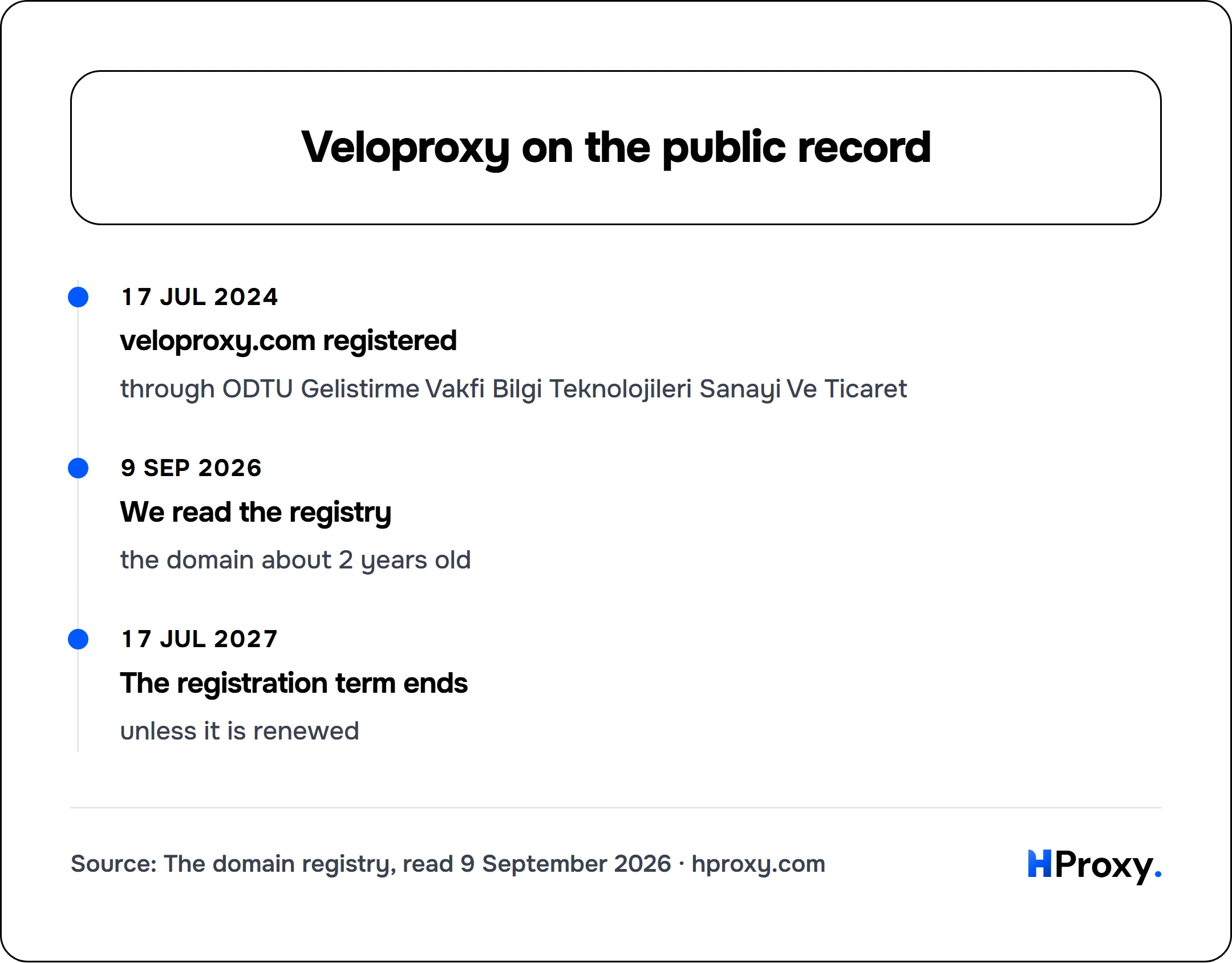
17 Jul 2024
veloproxy.com registered
through ODTU Gelistirme Vakfi Bilgi Teknolojileri Sanayi Ve Ticaret
9 Sep 2026
We read the registry
the domain about 2 years old
17 Jul 2027
The registration term ends
unless it is renewed
Age is not quality. A long registration does not make a network good, and a new one does not make it bad. What it does rule out is the shortest-lived pattern in this market, which is a site that appears, sells, and is gone inside a year.
The parts no marketing page answers
Ten million addresses, and none of them yours
Nobody audits pool totals in this market, and the counting rules differ between vendors. Even an accurate figure describes addresses that exist, not addresses you will be routed through. Treat it as a marketing unit rather than a capability.
The entry price is not the effective price
A starting rate is a marketing number. What you pay depends on the tier your volume lands in, the minimum purchase, and what happens to traffic you bought and did not use. An expiring balance quietly raises the price of every unit you did consume.
Threads, not gigabytes, are often the ceiling
Bandwidth is rarely the constraint on a real workload. Concurrent connections, requests per second and per-session caps are, and they are frequently buried in the documentation rather than the pricing page.
Side by side, with the blanks left blank
The table answers what we can answer and marks what we cannot:
| Question to ask | Veloproxy | HProxy |
|---|---|---|
| Entry price | Not verified by us, read their page | From $0.44/GB, pay as you go |
| Does unused balance expire? | On their own terms page | Never |
| Minimum commitment | Their terms page answers this | None |
| Identity checks | Check the current terms, this one moves | Card orders are screened, and verification is sometimes requested |
| Targeting | Their terms page answers this | Country, city and ISP |
| Free way to evaluate | Check the current terms, this one moves | Free proxy list and proxy checker |
Two notes on that table. The rows we left for you to check are not evasions: those terms change, and printing a stale figure is exactly the failure this page is trying to avoid. And no table can hold the number that should decide your purchase, which is the success rate on your own target.
A test worth more than this comparison
Do this once and you will never need a comparison page for this decision again.
- Open an account on each and add the smallest amount they take. Skip the trial if a paid unit is cheap enough to buy outright.
- Point both at your real target, through your real tool, on the same day, with the same mix of requests.
- Count how many requests returned what you wanted, and how much bandwidth each side spent doing it.
- Spot-check the exits. Confirm they are in the country you paid for and the connection type you were sold.
- Buy the one that won on your target, and diarise a re-test in three months.
Others in this market
Nearest alternatives by product shape rather than by who pays us, since nobody does:
- Proxying alternatives
- ProxyJet alternatives
- ProxyLand alternatives
- ProxyLine alternatives
- ProxyList.to alternatives
Our side of it
HProxy is pay as you go from $0.44 per GB on residential, with ISP, mobile and datacenter under one balance and no commitment attached to any of them. Run the test. If we lose on your target, we lose, and you have your answer.