Readers land here mid-decision, usually with a cart open somewhere. The fastest thing we can do is set out what ProxyBlocks publishes, what it does not, and what a few dollars of testing settles better than any argument.
What we can and cannot tell you about ProxyBlocks
The company behind the name sits at proxyblocks.io.
A price is missing here on purpose. We have not captured a sourced rate for ProxyBlocks recently enough to publish one, and a stale number in this market is a wrong number.
Copy down the entry rate, the commitment attached to the cheapest rate, the minimum top-up and the expiry rule. Those four turn a marketing figure into something you can compare.
What is on their front page
Read 9 September 2026, the homepage titles itself "Dedicated Mobile Proxy, Unlimited 5G". The one-paragraph pitch on their own page: "ProxyBlocks offers high-performance dedicated mobile proxies across multiple countries and providers , packed with powerful features."
Taken from the same page, on the same day:
The product lines named on that page are mobile, SOCKS5 and IPv6. The page offers some form of free trial. Their pricing page is titled "Dedicated Mobile Proxy Pricing, ProxyBlocks".
That is the vendor speaking, not us. We print it because a claim with a date attached is at least falsifiable.
How much site there is
We crawled 31 pages of their site on 19 June 2026 and found 7 blog pages, 1 pricing page and 7 use-case pages.
That mix tells you how the company sells. Heavy location pages mean a geography-led pitch, heavy blog means a search-led one, and a single pricing page usually means one simple offer or one sales call.
Signs of life
Our crawl of their site found 31 pages carrying a date. The oldest is from March 2025 and the newest from July 2026. 8 of them carry a date inside the last twelve months.
An actively maintained site is table stakes rather than a recommendation. It does rule out the failure that costs buyers the most here, which is prepaying a company that has quietly stopped.
What the advertised numbers cannot tell you
Who else is using your address
A shared address arrives with a history you did not create and cannot see. For read-only work it rarely matters. For anything that keeps a session, it is the most common cause of unexplained failure.
The line item hidden in the success rate
Some vendors bill every request, some bill only successful ones, and the difference is the whole comparison once a target starts blocking. A cheap rate with a fifty percent success rate is twice its advertised price.
What actually caps your throughput
Rate limits are often enforced per account rather than per plan, which means buying more traffic does not raise them. Confirm how yours scales before you assume a bigger plan runs faster.
What separates them, in a table
This is the shortest table that still decides the purchase:
| Question to ask | ProxyBlocks | HProxy |
|---|---|---|
| Entry price | Not verified by us, read their page | From $0.44/GB, pay as you go |
| Does unused balance expire? | Check the current terms, this one moves | Never |
| Minimum commitment | Not published clearly, ask before paying | None |
| Identity checks | On their own terms page | Card orders are screened, and verification is sometimes requested |
| Targeting | Read their current terms | Country, city and ISP |
| Free way to evaluate | Worth confirming in writing before you commit | Free proxy list and proxy checker |
That comparison covers what is publishable. What is not publishable, and what actually decides this, is how many of your requests come back correct.
The ten minute version of this decision
For a few dollars you can get a verdict specific to your job, which no comparison page can honestly promise you.
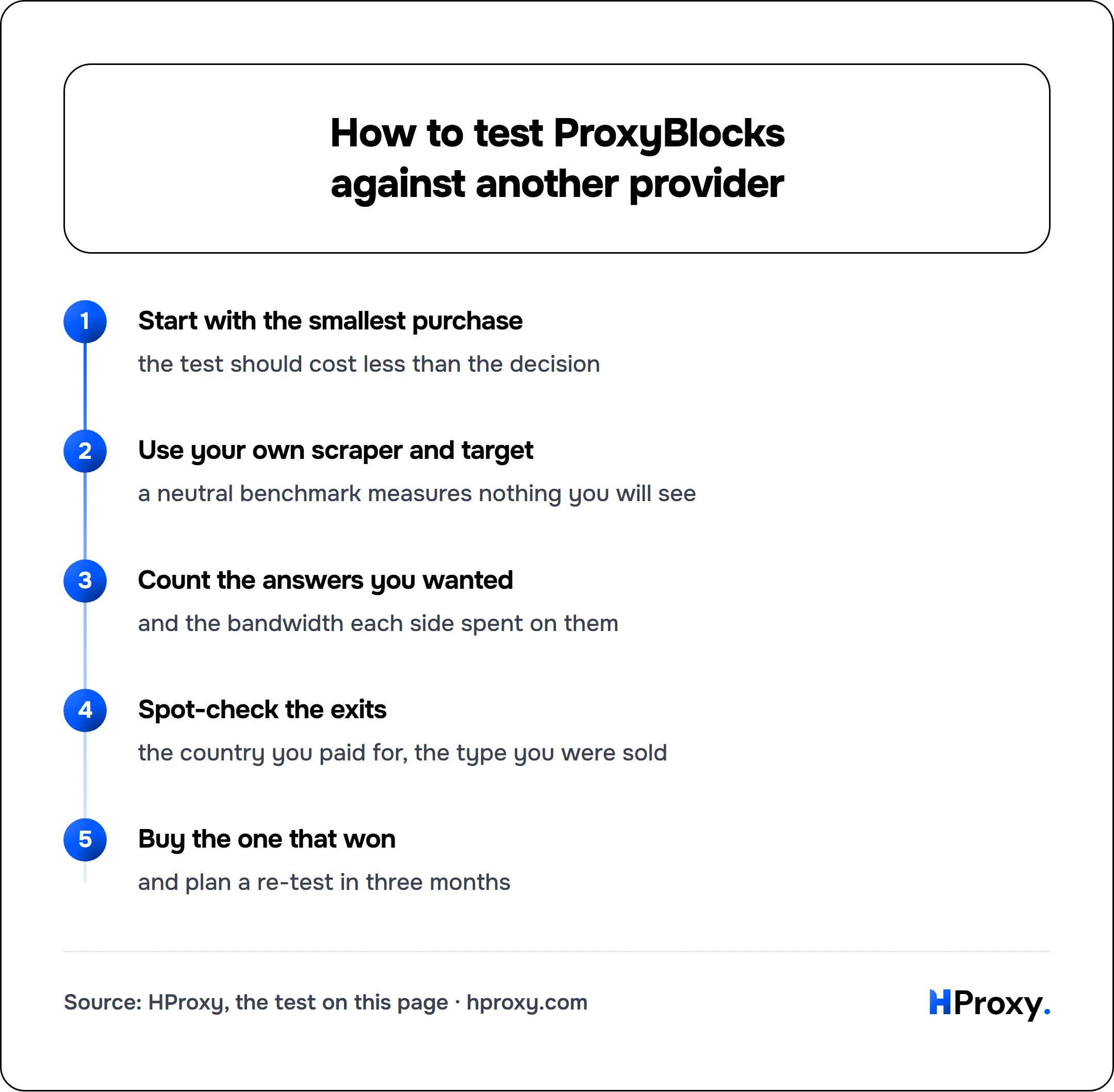
- Start with the smallest purchase each vendor allows, so the test costs less than the decision it replaces.
- Use your own scraper and your own target. A benchmark against a neutral site measures nothing you will experience.
- Count how many requests returned what you wanted, and how much bandwidth each side spent doing it.
- Spot-check the exits. Confirm they are in the country you paid for and the connection type you were sold.
- Buy the one that won on your target, and diarise a re-test in three months.
Start with the smallest purchase
the test should cost less than the decision
Use your own scraper and target
a neutral benchmark measures nothing you will see
Count the answers you wanted
and the bandwidth each side spent on them
Spot-check the exits
the country you paid for, the type you were sold
Buy the one that won
and plan a re-test in three months
The other names that come up
Other providers in the same bracket, priced and dated the same way:
Where HProxy sits in that test
We sell residential proxies from $0.44 per GB with no subscription and a balance that does not expire, plus ISP, mobile and datacenter in the same account. That is the pitch, and the test above is a better judge of it than this paragraph.