Smart DNS Proxy (smartdnsproxy.com) sells a Smart DNS service for streaming, with a VPN beside it. Its about page calls it "a brand of C Telekom Inc", the company its terms name and the name buyers see on card statements, and its domain dates from May 2013. In January 2025 its plans started at $5.90 a month; by 24 February 2025 every plan with a fixed term cost 15% more, from $6.79 a month, while the lifetime plan stayed at $200. Its own pages answered our server with empty pages, so its prices and terms below come from Internet Archive copies of 21 September 2026. Other services follow the fine print.
What Smart DNS Proxy does
Its about page describes "a secure DNS Proxy service to unblock websites, global video & music streaming services". The method is the DNS setting: "You simply need to change your DNS IP address in your device to Smart DNS Proxy Ip addresses." Its servers then send the lookups of chosen sites onward, so that, in its example, a viewer in Europe "and want to stream from USA Netflix site" is routed "to the proper US netflix servers". The same page promises that "All Smart DNS Proxy servers are secured and encrypted" and that "There is also no logs in our network".
Because it works through the DNS setting, it suits devices where a proxy cannot be set. Its help centre has setup guides for LG and Samsung TVs, Amazon Fire TV, Chromecast, iPhone, Android, Mac and routers running DD-WRT, and separate guides for its VPN, over OpenVPN and L2TP and in a "Smart VPN" app for Windows. Its terms call the whole offer "subscription-based DNS services for fast and secure anonymous browsing".
Its status page listed 38 DNS server locations on 14 October 2026, from Sydney and São Paulo to Dubai, Tokyo and nine US sites, every one marked "Good Service" under the banner "All Systems are Online". It shows no uptime history: each location reads "There is no data to display".
Who runs it
Its privacy policy covers a website "owned and operated by C Telekom, Inc.", and its terms name C Telekom, Inc. as the party whose liability they limit. A note in the terms warns buyers: "Charges will appear as C Telekom, Inc. on your bank or card statement." The about page goes further back, to a company "providing global internet security, data encryption and anonymity services since 1995", and says Fortune 500 companies "like Microsoft, Apple, IBM, BP, Shell" trust its brands. We found no record that confirms either claim.
A second company name appears in the affiliate terms. They list "SmartDNSProxy", "Smart DNS Proxy", "Smart DNS" and "Global Stealth, Inc." as its trade marks, and bar affiliates from bidding on ads for "Global Stealth Network" among other words. Disputes with buyers go to binding arbitration "under the jurisdiction of the Province of Ontario, Canada", in Toronto. The domain smartdnsproxy.com was registered on 15 May 2013 through NameCheap and is paid until May 2029.
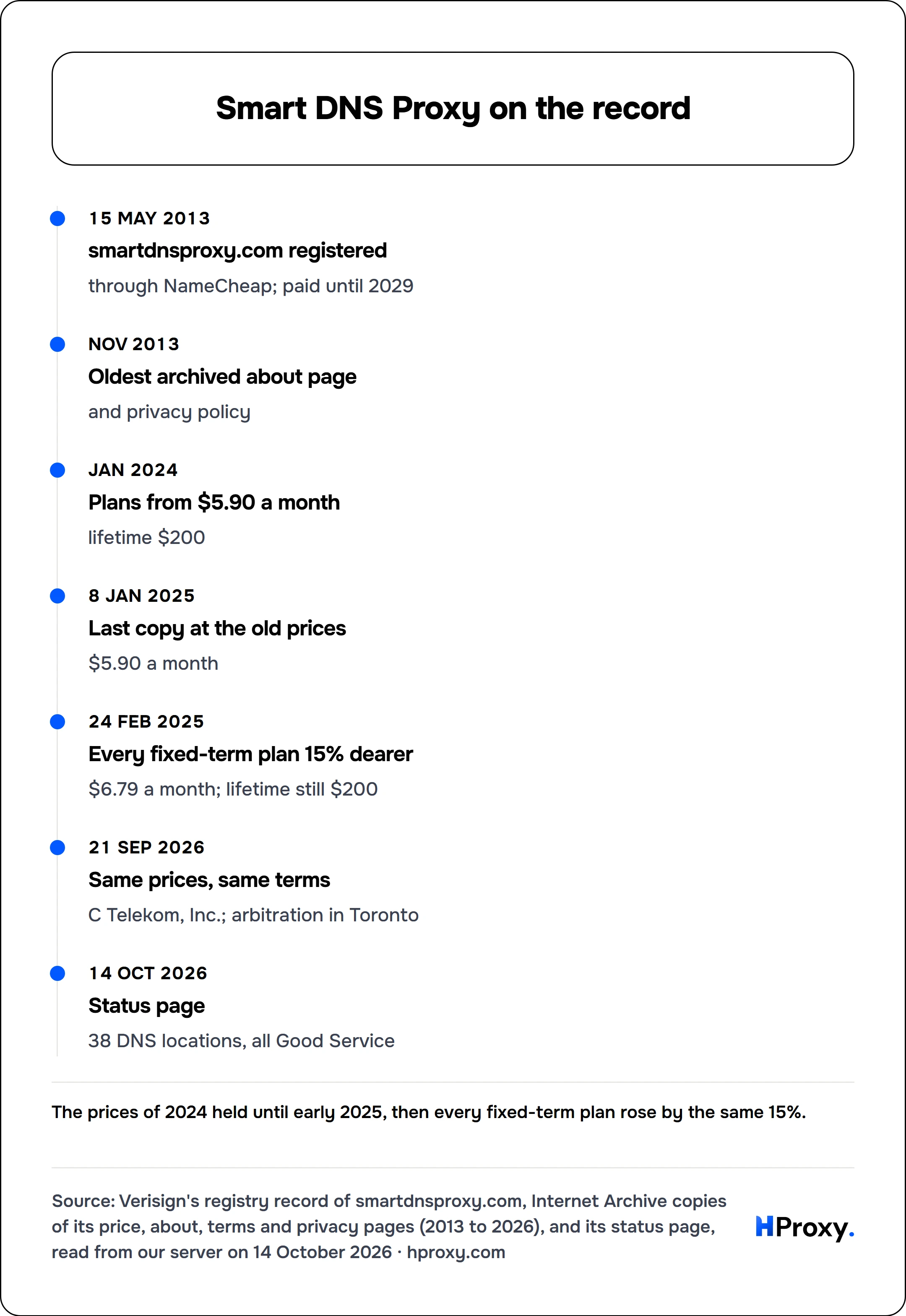
15 May 2013
smartdnsproxy.com registered
through NameCheap; paid until 2029
Nov 2013
Oldest archived about page
and privacy policy
Jan 2024
Plans from $5.90 a month
lifetime $200
8 Jan 2025
Last copy at the old prices
$5.90 a month
24 Feb 2025
Every fixed-term plan 15% dearer
$6.79 a month; lifetime still $200
21 Sep 2026
Same prices, same terms
C Telekom, Inc.; arbitration in Toronto
14 Oct 2026
Status page
38 DNS locations, all Good Service
What it costs, and the rise of early 2025
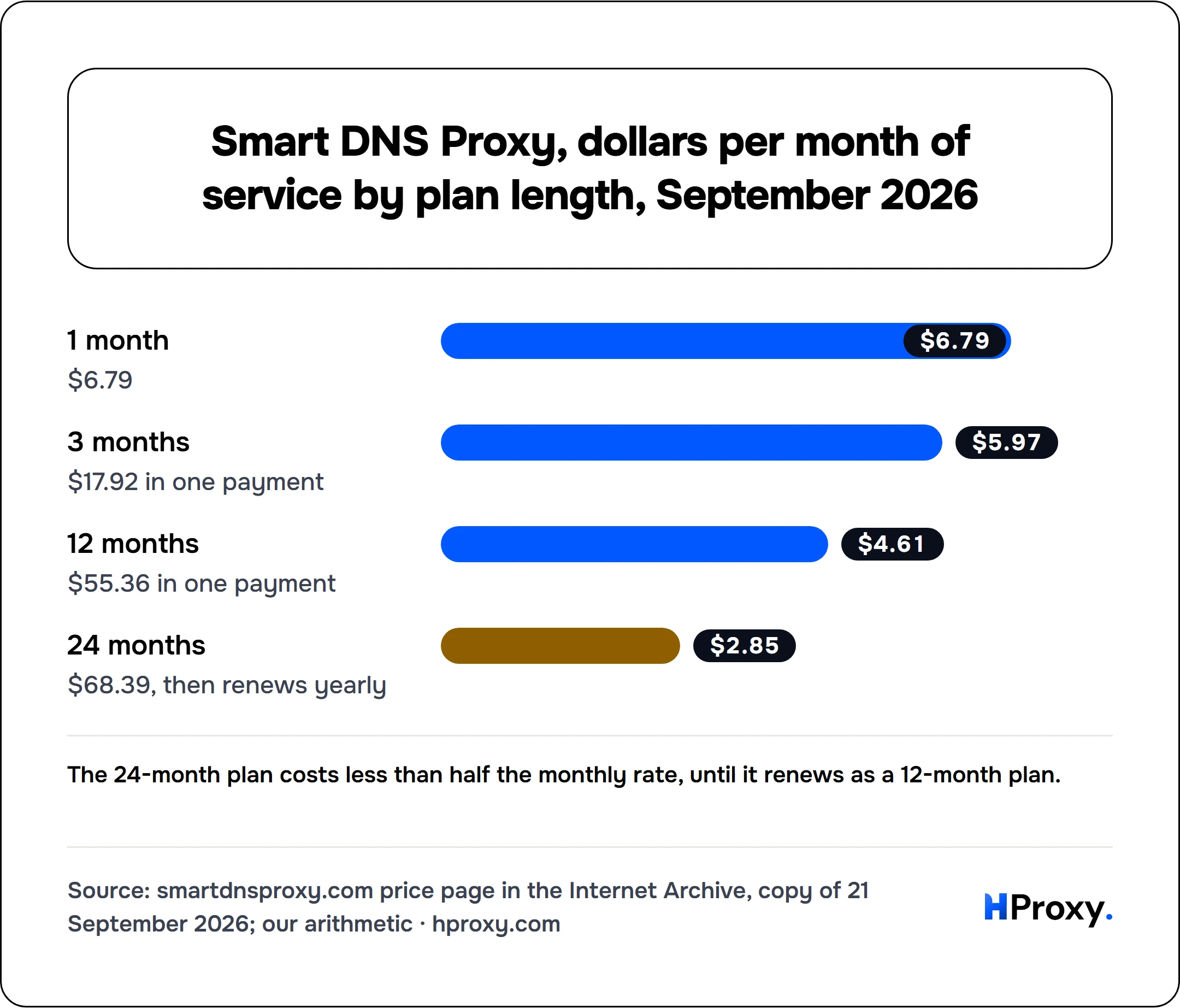
| plan | January 2025 | September 2026 |
|---|---|---|
| 1 month | $5.90 | $6.79 |
| 3 months | $15.58 | $17.92 |
| 12 months | $48.14 | $55.36 |
| 24 months | $59.47 | $68.39 |
| lifetime | $200.00 | $200.00 |
Each fixed-term price rose by the same 15% between the archive's copies of 8 January and 24 February 2025, and the discount labels beside them stayed the same, from "12% Discount" to "92% Discount". The lifetime plan is the exception: its $200 has not moved since at least January 2024, and it now costs as much as 29 and a half months of the monthly plan.
The fine print
Free days, then automatic renewal. The price page offers "14 days FREE!" with "No Credit Card Needed!", and says "30-day money back guarantee is provided per our terms of use." Every plan renews "at the end of each billing cycle for the same plan at the same price, unless a price increase has occurred", and cancelling before the renewal date is the buyer's job.
Refunds have a 30-day window. New customers may request a full refund within 30 calendar days of their first payment. Monthly and quarterly plans give "No refunds" for unused time.
Long plans come back shorter. The 24- and 36-month plans "automatically renew as 12-month subscriptions", and "No refunds will be issued once the renewal has occurred".
Logs. The terms say the site does not "maintain direct logs of any customer's Internet activities", and keep the right to investigate matters it considers illegal.
Other Smart DNS and VPN services
| service | what it sells | trial and refund |
|---|---|---|
| Unlocator | Smart DNS alone, or VPN with Smart DNS | 7-day free trial on some plans; 30-day money back on all |
| Control D | DNS service: free servers and paid plans | 14-day free trial, no card; businesses from $2 per device a month |
| HProxy | proxies for browsers, scripts and apps | pay as you go; our Netflix guide covers streaming |
Unlocator sells the same two products in one account. Its Smart DNS is pitched for "TVs, consoles, and more", with "no apps, no speed loss", and its price page lists a "7-Day Free Trial" beside some of its plans. The bundle adds a VPN, and the page advises: "For privacy protection select the VPN package." Its home page promises a "30-day money back guarantee on all plans". Its prices are drawn by script, so we could not read them.
Control D starts from the other end, as a DNS service that filters ads and malware. Its free DNS service "doesn't need an app", and its paid plans come with a 14-day free trial and "No credit card required". For businesses it lists a self-serve plan at "$2 / endpoint / month".
Where HProxy fits
Smart DNS is aimed at devices where you change the DNS server, which is why Smart DNS Proxy's guides centre on TVs and streaming sticks. We sell proxies, for a browser, a script or an app that takes proxy settings. Residential traffic from us costs $0.50 per GB with no plan and no renewal date, and our guide to proxies for Netflix explains what loads and what gets blocked. For how the three tools differ in general, see proxy, VPN or Tor.
Which one to pick
- Smart DNS Proxy if you stream on a TV or console and want a lifetime plan: $200 once.
- Unlocator if you want Smart DNS and a VPN in one account, with a 30-day money-back promise on every plan.
- Control D if you want a DNS service that also blocks ads and malware, free to start.
- A proxy if the device is a browser or an app with proxy settings.
What we could not find out
Smart DNS Proxy's own pages answered our server with empty pages on 14 October 2026, so its prices, terms and about page come from Internet Archive copies of 21 September 2026. We did not search Canadian or US registers for C Telekom, Inc. or Global Stealth, Inc., and we found no record behind its "since 1995" and Fortune 500 claims. Unlocator's and Control D's personal prices are drawn by script, so we give their trials and refund terms only. We tested none of the services. We plan to check again by 14 January 2027.
Sources
- smartdnsproxy.com in the Internet Archive: price pages of January 2024 to September 2026, about page, terms of use and privacy policy of 21 September 2026; its sitemap and status page, read from our server on 14 October 2026.
- Verisign's registry record of smartdnsproxy.com, 14 October 2026.
- Unlocator's home and price pages, and Control D's price and free DNS pages, read from our server on 14 October 2026.
- Our own price, from HProxy's live price table.