Comparison

ProxLux alternatives: what to check before you switch

Comparing a ProxLux alternative? The published numbers, the questions their pricing page leaves open, and a ten minute test that beats every review.

HProxy Team··3 min read
HProxy.Comparison

Free proxies won't hold up here.

Shared datacenter IPs get flagged and dropped fast. When it has to hold, gaming, streaming, accounts, you need mobile and residential IPs that read as a real device, from $0.44/GB, pay as you go.

Residential proxies

This page exists because the search you ran has almost no honest results. Nearly every page ranking for "ProxLux alternative" earns a commission on the answer it gives you. We earn money if you pick us, which we are stating in the first paragraph rather than the footer.

The record we hold

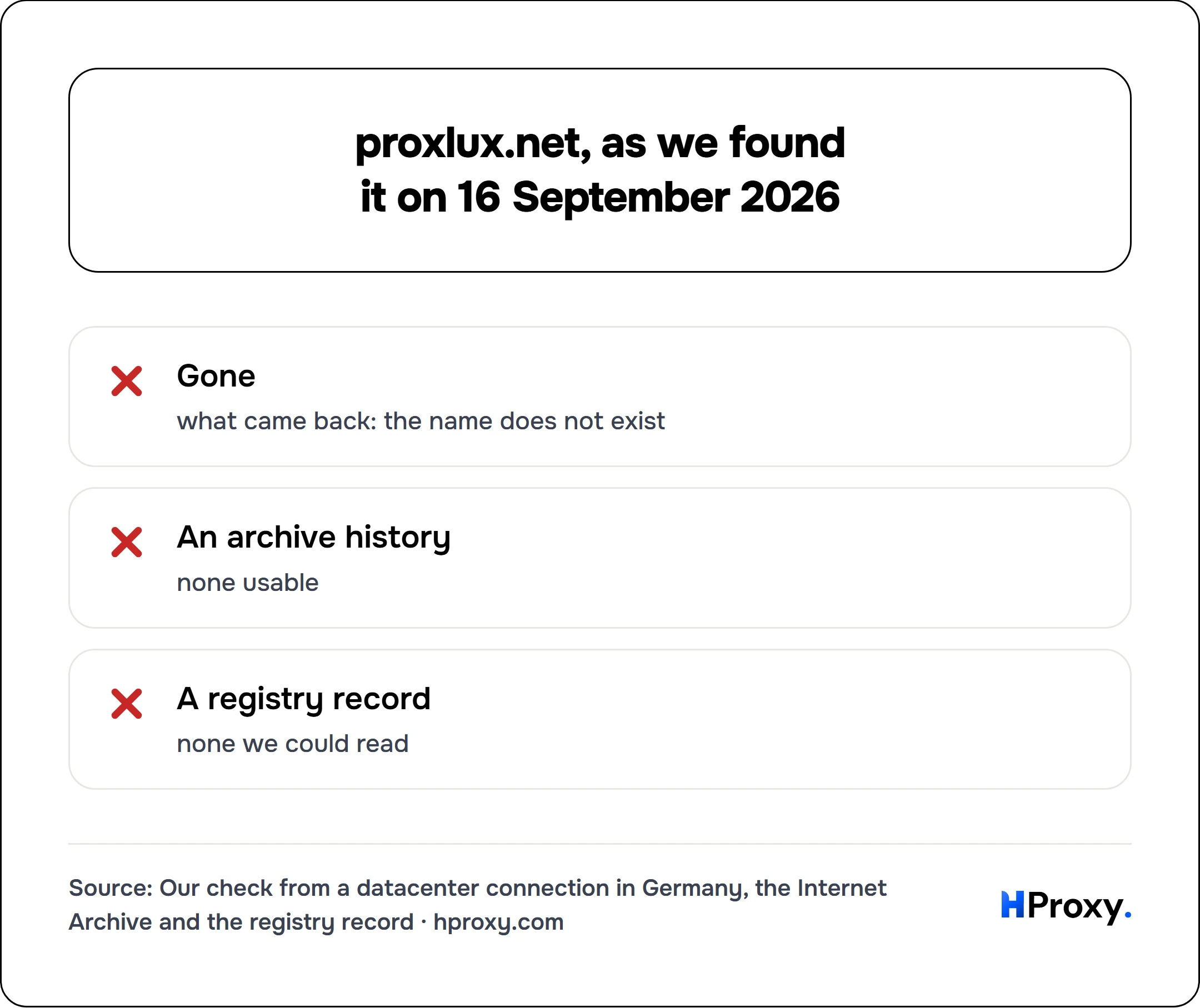
The domain is proxlux.net.

A price is missing here on purpose. We have not captured a sourced rate for ProxLux recently enough to publish one, and a stale number in this market is a wrong number.

Look for the tier you would actually land in, not the one at the bottom of the table, and find the expiry and failed-request clauses before the rate impresses you.

What the advertised numbers cannot tell you

A pool total is not a promise

Nobody audits pool totals in this market, and the counting rules differ between vendors. Even an accurate figure describes addresses that exist, not addresses you will be routed through. Treat it as a marketing unit rather than a capability.

Money you paid for and did not spend

This single term separates cheap providers from providers that look cheap. If a plan resets at month end, your effective rate is the plan price divided by what you actually used. Ours does not expire, which is easy to say and easy to verify in the terms.

The rate behind the sales call

A commitment converts a variable cost into a fixed one. That is a good trade at steady volume and a poor one otherwise, and the decision belongs to you rather than to whichever tier looks cheapest per unit.

What separates them, in a table

The rows below are the ones that change what you pay and whether the job runs:

Question to askProxLuxHProxy
Entry priceNot verified by us, read their pageFrom $0.44/GB, pay as you go
Does unused balance expire?Check the current terms, this one movesNever
Minimum commitmentNot published clearly, ask before payingNone
Identity checksOn their own terms pageCard orders are screened, and verification is sometimes requested
TargetingNot published clearly, ask before payingCountry, city and ISP
Free way to evaluateOn their own terms pageFree proxy list and proxy checker

Blanks in that table are deliberate. We print what we read and date it, and leave the rest empty rather than repeating something we cannot stand behind.

How to settle it yourself in ten minutes

Run this before you commit any volume. It replaces every opinion on this page, including ours.

  1. Buy the minimum each side offers. Prefer a small paid batch over a trial, because trial traffic does not always ride the same pool.
  2. Send an identical workload through each: same target, same tooling, same time of day, same request mix.
  3. Measure what came back correctly and what it consumed, then divide the spend by the successes.
  4. Push a sample of exit addresses through an independent checker and confirm the country and connection type are what was advertised.
  5. Take the winner and set a reminder to run this again, since a result has a shelf life of about a quarter.

Others in this market

Nearest alternatives by product shape rather than by who pays us, since nobody does:

The competing offer, for completeness

We are the pay as you go option in this market. Residential from $0.44 per GB, ISP and datacenter per address, mobile alongside them, all from one balance with nothing to forfeit. That model wins on irregular volume and loses on very large steady volume, which is worth knowing before you test.

Frequently asked questions

How do I compare two providers fairly?
Match the units first, because residential is billed per gigabyte, datacenter and ISP per address, and mobile per day or per port. Then compare the rate you can actually reach today rather than the volume tier behind a commitment. Finish by measuring the success rate on your own target, since a cheap request that fails costs more than a dearer one that works.
How is HProxy different?
The models differ more than the products do. HProxy is pay as you go from a balance you top up when you want, the balance does not expire, there is no subscription unless the optional discount suits you, and residential starts at $0.44 per GB with city and ISP targeting included. Whether that beats a tiered plan depends on your usage pattern, which a short test settles.
Do I have to talk to sales or sign a contract to switch?
Not with us. You can sign up, add funds and send traffic without a call, a minimum or a subscription. Whether another provider requires any of those is on their own pricing page and is worth reading, because a required commitment is part of the price even when it is not part of the rate.
How often should I re-test a provider?
Quarterly is a reasonable rhythm for most workloads, and immediately after a noticeable drop in success rate. Pools are rebuilt, suppliers change and detection improves, so a benchmark from last year describes a network that no longer exists.
Does a bigger pool mean better results?
No. Your job meets only the exits it draws, in the countries it needs, against one target's defences. Freshness and rotation policy move the outcome far more than the headline total, and pool totals across this market are counted generously and rarely audited.

Proxies that don't die mid-job

Residential, ISP, datacenter and mobile, verified by the same engine that runs tens of millions of checks. They read as a real device and hold up under load. Pay as you go, and your balance never expires. $0.44/GB is the 2,000 GB+ rate; a single gigabyte is $0.50/GB, with no minimum order.

129M+ proxy checks run · 100+ countries · HTTP / HTTPS / SOCKS · re-checked every few minutes · no signup