Proxies for WhatsApp route your connection through a different IP, so WhatsApp sees that address instead of your real one. For account work that swap matters most when you are running many numbers at once, warming new ones, or keeping a business presence on several lines, because WhatsApp links accounts that share a connection just like every other platform. But WhatsApp has one rule that changes every answer here: your identity on it is a phone number first and an IP second, so the proxy is one layer of two, and the smaller one.
We build the network these accounts run on, so we see both sides: the numbers people keep alive for years, and the batches that get banned over a weekend. If you are reading this because WhatsApp is blocked on your network and you just want it working again, that is a different job with a different tool, and we wrote it up in free WhatsApp proxy. This piece is about account work: running multiple numbers, business messaging, and why a clean IP cannot save a bad number. WhatsApp is close kin to Telegram here, where the same phone-number-first logic applies, so proxies for Telegram is worth a read alongside this. No provider can sell you unbannable WhatsApp accounts, and we will not pretend otherwise.
Why the phone number comes before the IP
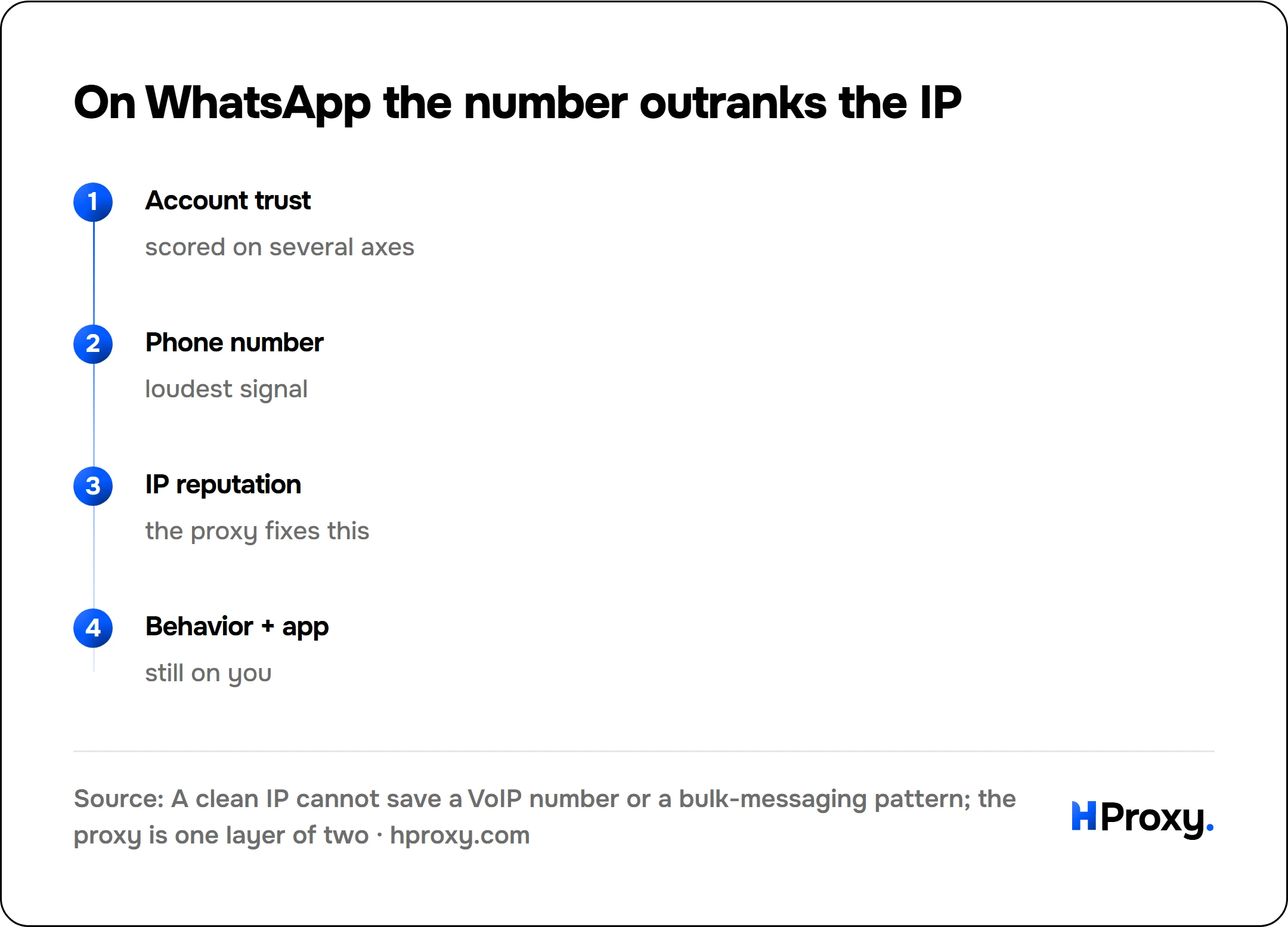
Before you pick a proxy, understand what WhatsApp actually reads, because the order is what makes this platform different.
Phone number, first
Every WhatsApp account is a phone number, and it is the loudest signal by far. Cheap VoIP (Voice over IP) and virtual numbers are the number one ban vector: WhatsApp distrusts known virtual-number ranges and fast-bans accounts built on burned number pools. A clean IP on a bad number still dies, and no proxy changes that.
Behavior, second
WhatsApp bans numbers for how they act. Bulk or automated messaging, sending the same message to people who have not saved your number, and drawing a high volume of blocks and spam reports from recipients are the classic triggers. This is a behavior signal, not a network one, so a perfect IP does nothing to soften it.
The app you use
WhatsApp treats unofficial modified clients (the GB WhatsApp and WhatsApp Plus family) as a violation on their own, and in its own words your messages "are only secure and private when using the official WhatsApp" (WhatsApp). Running accounts through a clone is a ban risk regardless of how clean the IP behind it is.
IP reputation, then
At registration and at each new login, datacenter and known-VPN ranges start with low trust, and a wave of signups from one datacenter address clusters those accounts into an obvious group. A residential or mobile IP walks the same flow with far less friction. This is the one axis a proxy actually fixes.
Device and session
WhatsApp ties a number to a primary phone and its linked devices, and records the sessions. An account that suddenly connects from a new country reads as a possible takeover and can trigger a security step. Consistency keeps it quiet.
Account trust
scored on several axes
Phone number
loudest signal
IP reputation
the proxy fixes this
Behavior + app
still on you
Why people use proxies for WhatsApp
With that order in mind, here is where a proxy earns its place in account work.
- Running multiple numbers. Marketing teams, resellers, one-time-password and number services, and businesses on several lines all run more than one account. WhatsApp clusters accounts that share an IP and a device, so many numbers on one home connection is the fast way to get the whole set flagged together.
- Registering and warming new numbers. A new number registered from an IP whose country does not match the number looks wrong on arrival. A +44 UK number coming online from a mismatched datacenter IP is a contradiction, and a country-matched residential or mobile IP is what makes a fresh number's first appearance look normal.
- Business messaging at scale. The compliant way to message many people is the official WhatsApp Business Platform, covered below. Proxies do not replace it, but businesses running the surrounding tooling still isolate accounts by IP so their lines are not all traced to one address.
- Privacy. Keeping your real home IP, and the rough location it exposes, off the record when you connect.
For reaching WhatsApp on a network that blocks it, none of the above applies, and a free proxy is genuinely fine. That is the job free WhatsApp proxy covers in full.
Which proxy type fits WhatsApp
Four types matter here, and they are not interchangeable. Mobile is the standout, residential is the sensible default, ISP is the stability play, and datacenter splits into two very different jobs.
| Proxy type | How WhatsApp treats it | Best for | Cost |
|---|---|---|---|
| Mobile (4G/5G) | Carrier IP, exactly what a mobile-first app expects, hardest to ban | Registering and warming numbers, high-value accounts | Highest |
| Residential | Reads as a real home user, high trust | Creating and running multiple numbers | Mid ($0.44/GB here) |
| ISP / static residential | Residential reputation on stable hardware, holds one address | A long-lived single number that needs a fixed session | Mid to high |
| Datacenter | Flagged for human accounts, but normal for the official Business Platform | The Business Platform (API) backend, reaching WhatsApp when blocked | Low |
| Free proxies | Almost all datacenter, mostly dead | Reachability testing only | Free |
Mobile proxies are IPs from 4G and 5G carriers, and they are the strongest fit for WhatsApp, which is mobile-first by design. A carrier IP is exactly what its servers expect to see. Carriers also put thousands of real subscribers behind each public address through Carrier-Grade NAT (CGNAT), so WhatsApp cannot hard-ban a mobile IP without hitting genuine users, and two or three numbers sharing one reads like a household rather than a farm. Our explainer on what a mobile proxy is covers how carrier IPs are sourced. Mobile is the priciest tier.
Residential proxies are IPs from real home connections, so you look like an ordinary person at home. That is the solid all-round choice for creating and running numbers where mobile is more than you need.
ISP proxies are static residential IPs on fast hardware, holding one residential-looking address for a long time. That makes them the cleanest home for a single long-lived number that logs in from a fixed session every day.
Datacenter is the split case, exactly as it is on Telegram. For human accounts it is flagged at registration and login, so it is the wrong tool. For the official WhatsApp Business Platform (the API businesses use to message at scale), running on a server is completely normal, because Meta expects that traffic to come from business infrastructure. Datacenter is fine for the Business Platform backend and for punching through a network block, wrong for creating human accounts.
Multiple numbers and business messaging
Two things people conflate are worth separating, because they need different setups.
Multiple personal accounts
WhatsApp officially supports two accounts on one phone, but each needs its own phone number and a second SIM or an eSIM, and you add the second under Settings by tapping the arrow next to your name and choosing Add account (WhatsApp). That covers a work and a personal line. Beyond two, or when you are running numbers at volume, the real setup is separate devices or Android emulators, each isolated with its own number and its own proxy, so WhatsApp cannot link them by a shared address.
Business messaging at scale
This is a different product. The free WhatsApp Business app suits a small business on one number. To message many people compliantly, the official path is the WhatsApp Business Platform (the API), where, since the November 2024 messaging-policy update, you must have opt-in permission before messaging someone and send pre-approved message templates (Meta for Developers). That is the sanctioned way to send at volume, and it runs on your server's IP. Trying to fake the same scale through a pile of personal numbers and modified apps is the exact behavior WhatsApp bans, and no proxy changes that math.
Sizing the pool, sticky or rotating
For account work the rule is short: one clean, sticky IP per warmed number, matched to the number's country. WhatsApp clusters accounts by IP, so putting many numbers on one address is how a single restriction cascades into a wipe.
One clean, sticky IP per warmed WhatsApp number:
  number A  ->  198.51.100.20   mobile, UK,       held   (+44, registered from a UK IP)
  number B  ->  198.51.100.21   mobile, UK,       held
  number C  ->  198.51.100.22   residential, DE,  held   (+49, matched to Germany)

Each number's IP country matches the number's country.
Restrict one and the rest stay clean.
Two nuances sit on top. Mobile IPs tolerate a small handful of numbers better than datacenter, because CGNAT genuinely puts many real people behind one carrier address, so two or three numbers on one mobile IP looks natural. Do not stretch it further. And sticky versus rotating flips with the task, the same way it does on Telegram: rotate a fresh IP per new registration so no two signups share a network, then pin the IP and leave it, because a warmed number wants the same address every login. If you remember one line, remember rotate to make them, stick to keep them.
How to set up a proxy with WhatsApp
One thing to clear up first: WhatsApp's built-in Proxy field is not a general proxy slot. It expects a host running WhatsApp's own proxy software and is meant for reaching WhatsApp when it is blocked, not for giving each account its own clean IP. That field, and where to find hosts for it, is covered in free WhatsApp proxy. For account isolation you set the proxy somewhere else.
- Per device or emulator. Set the proxy at the phone's or emulator's network level (a per-app or Wi-Fi proxy), so everything that number's environment sends exits through its own IP. This is the closest to what WhatsApp expects and the usual setup for a phone or emulator farm.
- Match the IP country to the number. A +49 German number should come online and log in from a German IP, not a mismatch that reads as a mask.
- One number per isolated environment. Give each number its own device or emulator profile and its own sticky exit, so a clean IP is not undone by a shared environment that links your numbers anyway.
- Verify before you register. Confirm the IP is alive and resolves to the right country before you build a number on it. Our free proxy checker shows the real exit location, and a recycled IP another operator already burned is dead on arrival.
- For the Business Platform, route the API through your server's own IP, which Meta expects, and keep the sends compliant with opt-in and approved templates rather than leaning on a proxy to hide volume.
How to keep WhatsApp accounts unbanned
The IP is one layer. These are the rules that actually change outcomes on WhatsApp, and most of them sit above the network:
- Start with a good phone number. This is the biggest lever on the platform. A cheap VoIP number gets the account banned no matter how clean the IP, and a proxy cannot save it.
- Do not bulk-message from personal numbers. Sending the same message to people who never saved your number, or blasting at volume, is the fastest behavior ban there is. Message at scale only through the official Business Platform with opt-in.
- Use the official app. Modified clones are a violation on their own. Run accounts through official WhatsApp, not GB WhatsApp or WhatsApp Plus.
- One sticky IP per warmed number, matched to its country. A +7 number surfacing from a US IP an hour later looks wrong.
- Warm new numbers. A number that mass-adds contacts or messages strangers on day one triggers the spam system fast. Let it behave like a person first.
- Never reuse a banned number's IP or number for a clean one. A burned identity is dead on arrival.
One input, not the whole machine
A proxy fixes your network identity and nothing else. It makes each number look like it comes from a separate, legitimate connection, which is real value when you are running many at once, but on WhatsApp the phone number sits above the IP, and the proxy does nothing about a burned number, bulk-messaging behavior, a modified app, or the blocks and reports from people you message. Anyone selling proxies as an unbannable guarantee is selling a story.
If you only need to reach WhatsApp on a blocked network, that is the free job, and free WhatsApp proxy walks through it. If you are creating numbers, warming them, or running many lines, free datacenter IPs will cost you accounts, and clean mobile or residential is the right tool. Ours is pay-as-you-go residential at $0.44/GB with a balance that does not expire, with mobile for the numbers you register and warm and cannot afford to lose. Give each number a good phone number and its own clean, country-matched IP, message only the way WhatsApp allows, and it will last.
Sources
- WhatsApp, multiple accounts on one phone (each account needs its own number and a second SIM or eSIM, and a warning to use only the official app): https://blog.whatsapp.com/multiple-accounts-coming-to-whatsapp
- Meta for Developers, get opt-in for WhatsApp (the Business Platform requires opt-in permission and pre-approved templates to message at scale): https://developers.facebook.com/documentation/business-messaging/whatsapp/getting-opt-in