Nothing here is a hit piece. PowerNet has customers who are well served by it, and this page says which ones. It also says where we think the model costs a buyer money.
The record we hold
The domain is powernet.vn. They are filed here as a datacenter proxy provider.
PowerNet is not in our priced record, so nothing about their rate appears below. That gap is stated rather than filled, which is the only honest option available.
Their pricing page will answer three of the four questions that matter. Send an email for the fourth, which is usually whether blocked requests are billed, and keep the reply.
How PowerNet presents itself
As of 9 September 2026 the tab reads "Dịch vụ Hosting, Máy chủ, Cloud Server, VPS, Email, Tên miền, Proxy tại Đà Nẵng". Written for search engines, their description says: "PowerNet cung cấp dịch vụ Hosting, Máy chủ, Cloud Server, VPS, Cloud VPS, Máy chủ ảo, Email Doanh nghiệp, Tên miền, Proxy, Giải pháp mạng uy tín hàng đầu Miền Trung"
Also on the page, stated plainly:
Support is advertised as around the clock. We found no separate pricing page linked from the homepage, which usually means the price arrives by quotation.
That is the vendor speaking, not us. We print it because a claim with a date attached is at least falsifiable.
What the timestamps show
Our crawl of their site found 1,455 pages carrying a date. The oldest is from August 2026 and the newest from August 2026. 1,455 of them carry a date inside the last twelve months.
An actively maintained site is table stakes rather than a recommendation. It does rule out the failure that costs buyers the most here, which is prepaying a company that has quietly stopped.
The demand around this name
The Keyword Planner puts brand demand at 20 a month: 20 a month for a review of them. Figures read from Google Keyword Planner on 9 September 2026.
Weighted towards people checking whether to trust it. A comparison that ignores that and opens with a pitch has misread the room.
The parts no marketing page answers
Who else is using your address
An address you share carries the reputation of everyone else on it. That is acceptable for some work and fatal for anything involving a login. The price difference between shared and dedicated usually reflects exactly this.
The line item hidden in the success rate
Divide the spend by the successful responses, not by the requests sent. That single change reorders most price comparisons in this market, and your accounting will use it eventually anyway.
What actually caps your throughput
A plan with generous traffic and a low thread limit is a slow plan. Find both numbers before you size anything, because the smaller of the two is your actual ceiling.
Side by side, with the blanks left blank
The rows below are the ones that change what you pay and whether the job runs:
| Question to ask | PowerNet | HProxy |
|---|---|---|
| Entry price | Not verified by us, read their page | From $0.44/GB, pay as you go |
| Does unused balance expire? | On their own terms page | Never |
| Minimum commitment | Read their current terms | None |
| Identity checks | Worth confirming in writing before you commit | Card orders are screened, and verification is sometimes requested |
| Targeting | Read their current terms | Country, city and ISP |
| Free way to evaluate | Worth confirming in writing before you commit | Free proxy list and proxy checker |
That comparison covers what is publishable. What is not publishable, and what actually decides this, is how many of your requests come back correct.
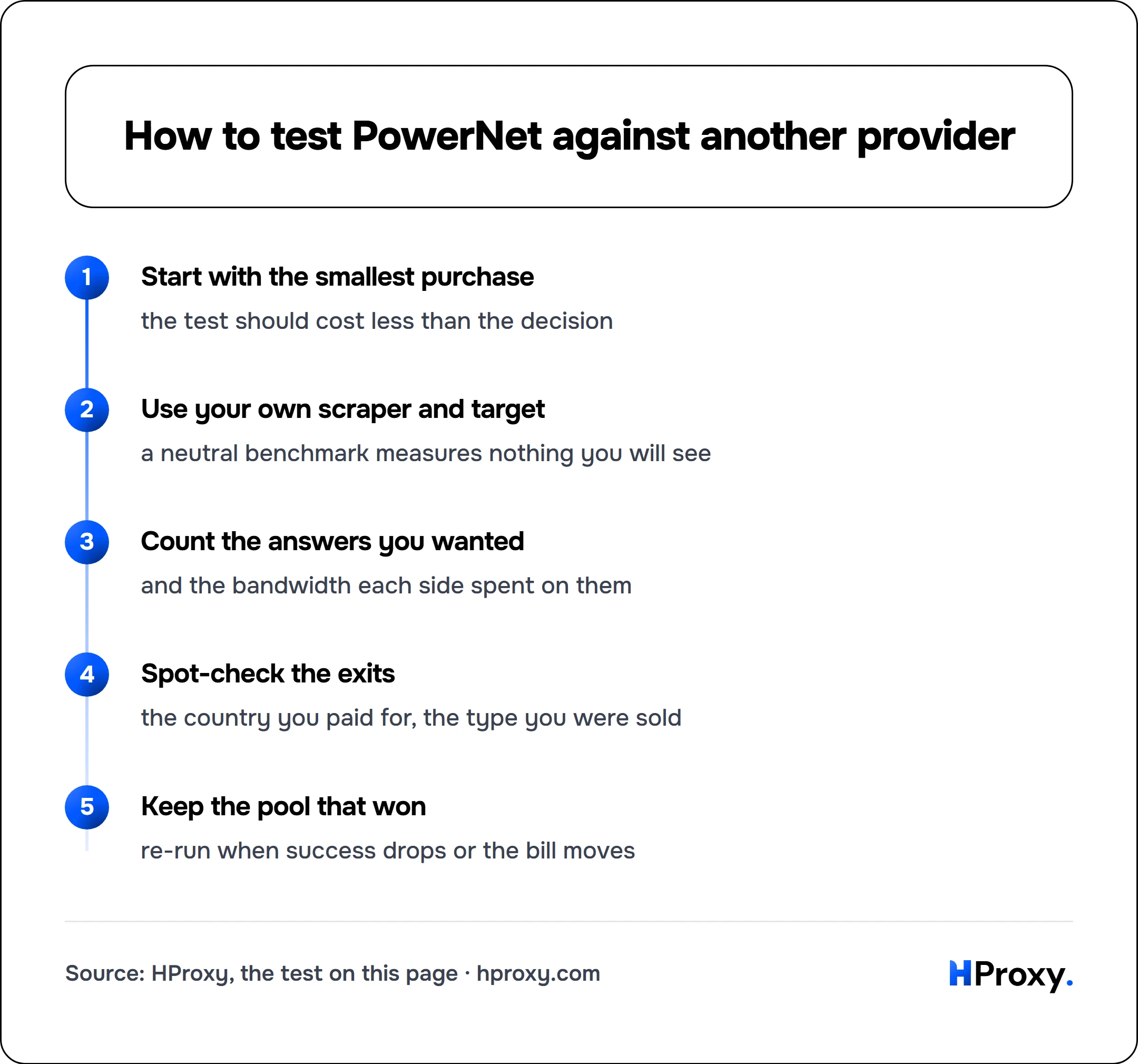
How to settle it yourself in ten minutes
Run this before you commit any volume. It replaces every opinion on this page, including ours.
- Start with the smallest purchase each vendor allows, so the test costs less than the decision it replaces.
- Use your own scraper and your own target. A benchmark against a neutral site measures nothing you will experience.
- Count how many requests returned what you wanted, and how much bandwidth each side spent doing it.
- Spot-check the exits. Confirm they are in the country you paid for and the connection type you were sold.
- Keep whichever pool won on your job. Re-run this whenever success rate drops or the bill moves.
Start with the smallest purchase
the test should cost less than the decision
Use your own scraper and target
a neutral benchmark measures nothing you will see
Count the answers you wanted
and the bandwidth each side spent on them
Spot-check the exits
the country you paid for, the type you were sold
Keep the pool that won
re-run when success drops or the bill moves
The other names that come up
Other providers in the same bracket, priced and dated the same way:
- Bestproxyandvpn alternatives
- Cyber Gateway alternatives
- Dcproxy alternatives
- Proxy007 alternatives
- 5Socks alternatives
- 711Proxy alternatives
Our side of it
What we offer is one account holding residential, ISP, mobile and datacenter, priced from $0.44 per GB on residential, with no tier to climb and no allocation to lose at month end. Whether that suits you depends on how steady your volume is.