
If you are comparing OnlineProxy against anything else, the first thing to fix is units. A per-gigabyte rate against a per-address rate is not a comparison, and half the mobile proxy provider market prices in a different unit to the other half.
Everything we can stand behind
Their site is onlineproxy.io. Category, as we track it: mobile proxy provider.
We have no verified current rate for OnlineProxy on file. Printing a guess would make this page worse than useless, so the price row below is empty and the reading list is not.
Find the rate available with no commitment, then find the cheapest rate and what it costs to reach. The distance between those two tells you what kind of vendor you are dealing with.
The site, as it reads today
On 9 September 2026 the site introduced itself as "Buy Mobile Proxies: Unlimited 5G/4G/LTE Rotating IPs, OnlineProxy". The one-paragraph pitch on their own page: "Get high-speed 5G/4G/3G/LTE rotating mobile proxies. The most cost-effective solution with unlimited data and no hidden fees. Secure & reliable by OnlineProxy. Try now!"
What else that page states, without interpretation:
The product lines named on that page are residential, datacenter, mobile and SOCKS5. They advertise 40 countries or locations. Payment methods mentioned: crypto. The page offers some form of free trial. Support is advertised as around the clock.
Every line above is a quotation from their marketing rather than a measurement by us. It is included because it is checkable, not because it is evidence of performance.
Age, and why it matters here
The domain was registered on 11 December 2021, through TLD Registrar Solutions Ltd, which makes it about 4 years old. We pulled that from the registry on 23 April 2026. The Internet Archive holds 20 snapshots of the site, the earliest from April 2023. The current registration term ends 11 December 2026.
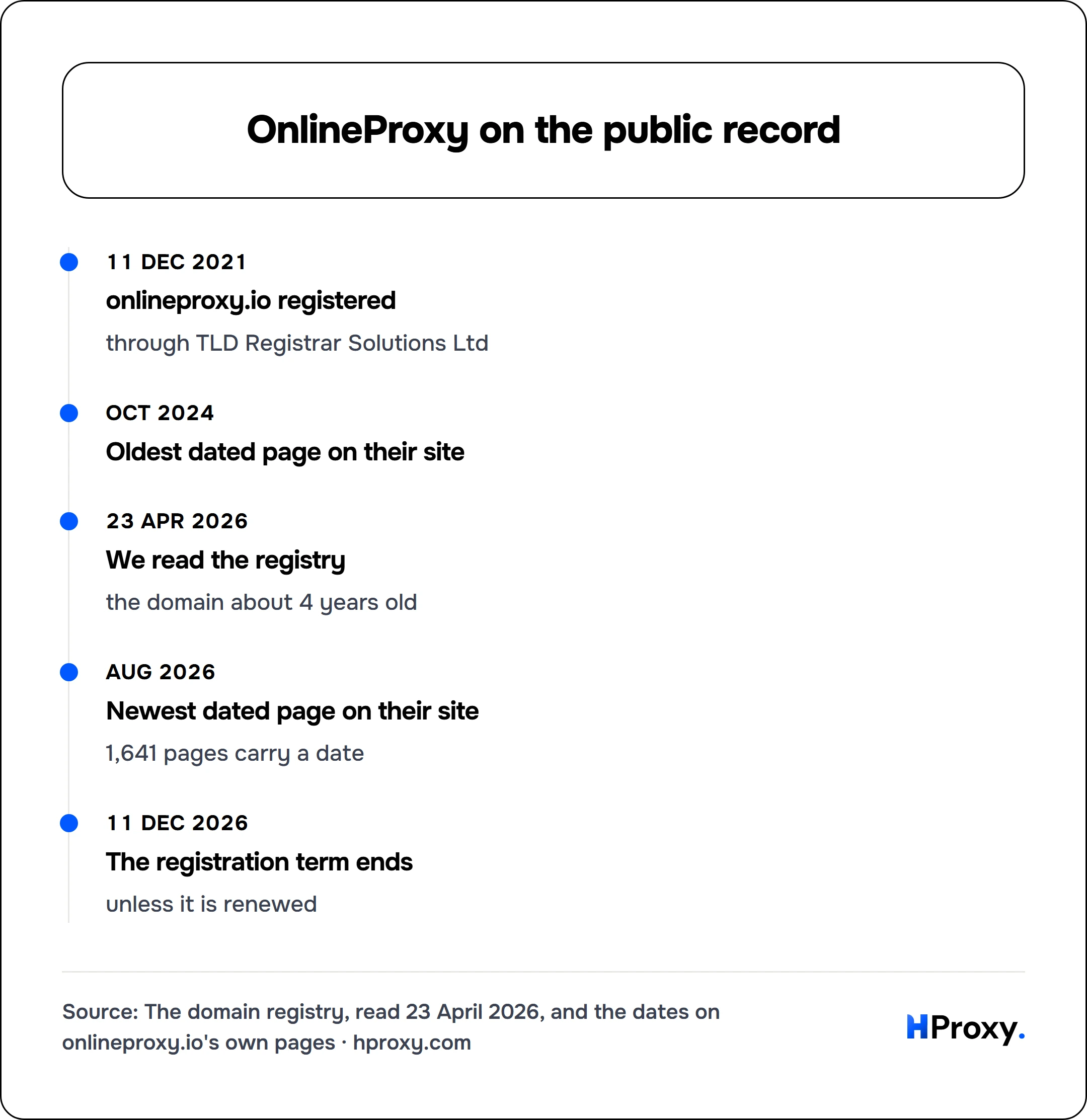
11 Dec 2021
onlineproxy.io registered
through TLD Registrar Solutions Ltd
Oct 2024
Oldest dated page on their site
23 Apr 2026
We read the registry
the domain about 4 years old
Aug 2026
Newest dated page on their site
1,641 pages carry a date
11 Dec 2026
The registration term ends
unless it is renewed
None of it predicts success rate. It is here because domain age and archive depth are free to check, and a provider whose public record starts last quarter deserves a smaller first order.
Their published surface
A crawl of 1.712 pages on 19 June 2026 returned 724 blog pages.
Site size is a signal about marketing budget rather than network quality, and the two are frequently unrelated. It is useful for a different reason: a provider with many pricing pages is usually segmenting hard, and a provider with none is selling by quotation.
Whether anyone is still working on it
Our crawl of their site found 1,641 pages carrying a date, 716 of them articles. The oldest is from October 2024 and the newest from August 2026. 927 of them carry a date inside the last twelve months.
Timestamps are not quality, and a company still publishing is at least a company still trading. That is worth more than it sounds in a market where providers disappear without notice.
What you still do not know after reading their site
The entry price is not the effective price
Rates in this market are quoted from the bottom of the table. The relevant question is which row you land on at your volume, and whether reaching a cheaper row costs more in commitment than it saves per unit.
What happens at the end of the month
This single term separates cheap providers from providers that look cheap. If a plan resets at month end, your effective rate is the plan price divided by what you actually used. Ours does not expire, which is easy to say and easy to verify in the terms.
What the lowest rate actually costs
Treat a required call with a salesperson as a cost. It delays the work, it usually arrives with an annual term attached, and it exists because the published price is negotiable in one direction only.
The two of us, on the questions that matter
Here are the comparisons that survive contact with a real workload:
| Question to ask | OnlineProxy | HProxy |
|---|---|---|
| Entry price | Not verified by us, read their page | From $0.44/GB, pay as you go |
| Does unused balance expire? | Their terms page answers this | Never |
| Minimum commitment | Worth confirming in writing before you commit | None |
| Identity checks | Read their current terms | Card orders are screened, and verification is sometimes requested |
| Targeting | Worth confirming in writing before you commit | Country, city and ISP |
| Free way to evaluate | Read their current terms | Free proxy list and proxy checker |
A table like this can rank the things that are written down. It cannot rank the thing that matters most, which is how the network behaves against the site you care about.
The test that beats this page
It is a small amount of money for an answer that is actually about your target.
- Fund both accounts with the least money each will accept, and note what that minimum was, because it is part of the comparison.
- Aim both at the page that matters to you rather than a test endpoint, and keep every other variable fixed.
- Record the success rate and the data consumed for the identical batch on each side.
- Check some of the addresses yourself for country, ASN and type before you trust the label on the plan.
- Keep the winner, and repeat the whole thing quarterly, because pools age.
Comparable providers
We hold the same record for these, and the same honest limits apply to each:
- Obitel Proxy alternatives
- Proxidize alternatives
- Proxybrazil alternatives
- Proxybrothers alternatives
- Proxygo alternatives
- Proxygram alternatives
Where we fit
For completeness: residential from $0.44 per GB with country targeting, city and ISP targeting on Residential Premium from $1.00 per GB, no monthly minimum, and a balance that stays where you left it. We are a good fit for uneven workloads and a poor one for anybody who wants a signed enterprise agreement.