A comparison written by a competitor is worth reading only if it says where the competitor loses. That rule shapes this page about Obitel Proxy, and the last section names the reader who should stay put.
Obitel Proxy on the record
Obitel Proxy operates from obitel-proxy.com. Our classification for them is mobile proxy provider.
What we do not hold is a current, sourced price for Obitel Proxy. Rather than print a figure we cannot stand behind, this page leaves it out and tells you what to look for when you read their page yourself.
Read their page for the reachable rate rather than the headline, the minimum spend, the expiry clause and the billing treatment of blocked requests. Write down the date, because all four move.
What is on their front page
As of 9 September 2026 the tab reads "403 Forbidden - Apache".
What else that page states, without interpretation:
We found no separate pricing page linked from the homepage, which usually means the price arrives by quotation.
Nothing there has been tested. It is a record of what the page said on the day, which is the honest limit of what a page like this can offer without a measurement.
Longevity, on the public record
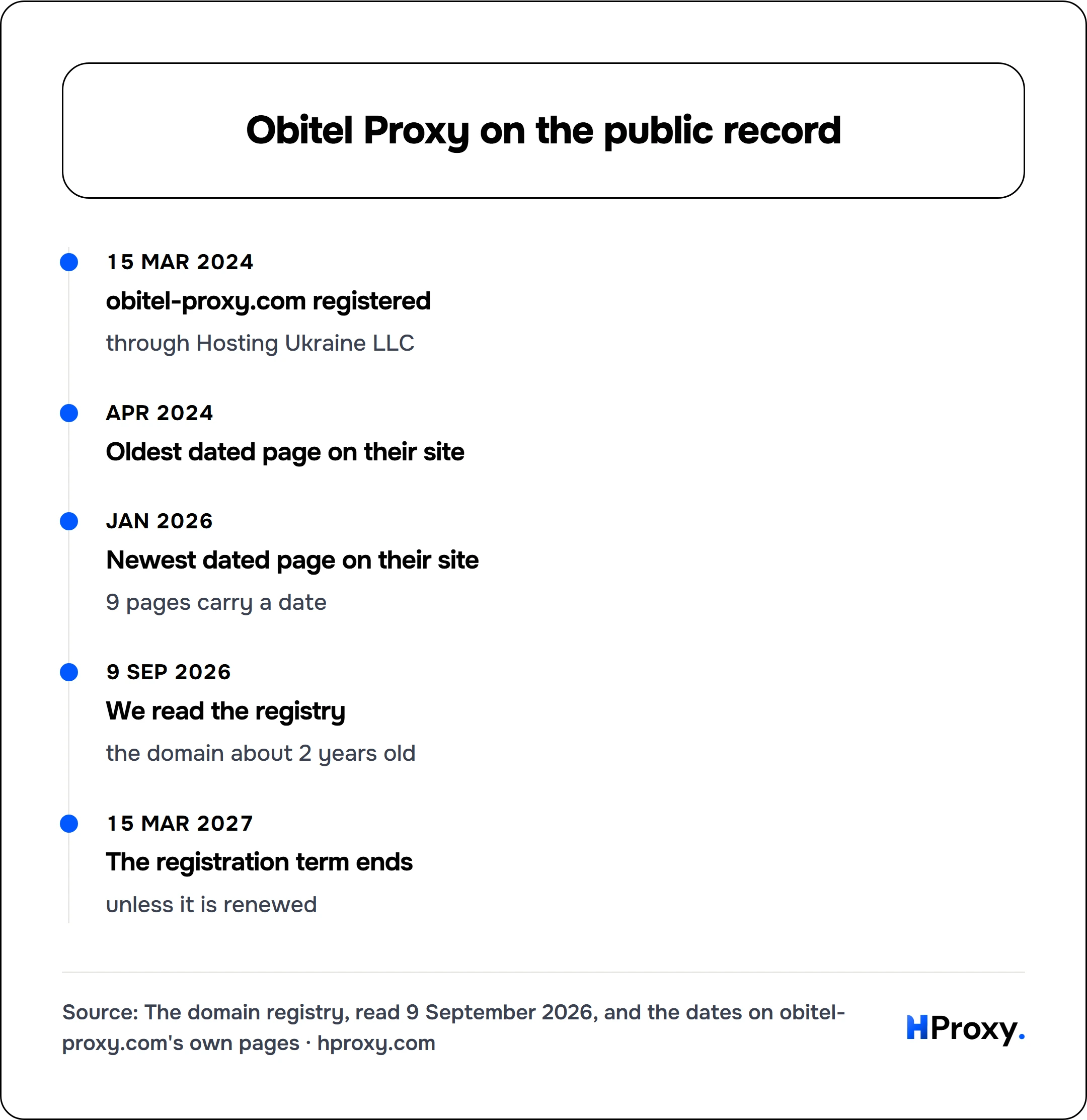
The domain was registered on 15 March 2024, through Hosting Ukraine LLC, which makes it about 2 years old. Those dates come from a registry query on 9 September 2026. Their registration is booked through 15 March 2027.
15 Mar 2024
obitel-proxy.com registered
through Hosting Ukraine LLC
Apr 2024
Oldest dated page on their site
Jan 2026
Newest dated page on their site
9 pages carry a date
9 Sep 2026
We read the registry
the domain about 2 years old
15 Mar 2027
The registration term ends
unless it is renewed
Read that as a floor rather than a recommendation. Longevity says somebody has kept paying the registrar, and in a market with this much churn that is worth ten seconds of your attention.
What the timestamps show
Our crawl of their site found 9 pages carrying a date. The oldest is from April 2024 and the newest from January 2026. 3 of them carry a date inside the last twelve months.
An actively maintained site is table stakes rather than a recommendation. It does rule out the failure that costs buyers the most here, which is prepaying a company that has quietly stopped.
Where published figures stop being useful
Who else is using your address
An address you share carries the reputation of everyone else on it. That is acceptable for some work and fatal for anything involving a login. The price difference between shared and dedicated usually reflects exactly this.
The line item hidden in the success rate
Divide the spend by the successful responses, not by the requests sent. That single change reorders most price comparisons in this market, and your accounting will use it eventually anyway.
What actually caps your throughput
A plan with generous traffic and a low thread limit is a slow plan. Find both numbers before you size anything, because the smaller of the two is your actual ceiling.
A comparison that admits what it cannot say
The rows below are the ones that change what you pay and whether the job runs:
| Question to ask | Obitel Proxy | HProxy |
|---|---|---|
| Entry price | Not verified by us, read their page | From $0.44/GB, pay as you go |
| Does unused balance expire? | Check the current terms, this one moves | Never |
| Minimum commitment | Not published clearly, ask before paying | None |
| Identity checks | On their own terms page | Card orders are screened, and verification is sometimes requested |
| Targeting | Not published clearly, ask before paying | Country, city and ISP |
| Free way to evaluate | On their own terms page | Free proxy list and proxy checker |
Nothing in that table settles the decision on its own. It narrows the field to two or three, and then measurement finishes the job.
A test worth more than this comparison
Do this once and you will never need a comparison page for this decision again.
- Open an account on each and add the smallest amount they take. Skip the trial if a paid unit is cheap enough to buy outright.
- Point both at your real target, through your real tool, on the same day, with the same mix of requests.
- Log successes, failures and gigabytes used. Cost per successful request is the figure you are after.
- Verify a slice of the exits independently. Country labels in this market are self-reported and are not always right.
- Buy the one that won on your target, and diarise a re-test in three months.
Who else is in this bracket
The same treatment, applied to the providers most often weighed against this one:
- Iproxy alternatives
- Keyproxy alternatives
- Lteboost alternatives
- Ltespace alternatives
- Mobileproxy alternatives
- Onlineproxy alternatives
Where HProxy sits in that test
We sell residential proxies from $0.44 per GB with no subscription and a balance that does not expire, plus ISP, mobile and datacenter in the same account. That is the pitch, and the test above is a better judge of it than this paragraph.