A proxy provider is a network, and networks age in ways a screenshot cannot show. What was true about OmegaProxy a year ago may be wrong today, which is why the last section is a test rather than a verdict.
What we know about OmegaProxy, and what we do not
Their site is omegaproxy.com.
There is no price in this comparison because we do not have one we can date and attribute. What follows instead is the set of questions that decide the cost once you do read their page.
The four figures worth copying down are the rate without a commitment, the smallest purchase allowed, what happens to unspent balance, and whether a failed request still costs money.
The site, as it reads today
On 9 September 2026 the site introduced itself as "OmegaProxy: 90M+ Rotating Residential Proxies Provider". Their meta description, the sentence Google shows under the link, says: "Omegaproxy: Premier Residential Proxy Service with 90M+ IPs across 190 Countries, featuring Omegaproxy Extension Supporting Proxy SwitchyOmega. Caters to diverse proxy needs with professional solutions."
The rest of what the page puts in writing:
The product lines named on that page are residential, datacenter, ISP or static residential and a scraping or SERP API. They advertise 220 countries or locations. The page offers some form of free trial. Support is advertised as around the clock. We found no separate pricing page linked from the homepage, which usually means the price arrives by quotation.
All of the above is their copy, not our finding. A dated quotation is the weakest kind of evidence that is still evidence.
How long OmegaProxy has been trading
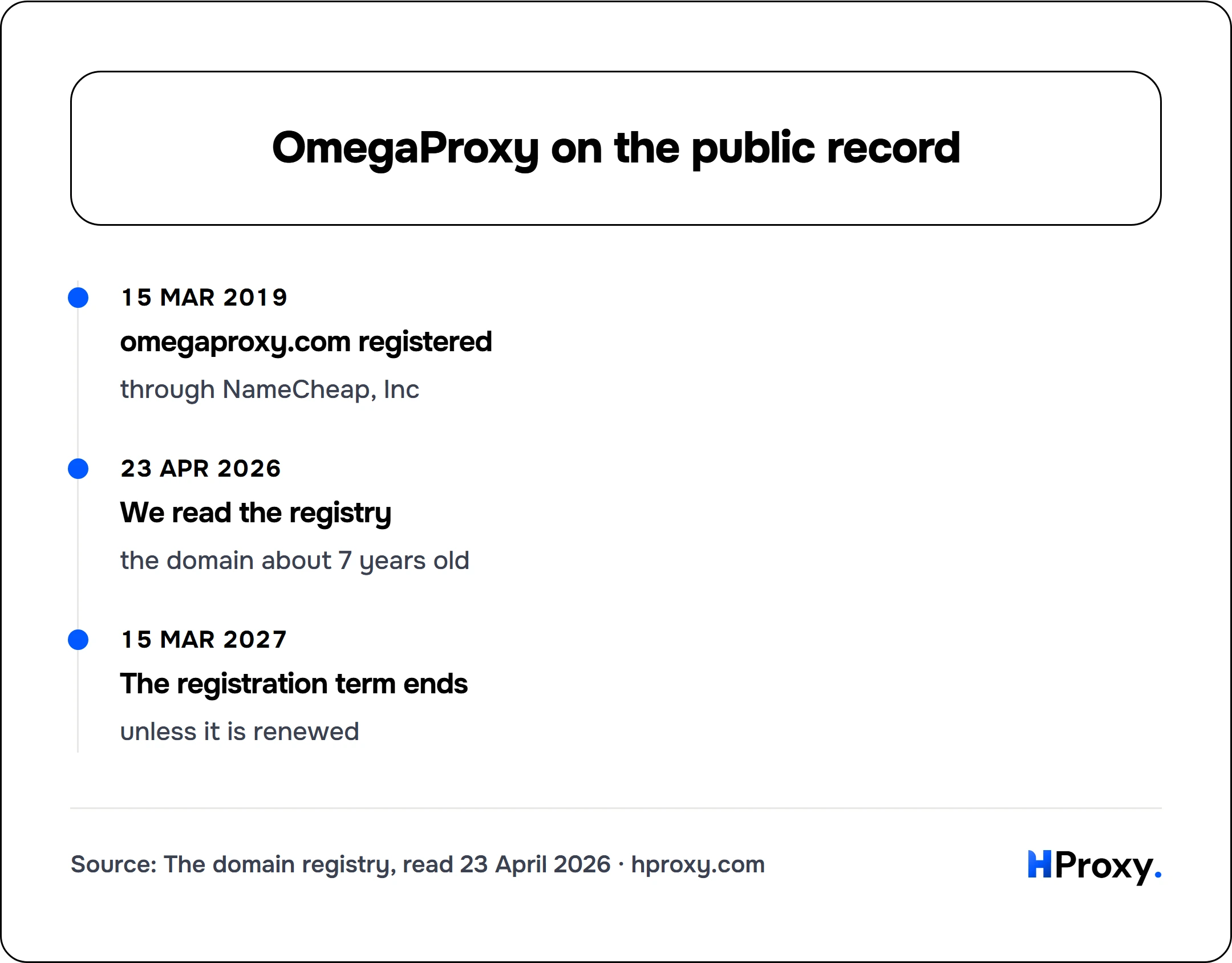
The domain was registered on 15 March 2019, through NameCheap, Inc, which makes it about 7 years old. The lookup behind those dates ran on 23 April 2026. The Internet Archive holds 20 snapshots of the site, the earliest from April 2006. As things stand the domain is held to 15 March 2027.
15 Mar 2019
omegaproxy.com registered
through NameCheap, Inc
23 Apr 2026
We read the registry
the domain about 7 years old
15 Mar 2027
The registration term ends
unless it is renewed
This proves nothing about the product. It is a cheap check against the one failure mode that costs buyers real money in this market, which is paying a provider that will not exist in six months.
What our crawl found
A crawl of 1.116 pages returned 72 pricing pages and 9 location pages.
The number is not a compliment or a criticism. It describes how much of their effort goes into being found, which is worth knowing when you are weighing a marketing claim against a measurement.
What a pricing page leaves out
Advertised rate against the rate you reach
Rates in this market are quoted from the bottom of the table. The relevant question is which row you land on at your volume, and whether reaching a cheaper row costs more in commitment than it saves per unit.
Who else is using your address
An address you share carries the reputation of everyone else on it. That is acceptable for some work and fatal for anything involving a login. The price difference between shared and dedicated usually reflects exactly this.
Ask whether failed requests are billed
Some vendors bill every request, some bill only successful ones, and the difference is the whole comparison once a target starts blocking. A cheap rate with a fifty percent success rate is twice its advertised price.
The rows that decide it
Six questions, both answers, and an honest blank where we do not hold a current figure:
| Question to ask | OmegaProxy | HProxy |
|---|---|---|
| Entry price | Not verified by us, read their page | From $0.44/GB, pay as you go |
| Does unused balance expire? | Their terms page answers this | Never |
| Minimum commitment | On their own terms page | None |
| Identity checks | Not published clearly, ask before paying | Card orders are screened, and verification is sometimes requested |
| Targeting | Worth confirming in writing before you commit | Country, city and ISP |
| Free way to evaluate | Read their current terms | Free proxy list and proxy checker |
The useful part of that table is the left column. Take those six questions to any provider in this market and the answers will sort them faster than any review.
What to do instead of reading more comparisons
The steps below take about ten minutes and settle the question properly.
- Put a few dollars on each account. Trials are fine for a first look, but paid traffic is what you will actually be buying.
- Run them against the site you actually care about, using the code you actually run, within the same hour.
- Record the success rate and the data consumed for the identical batch on each side.
- Check some of the addresses yourself for country, ASN and type before you trust the label on the plan.
- Keep the winner, and repeat the whole thing quarterly, because pools age.
The rest of the shortlist
Buyers comparing this name usually have two or three of these open in other tabs:
What we sell, stated plainly
Our position is narrow. Residential from $0.44 per GB, no subscription, no expiry on the balance, and a public record of what our free network actually does. A provider unwilling to be measured is telling you something, and so is one that asks to be.