Mexela sits in a market where the advertised number and the number you pay are frequently different, because tiers, minimums and expiry all sit between them. Untangling that is most of the work here.
The record we hold
The domain is mexela.com.
Mexela is not in our priced record, so nothing about their rate appears below. That gap is stated rather than filled, which is the only honest option available.
Their pricing page will answer three of the four questions that matter. Send an email for the fourth, which is usually whether blocked requests are billed, and keep the reply.
How Mexela presents itself
On 9 September 2026 their homepage carried the title "Buy Private Proxies, Dedicated IPv4 Proxy Service, Mexela". The description they publish for search engines reads: "Buy private proxies with dedicated IPv4 addresses, unlimited bandwidth, HTTP/HTTPS support, fast delivery, and locations across the USA and Europe."
The rest of what the page puts in writing:
The product lines named on that page are SOCKS5. We found no separate pricing page linked from the homepage, which usually means the price arrives by quotation.
That is the vendor speaking, not us. We print it because a claim with a date attached is at least falsifiable.
Longevity, on the public record
The domain was registered on 16 March 2014, through NameCheap, Inc, which makes it about 12 years old. Those dates come from a registry query on 23 April 2026. The Internet Archive holds 20 snapshots of the site, the earliest from September 2014. Their registration is booked through 16 March 2027.
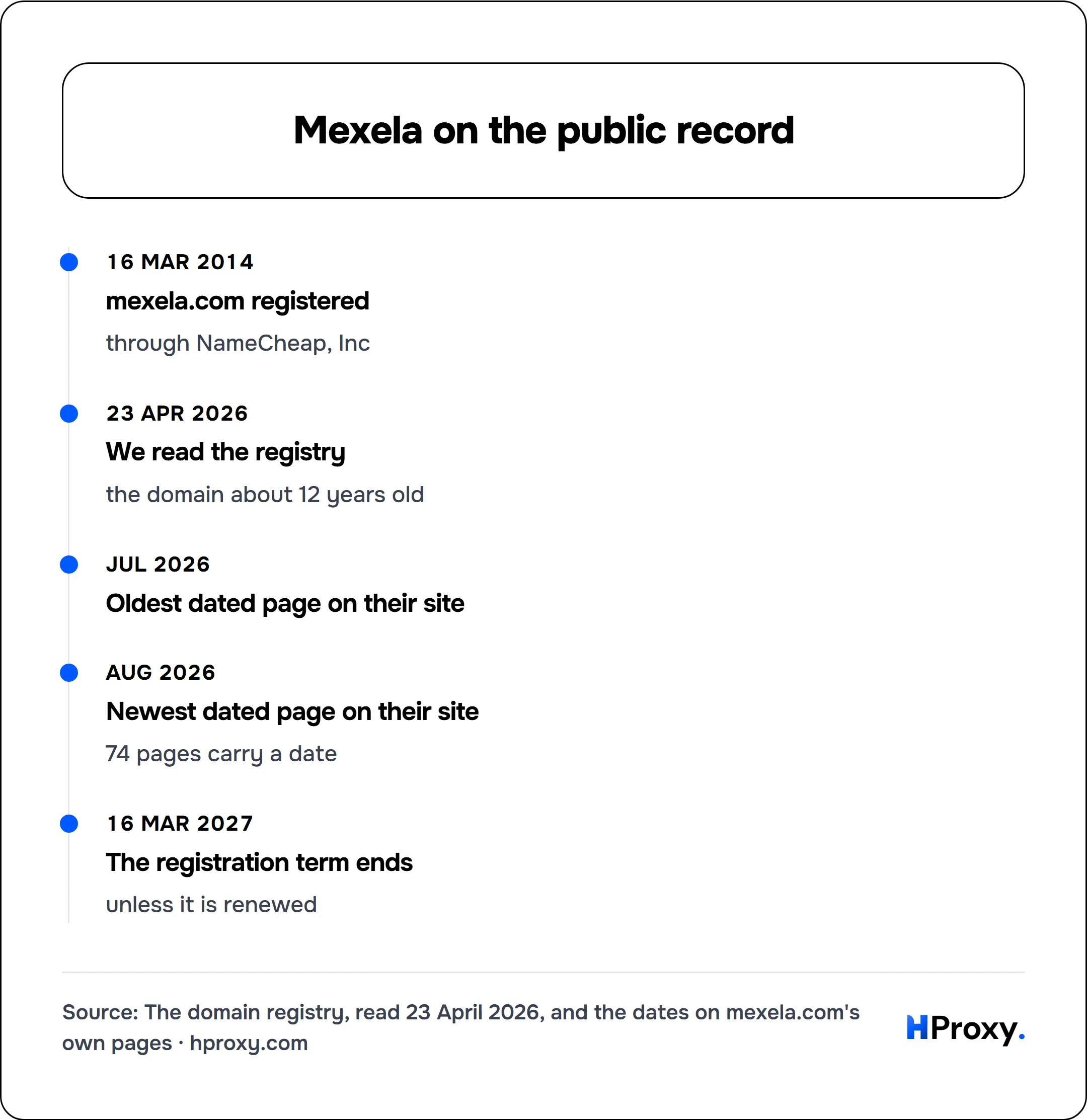
16 Mar 2014
mexela.com registered
through NameCheap, Inc
23 Apr 2026
We read the registry
the domain about 12 years old
Jul 2026
Oldest dated page on their site
Aug 2026
Newest dated page on their site
74 pages carry a date
16 Mar 2027
The registration term ends
unless it is renewed
Age is not quality. A long registration does not make a network good, and a new one does not make it bad. What it does rule out is the shortest-lived pattern in this market, which is a site that appears, sells, and is gone inside a year.
The shape of their site
Our own crawl reached 87 of their pages. The mix was 74 blog pages and 1 use-case page.
Read it as a map of what they emphasise. It is our count, from our crawler, on the date shown, and it is the only figure on this page that neither of us can dispute.
What the timestamps show
Our crawl of their site found 74 pages carrying a date, 73 of them articles. The oldest is from July 2026 and the newest from August 2026. 74 of them carry a date inside the last twelve months.
Recent dates prove somebody is still at the keyboard. They prove nothing about the network, which is what the test at the end of this page is for.
What the advertised numbers cannot tell you
The country total, and the country you use
Country totals are counted generously across this whole market. A country with a handful of addresses counts the same as one with hundreds of thousands. If your work depends on one location, test that location before you switch.
Match the units before anything else
Work out what your job actually consumes, in gigabytes or in concurrent addresses, before you look at any price. Without that number, no two quotations in this market can be compared at all.
Threads, not gigabytes, are often the ceiling
Rate limits are often enforced per account rather than per plan, which means buying more traffic does not raise them. Confirm how yours scales before you assume a bigger plan runs faster.
What separates them, in a table
The rows that matter, with our own answers stated plainly:
| Question to ask | Mexela | HProxy |
|---|---|---|
| Entry price | Not verified by us, read their page | From $0.44/GB, pay as you go |
| Does unused balance expire? | On their own terms page | Never |
| Minimum commitment | Their terms page answers this | None |
| Identity checks | Check the current terms, this one moves | Card orders are screened, and verification is sometimes requested |
| Targeting | Read their current terms | Country, city and ISP |
| Free way to evaluate | Worth confirming in writing before you commit | Free proxy list and proxy checker |
Every unfilled cell above is a question to put to them directly, in writing, before money changes hands. Vendors answer those questions readily; comparison sites guess at them.
The ten minute version of this decision
For a few dollars you can get a verdict specific to your job, which no comparison page can honestly promise you.
- Open an account on each and add the smallest amount they take. Skip the trial if a paid unit is cheap enough to buy outright.
- Point both at your real target, through your real tool, on the same day, with the same mix of requests.
- Count how many requests returned what you wanted, and how much bandwidth each side spent doing it.
- Spot-check the exits. Confirm they are in the country you paid for and the connection type you were sold.
- Take the winner and set a reminder to run this again, since a result has a shelf life of about a quarter.
The other names that come up
Other providers in the same bracket, priced and dated the same way:
- Zeus Proxy alternatives
- Zingproxy alternatives
- Ziny alternatives
- 1024Proxy alternatives
- 1Abc alternatives
- 2Captcha alternatives
Our side of it
HProxy is pay as you go from $0.44 per GB on residential, with ISP, mobile and datacenter under one balance and no commitment attached to any of them. Run the test. If we lose on your target, we lose, and you have your answer.