The shortest useful answer about Insorg: find out what their current published rate is, find out whether your balance expires, then measure success rate on your own target. Everything below expands those three steps.
Insorg on the record
The company behind the name sits at insorg.org. We could not fetch their site automatically on the last attempt. A bot filter is the usual explanation and says nothing about the business.
A price is missing here on purpose. We have not captured a sourced rate for Insorg recently enough to publish one, and a stale number in this market is a wrong number.
Note the price, the unit it is quoted in, the minimum, and the expiry. Unit and expiry are where most comparisons in this market quietly go wrong.
What Insorg says about itself today
Read 9 September 2026, the homepage titles itself "insorg.org, 526: Invalid SSL certificate".
Reading the same page for the things buyers actually ask about:
We found no separate pricing page linked from the homepage, which usually means the price arrives by quotation.
Nothing there has been tested. It is a record of what the page said on the day, which is the honest limit of what a page like this can offer without a measurement.
What the registration record shows
The domain was registered on 10 June 2004, through GoDaddy.com, LLC, which makes it about 22 years old. Registry data as of 9 September 2026. It is paid up until 10 June 2027.
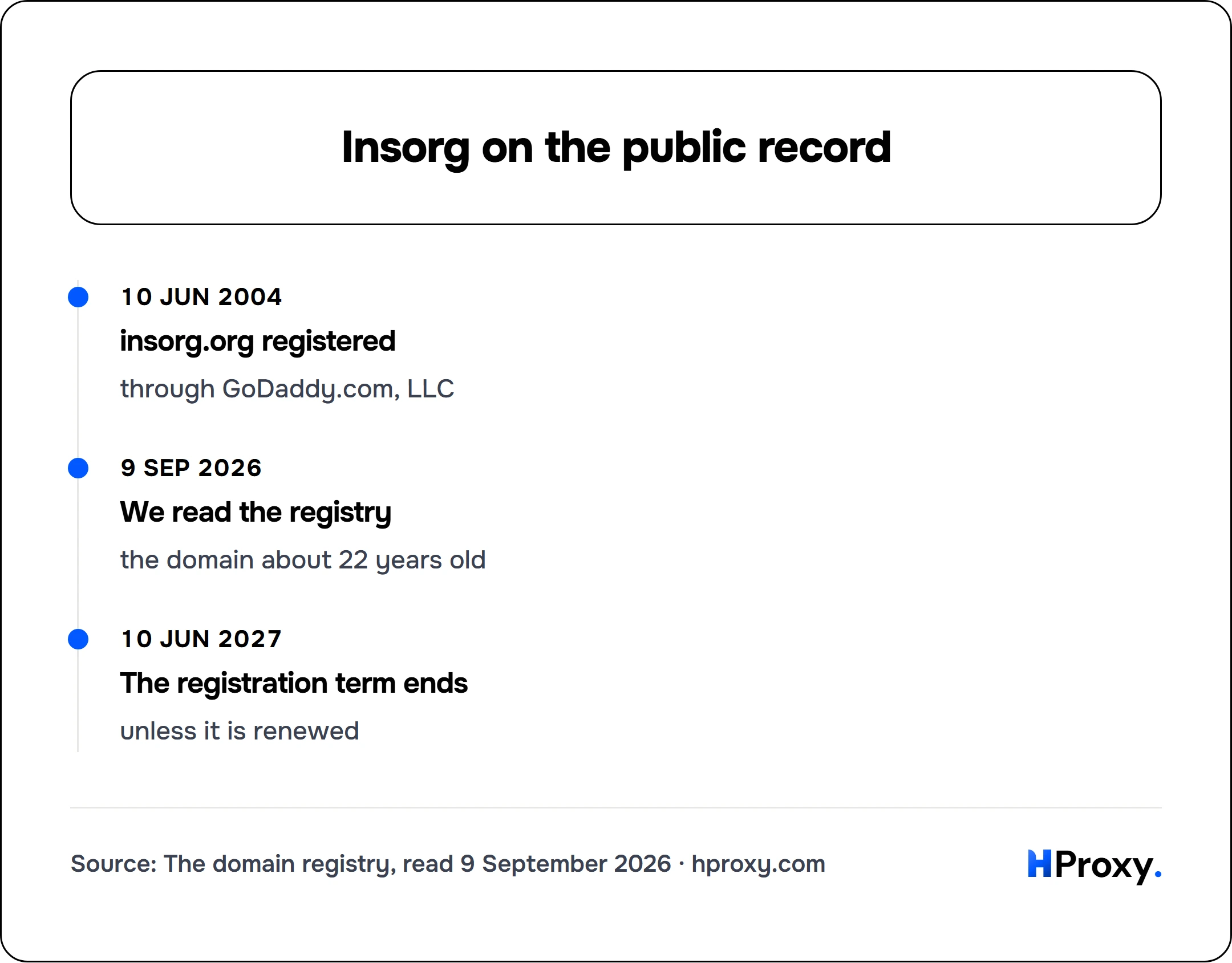
10 Jun 2004
insorg.org registered
through GoDaddy.com, LLC
9 Sep 2026
We read the registry
the domain about 22 years old
10 Jun 2027
The registration term ends
unless it is renewed
Age is not quality. A long registration does not make a network good, and a new one does not make it bad. What it does rule out is the shortest-lived pattern in this market, which is a site that appears, sells, and is gone inside a year.
The demand around this name
Google reports 10 searches a month worldwide across the terms carrying this brand: 10 a month for a review of them. Figures read from Google Keyword Planner on 9 September 2026.
Most of that demand is people checking whether to trust it. That is what this page is written for, and it is why the sections above lead with what is published rather than with a verdict.
Where published figures stop being useful
Ten million addresses, and none of them yours
Claims of ten million, one hundred million or more say nothing about whether your requests get through this week. Your job meets the handful of exits it draws, in your countries, against one target. Rotation policy and freshness move that outcome far more than the headline total.
The entry price is not the effective price
Rates in this market are quoted from the bottom of the table. The relevant question is which row you land on at your volume, and whether reaching a cheaper row costs more in commitment than it saves per unit.
Threads, not gigabytes, are often the ceiling
Rate limits are often enforced per account rather than per plan, which means buying more traffic does not raise them. Confirm how yours scales before you assume a bigger plan runs faster.
A comparison that admits what it cannot say
The table answers what we can answer and marks what we cannot:
| Question to ask | Insorg | HProxy |
|---|---|---|
| Entry price | Not verified by us, read their page | From $0.44/GB, pay as you go |
| Does unused balance expire? | Check the current terms, this one moves | Never |
| Minimum commitment | Read their current terms | None |
| Identity checks | Worth confirming in writing before you commit | Card orders are screened, and verification is sometimes requested |
| Targeting | Read their current terms | Country, city and ISP |
| Free way to evaluate | Worth confirming in writing before you commit | Free proxy list and proxy checker |
Every unfilled cell above is a question to put to them directly, in writing, before money changes hands. Vendors answer those questions readily; comparison sites guess at them.
How to settle it yourself in ten minutes
Run this before you commit any volume. It replaces every opinion on this page, including ours.
- Buy the minimum each side offers. Prefer a small paid batch over a trial, because trial traffic does not always ride the same pool.
- Send an identical workload through each: same target, same tooling, same time of day, same request mix.
- Log successes, failures and gigabytes used. Cost per successful request is the figure you are after.
- Verify a slice of the exits independently. Country labels in this market are self-reported and are not always right.
- Take the winner and set a reminder to run this again, since a result has a shelf life of about a quarter.
The other names that come up
Other providers in the same bracket, priced and dated the same way:
- MobileProxy.space alternatives
- Mobileproxynow alternatives
- Mobilproxy alternatives
- Momoproxy alternatives
- MoreLogin alternatives
- MountProxies alternatives
Where HProxy sits in that test
Our own lane is easy to state. Residential starts at $0.44 per GB with country targeting, the balance is topped up when you want and does not expire, there is no subscription unless the optional discount suits you, and city and ISP targeting come with Residential Premium from $1.00 per GB. If the test above puts us second on your target, buy the winner.