MoreLogin (morelogin.com) is an antidetect browser with Android cloud phones, sold by a company registered in Singapore. Each browser profile carries its own fingerprint, and each cloud phone is a remote Android device, so many accounts can run from one computer. On 12 October 2026 it asked $35 a month for 100 profiles, second only to BitBrowser among the browsers we priced, and $0.006 a minute for a cloud phone. The comparison puts seven alternatives against it.
MoreLogin's plans and prices
The price page shows a free plan and a Pro plan at $9 for 10 profiles; every larger size sits in a price list in MoreLogin's help centre, updated on 3 February 2026:
MoreLogin's profile packages, 12 October 2026
| Profiles | 30 days | A month, paid for 360 days |
|---|---|---|
| 10 | $9 | $5.40 |
| 20 | $15 | $9 |
| 50 | $25 | $15 |
| 100 | $35 | $21 |
| 150 | $45 | $27 |
| 200 | $55 | $33 |
| 250 | $65 | $39 |
| 400 | $80 | $48 |
| 1,000 | $160 | $96 |
MoreLogin Help Center, Subscription Packages (updated 3 February 2026), read from our server on 12 October 2026; the monthly rates for 360 days are the listed totals divided by twelve
The free plan keeps 2 profiles and 2 users forever, and new accounts get 100 minutes of cloud phone time. Billing also runs for 60 and 180 days at smaller discounts. The entry price has not moved: the archive's copy of January 2023 shows a Base plan at $9 for 10 profiles, and by March 2024 the page offers 40% off for paying a year ahead.
Cloud phones, and what they cost now
A MoreLogin cloud phone runs Android 12 to 15 in the cloud, with a camera, audio and file uploads. On 12 October 2026 it cost "$0.006/min, capped at $1.5/day", or $23 to $25 for 30 days as a monthly phone. The help centre adds that a phone draws at most 250 minutes a day from a prepaid package, which is the same $1.50.
The rate went up. In July 2025 the price page billed an Android 12 phone at "$0.05 per 15 minutes per device, capped at $25 per device per month". By January 2026 it was $0.006 a minute: 80% more per minute, and a daily cap that adds up to $45 over 30 days instead of $25.
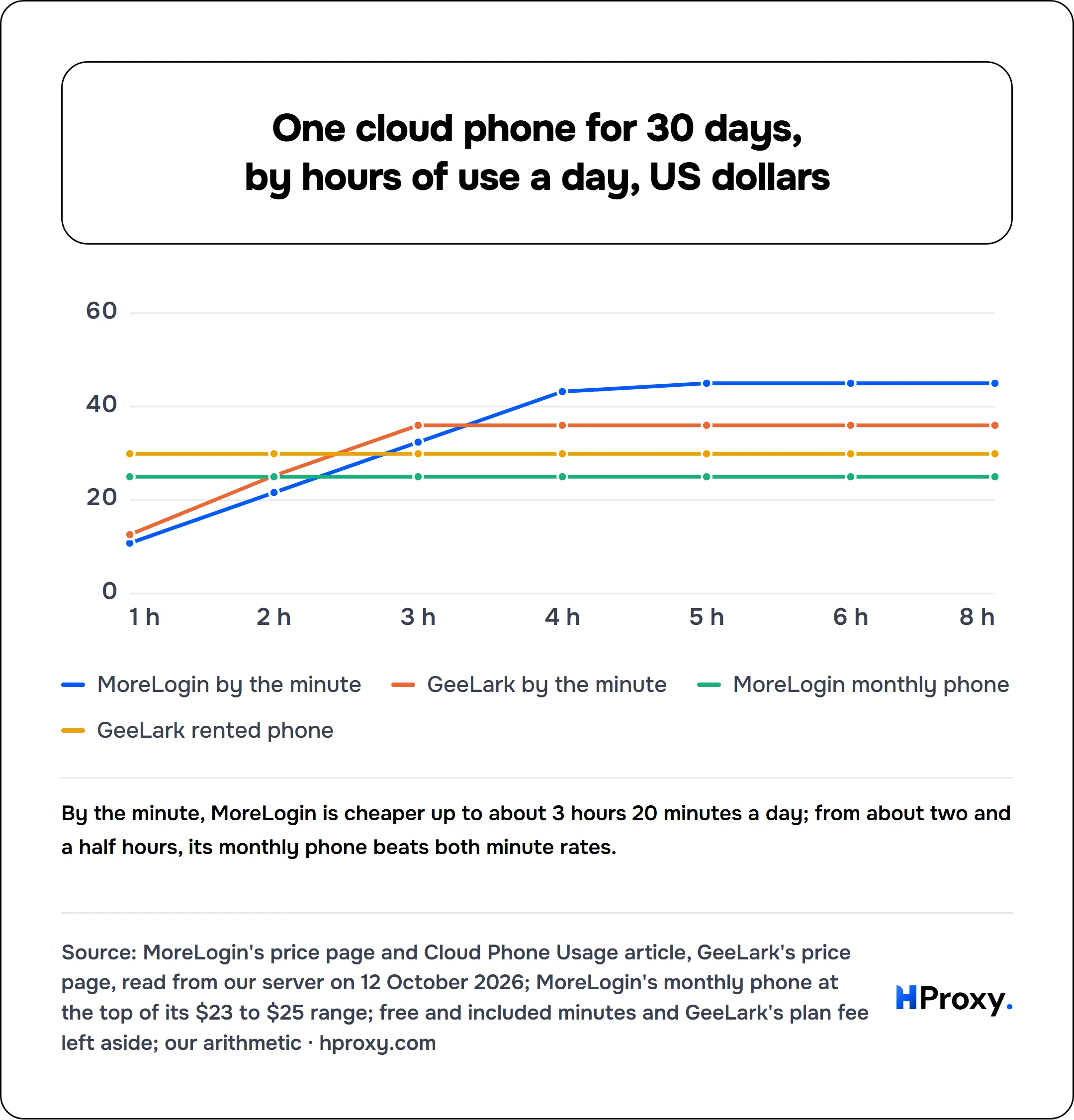
GeeLark, a cloud phone service, bills $0.007 a minute up to $1.20 a day on a paid plan, or $29.90 a month for a rented phone. Which is cheaper depends on how long a phone runs:
- MoreLogin by the minute
- GeeLark by the minute
- MoreLogin monthly phone
- GeeLark rented phone
Who runs MoreLogin
The contact page names EASYANT PTE. LTD., at an address in Singapore. OpenCorporates lists it as a live exempt private company (202411658R) whose industry codes are software wholesale and publishing; the register shows its founding date only to logged-in users. The terms of 27 March 2026 speak only of "the operator of MoreLogin", under the laws of Singapore with arbitration at the Singapore International Arbitration Centre, and the privacy policy was last updated on 6 October 2022.
The dates do not agree with each other. The domain was registered on 23 September 2022 and the archive's first copy of the price page is from January 2023, while the footer reads "© 2009-2026" and the contact page speaks of "our business's seven-year existence".
Fees, in the terms' words, "are non-refundable once paid", with requests reviewed case by case. MoreLogin also sells proxies inside the app; its proxy terms of 25 August 2026 say the network "may be supplied and operated by independent third-party network providers", make purchases non-refundable once allocated, and forbid using a proxy or its credential "outside MoreLogin".
What MoreLogin's own comparisons say
MoreLogin publishes comparison pages against Dolphin Anty, GoLogin, Multilogin and AdsPower, and their numbers are old. The Dolphin Anty page gives Dolphin's "Minimum tariff" as €99 a month and its free plan as 10 profiles; Dolphin's cheapest paid plan costs $10 and its free plan has held 5 profiles since September 2025. The GoLogin page says GoLogin "starts at $49/month" and only offers a seven-day trial, while GoLogin sold 10 profiles for $9 and kept 3 free. The Multilogin page states "The basic price for Multilogin is $99", against $40 for 100 profiles and a free plan of 5 on 12 October 2026.
Why MoreLogin users look elsewhere
Google's Keyword Planner counted 40,500 monthly searches for "morelogin" worldwide on 12 October 2026, with 3,600 for "morelogin download", 480 for "morelogin cloud phone", 110 each for its pricing and price, and 50 for "morelogin alternative". Google's suggestions ask whether MoreLogin is a proxy, a VPN, safe or free, set it against GoLogin, Multilogin, AdsPower, ixBrowser and Dolphin Anty, and look for an Android version.
The reasons on record: no refunds, a free plan of only 2 profiles, a cloud phone rate that rose 80% per minute, and proxies that cannot leave the app.
The alternatives side by side
The chart prices the smallest offer that seats three people and holds 400 profiles, taken from each company's price page, price list or price service on 12 October 2026. Octo bills in euros, turned into dollars here at 1.1206, the European Central Bank's figure for 9 October. None of the tools was installed for this page.
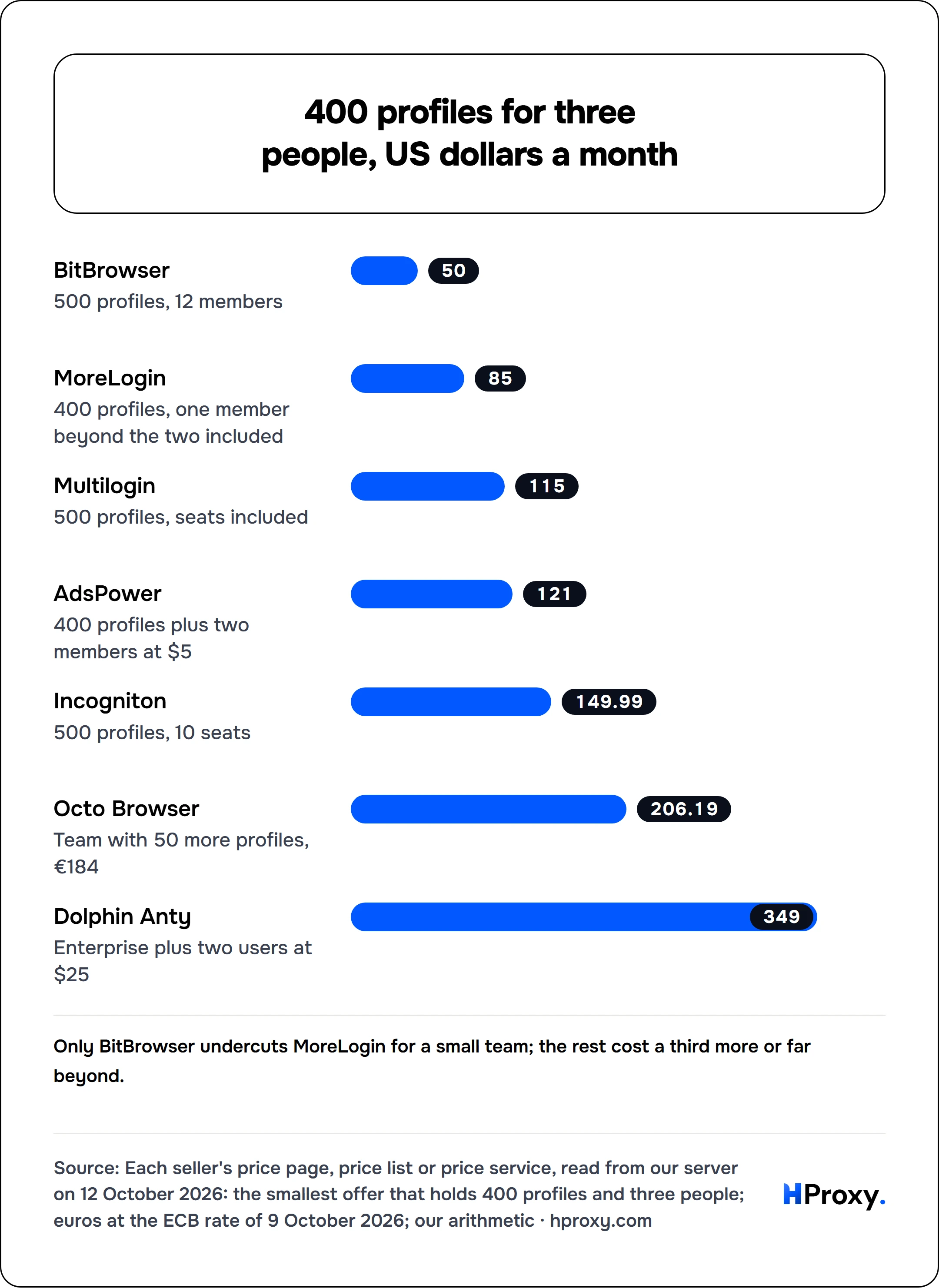
GoLogin has no bar: its price page names no price for additional team members.
BitBrowser
BitBrowser undercuts MoreLogin at every size: $15 for 100 profiles with four members, $50 for 500 with twelve. It refunds nothing either, names a court in Beijing, and has no Linux build. Our BitBrowser page covers its terms.
AdsPower and GoLogin
AdsPower's own price service quoted $36 for 100 profiles, one dollar more than MoreLogin, with $5 a month for each member after the first. It has a Linux build too, and once a package is confirmed the money stays with AdsPower. GoLogin charges $39 for 100 profiles, leaves 3 free, and aims a page at MoreLogin users titled "MoreLogin Alternative: 90% Off Your First Month". It also states the case against itself: MoreLogin "stays a few dollars cheaper above" 10 profiles.
Multilogin
Multilogin's 100 profiles cost $40 and its 500 cost $115, team seats included; 5 profiles stay free, and Android cloud phones come inside its plans. For a team that wants browsers and phones under one plan, it is the nearest match at a higher price.
GeeLark
GeeLark is built around cloud phones rather than browsers: plans from $5 a month for 5 profiles, phones by the minute with a $1.20 daily cap, or rented by the month. Its cap beats MoreLogin's minute rate for long sessions, but not MoreLogin's monthly phone, as the chart above shows. Our GeeLark page covers it in depth.
Incogniton, Octo Browser and Dolphin Anty
Incogniton costs more for this team but refunds within 24 hours and includes proxies in its plans. Octo Browser and Dolphin Anty cost two to four times as much at this size; Octo refunds a first payment within 5 days.
Where MoreLogin still leads
- Price: the second lowest for 100 profiles and for a small team, behind BitBrowser only.
- Two members included on every plan, the free one too, with more at $5 each.
- Linux for desktop and server, and Chromium or Firefox engines for profiles.
- Browser and cloud phones in one app, with phones from $0.006 a minute.
Moving your accounts out
Plan the move around what cannot travel. Proxies bought inside MoreLogin stay there, by its own proxy terms. Browser profiles get rebuilt in the new tool with their cookies imported; even GoLogin's switch page admits that "Full profile-level migration isn't documented for MoreLogin". Nothing we read describes moving a cloud phone to another service, so expect to install its apps and sign in again.
Where HProxy fits
A proxy you buy yourself moves with you from one browser or cloud phone to the next, which a proxy from MoreLogin's store cannot. For a profile that must hold its address through a session, Residential Premium holds one home IP steady for as long as 24 hours, picked by state, city or ISP, from $1.49 a gigabyte. For an address that never changes, a static ISP proxy costs $2.70/IP a month with no traffic limit. Pairing one address with each profile is covered in our antidetect browser proxy guide.
Which one to pick
- Stay with MoreLogin for a low price, two members included, Linux, and phones billed by the minute or the month.
- BitBrowser for the lowest price, if refunds and the court do not matter to you.
- GeeLark for a tool built around cloud phones; on price alone, MoreLogin's phones cost less at every daily use we charted.
- Multilogin for browsers and phones under one plan with seats included.
- Incogniton if a refund window or bundled proxies matter more than price.
- The poorest swap for a small team: Dolphin Anty, whose Enterprise plan and two added users come to $349 a month.
What we could not find out
Everything here comes from documents; we tested nothing. The register shows EASYANT's founding date and officers only after a login, so we cannot say when the company behind MoreLogin was set up. Incogniton and Multilogin quote a $0.03 daily storage charge for cloud phones left idle for seven days; we did not find it on the MoreLogin pages we read. Two rivals call MoreLogin Chinese without giving a source, so we do not repeat it. These prices are due for a recheck by 12 January 2027.
Sources
- MoreLogin: home, price page, contact page, privacy policy, terms, proxy service agreement, its comparison pages, and the help centre's price list, cloud phone rules and version log, read 12 October 2026.
- Internet Archive: morelogin.com/pricing from January 2023 to June 2026, read in its original form.
- OpenCorporates: EASYANT PTE. LTD. (202411658R), read 12 October 2026.
- GeeLark's price page and FAQ, and the price pages, price services and terms of BitBrowser, AdsPower, GoLogin, Multilogin, Incogniton, Octo Browser and Dolphin Anty, read 12 October 2026.
- What GoLogin, Multilogin, Dolphin Anty and Incogniton publish about MoreLogin, and eight proxy sellers' MoreLogin setup guides, read 12 October 2026.
- Monthly MoreLogin, cloud phone and antidetect browser searches from Keyword Planner, worldwide, with Google's related suggestions, both taken on 12 October 2026.
- HProxy's Residential Premium and static ISP prices, inserted from our price data rather than typed into this page.