Choosing a proxy provider on price alone is the most common and most expensive mistake in this market, because a cheap request that fails costs more than a dearer one that works. That framing runs through the whole page.
What we know about Youproxy, and what we do not
Youproxy trades at youproxy.io.
We price the providers we can source and date, and Youproxy is not currently one of them. The rest of this page is about what to check when you read their pricing yourself.
Check the reachable rate, the minimum, the expiry terms and the failure billing, and date your note. A price without those four attached is not a price.
Youproxy in its own words
The title tag on 9 September 2026 was "Buy Cheap Proxies - Affordable Proxies from $0.07/IP". The description they publish for search engines reads: "Get the cheapest proxy solutions from $0.07/IP. Affordable proxy server plans with global coverage, dedicated API, fast connections, and reliable 24/7 support."
Also on the page, stated plainly:
The product lines named on that page are residential, ISP or static residential, mobile, SOCKS5 and IPv6. They advertise 50 countries or locations. Payment methods mentioned: PayPal, crypto, cards and Wise or Payoneer. The page offers some form of free trial. Support is advertised as around the clock. A refund or money-back term is mentioned. Their pricing page is titled "Proxy prices servers, Youproxy".
Every line above is a quotation from their marketing rather than a measurement by us. It is included because it is checkable, not because it is evidence of performance.
Age, and why it matters here
The domain was registered on 18 October 2021, through NameCheap, Inc, which makes it about 4 years old. We pulled that from the registry on 23 April 2026. The Internet Archive holds 20 snapshots of the site, the earliest from March 2022. The current registration term ends 18 October 2026.
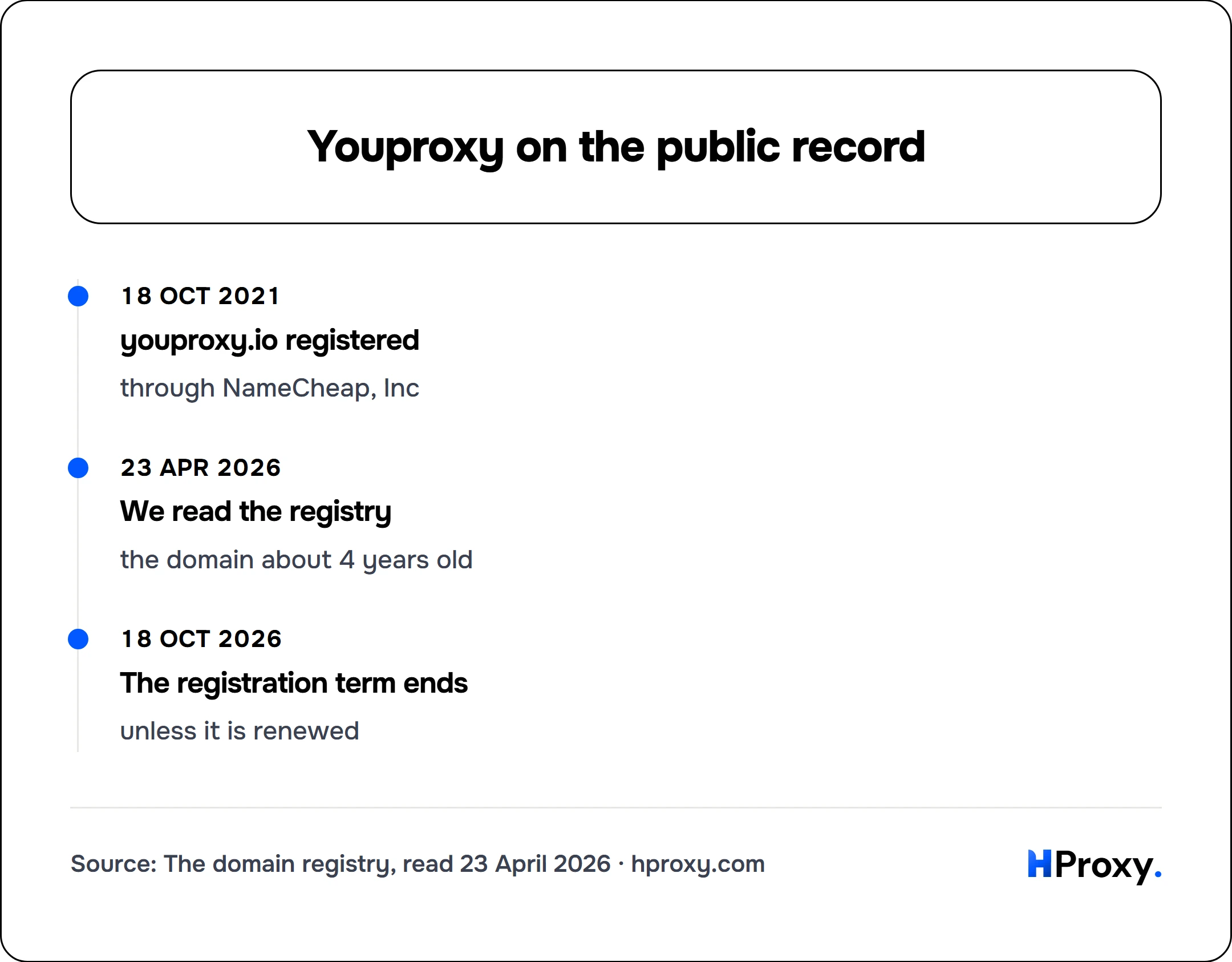
18 Oct 2021
youproxy.io registered
through NameCheap, Inc
23 Apr 2026
We read the registry
the domain about 4 years old
18 Oct 2026
The registration term ends
unless it is renewed
This proves nothing about the product. It is a cheap check against the one failure mode that costs buyers real money in this market, which is paying a provider that will not exist in six months.
We also track youproxy.com under the same name. Where a brand runs several domains, check which entity your contract is actually with.
What Youproxy publishes
Our own crawl reached 148 of their pages, last run 19 June 2026. The mix was 93 blog pages and 1 pricing page.
The number is not a compliment or a criticism. It describes how much of their effort goes into being found, which is worth knowing when you are weighing a marketing claim against a measurement.
What you still do not know after reading their site
Why 195 countries tells you nothing
Almost every provider claims almost every country. What differs is depth, and depth decides whether a single city or a single carrier is usable. No published figure tells you that.
Per gigabyte against per address
Work out what your job actually consumes, in gigabytes or in concurrent addresses, before you look at any price. Without that number, no two quotations in this market can be compared at all.
Networks age, so re-test quarterly
Supply changes hands quietly in this industry. The network behind a brand can be replaced with no announcement, which is why a benchmark is a perishable good and a re-test is cheap insurance.
The two of us, on the questions that matter
Set the two side by side on the questions that decide the outcome, rather than on feature counts:
| Question to ask | Youproxy | HProxy |
|---|---|---|
| Entry price | Not verified by us, read their page | From $0.44/GB, pay as you go |
| Does unused balance expire? | Not published clearly, ask before paying | Never |
| Minimum commitment | On their own terms page | None |
| Identity checks | Read their current terms | Card orders are screened, and verification is sometimes requested |
| Targeting | Worth confirming in writing before you commit | Country, city and ISP |
| Free way to evaluate | Read their current terms | Free proxy list and proxy checker |
The useful part of that table is the left column. Take those six questions to any provider in this market and the answers will sort them faster than any review.
The test that beats this page
It is a small amount of money for an answer that is actually about your target.
- Put a few dollars on each account. Trials are fine for a first look, but paid traffic is what you will actually be buying.
- Run them against the site you actually care about, using the code you actually run, within the same hour.
- Record the success rate and the data consumed for the identical batch on each side.
- Check some of the addresses yourself for country, ASN and type before you trust the label on the plan.
- Choose on the measurement, not the marketing, and expect the answer to change within a year.
Comparable providers
We hold the same record for these, and the same honest limits apply to each:
What we sell, stated plainly
Our position is narrow. Residential from $0.44 per GB, no subscription, no expiry on the balance, and a public record of what our free network actually does. A provider unwilling to be measured is telling you something, and so is one that asks to be.