Apify sells compute units, and a compute unit is one gigabyte of memory held for one hour. That is a rental price for a server, not a price for a page. Anyone budgeting a scraping job needs money per result, and the pricing page does not give it. This page converts the published rates into money per thousand calls. Every figure was read from their pricing page on 9 September 2026, and the arithmetic is shown in full.
We compete with Apify on the scraper side, so read our bias into every line below. Nothing here is worth trusting if you do not check the rates yourself.
The short version
Apify credits are denominated in dollars, which is more honest than most of this market. The opacity sits one level down. A compute unit is memory multiplied by time, so the same thousand pages can cost twice as much on a heavier actor. Residential traffic is billed separately at $8 per gigabyte, and at a measured 6.54 MB per protected page fetch that is $52.32 per thousand fetches in bandwidth alone. Unused allowance expires monthly.
What Apify publishes
These are the advertised plans, in Apify's own units, read from their pricing page on 9 September 2026. Each plan includes prepaid platform usage equal to its price.
Apify plans and unit rates
| Item | Free | Starter | Scale | Business |
|---|---|---|---|---|
| Monthly price | $0 | $19 | $199 | $999 |
| Annual price, per month | $0 | $17 | $179 | $899 |
| Included platform usage | $5 | $19 | $199 | $999 |
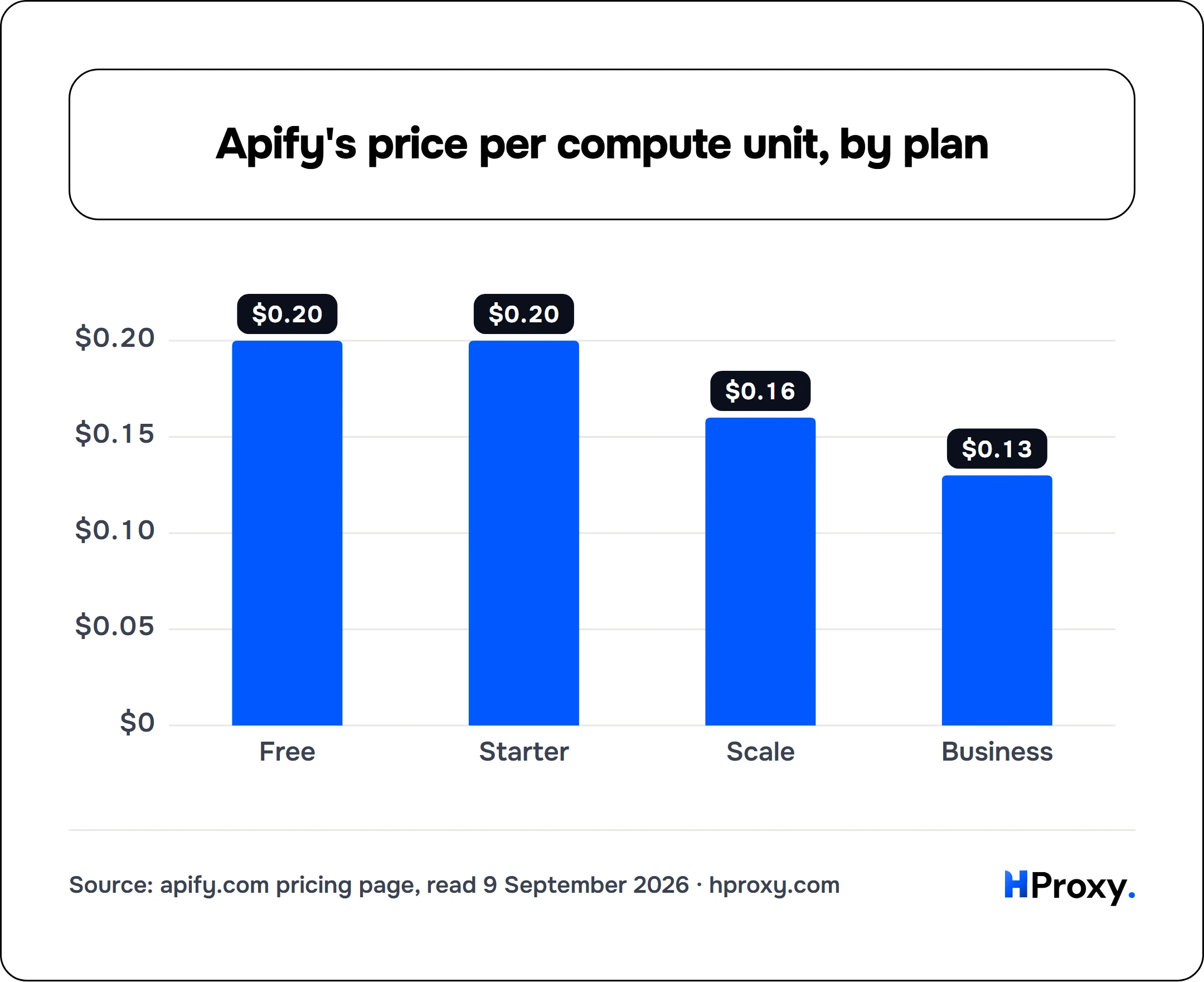
| Compute unit | $0.20 | $0.20 | $0.16 | $0.13 |
| Residential proxy, per GB | $8 | $8 | $7.50 | $7 |
| SERPs, per 1,000 | $2.50 | $2.50 | $2 | $1.70 |
| Web Unblocker, per 1,000 | $1.50 | $1.50 | $1.25 | $1 |
| Datacenter proxy, per IP | 5 included | $1 past 30 | $0.80 past 200 | $0.60 past 500 |
| Max actor memory | 16 GB | 64 GB | 256 GB | 512 GB |
| Concurrent runs | 5 | 32 | 128 | 256 |
apify.com pricing page, read 9 September 2026
One point in Apify's favour, before the criticism starts: a credit here is a dollar. Nineteen dollars of platform usage costs nineteen dollars, and the pricing page says so plainly. Most vendors in this market invent a token and let the buyer guess the exchange rate. Apify does not do that, and the difference deserves saying out loud.
Now read the table downwards rather than across, because scale buys less than it appears to. Moving from Starter to Business multiplies the monthly price by about 53, from $19 to $999. The compute unit rate falls from $0.20 to $0.13, a discount of 35 percent. Residential bandwidth falls from $8 to $7, a discount of only 12.5 percent. The larger plans buy allowance, memory and concurrency, not a meaningfully cheaper unit of work.
What a compute unit means in money
Apify's documentation defines the unit exactly: compute units are memory in megabytes multiplied by duration in hours. Their own example states that one gigabyte of memory for one hour consumes one unit.
The meter does not count pages, only how long a server sat there at the size you set. Two actors returning the same thousand records can differ fourfold in cost, on the memory setting alone.
The same logic works against you when a target is slow, because waiting is billed as time. A page that takes four seconds to answer costs four times a page that takes one. Nothing about the data changed, and the meter does not care.
At the Starter rate of $0.20, a four gigabyte actor costs $0.80 for each hour it runs. That four gigabyte assumption is ours, chosen because browser based actors commonly run at that size. Change the setting and every number below moves with it.
What the entry tier really buys
The Starter plan is $19 a month and includes $19 of platform usage, which is 95 compute units. Against our four gigabyte assumption, that buys about 24 hours of runtime in a month.
Hours are still not pages, and for that step Apify gives one figure of its own. The Web Scraper actor page states that $5 of platform credits covers 500 to 1,000 web pages.
Take that at face value and the conversion falls out:
Apify converted to money per thousand pages
| Question | Answer |
|---|---|
| Apify's own figure | $5 of credits, 500 to 1,000 pages |
| Cost per 1,000 pages | $5.00 to $10.00 |
| What the $19 Starter plan buys | about 1,900 to 3,800 pages a month |
| Cost if you use 60 percent of the allowance | $8.33 to $16.67 per 1,000 pages |
arithmetic on apify.com published figures, 9 September 2026
That last row is the expiry rule doing its work, and most buyers never calculate it. The spread between the two ends of that range is Apify's own figure, not ours. A factor of two, published by the vendor itself, shows how much the actor matters.
The minimum, the commitment and the expiry
There is no minimum purchase, no annual commitment, and no card needed for the free tier. That tier gives $5 of usage a month, which is a real trial rather than a demo. Annual billing is advertised at 10 percent off, so Starter drops from $19 to $17 a month.
The expiry is the term that costs money, and the billing documentation is explicit about it. Unused prepaid usage does not roll over, and it expires at the end of the billing cycle. You are buying a monthly allowance, not a balance, and the two behave very differently.
Two further rules apply once you pass the allowance, and they differ by plan. Free accounts are simply blocked until the next monthly cycle begins. Paid accounts can enable overage, which is invoiced immediately once it reaches $20 on Starter. On higher plans that immediate invoice threshold is $200.
Work that arrives in bursts pays badly under this shape, because quiet months still bill. A month where you scrape nothing costs the full plan price and returns nothing. That is the structural difference between an allowance and a balance. It applies to every subscription vendor in this market, not only to this one.
What is metered on top
Pay-per-usage actors bill compute units, storage operations, and any residential or SERP traffic separately. The proxy line is where scraping budgets usually break, and by a wide margin.
Our own bandwidth study used a published benchmark from Hyper Solutions, who measured both approaches. They recorded 6.54 MB moving through browser automation for a single protected page fetch. Hold that figure against Apify's advertised $8 per gigabyte and the arithmetic is short:
- One thousand protected fetches move about 6.54 GB.
- At $8 per gigabyte that is $52.32.
- That is bandwidth alone, before a single compute unit is counted.
The full working is in our study on what headless browsers cost in proxy bandwidth. Undefended pages are far lighter, and the number falls a long way with them. The point stands either way: on a defended target, traffic costs more than compute.
Failed work is billed too, and the definition of the unit makes that unavoidable. A run that crashes after 40 minutes still held memory for 40 minutes, so it still billed. A meter made of memory and time has no successful-result condition in it.
Datacenter proxies are included up to a count that rises with the plan. Free gets five IPs, Starter 30, Scale 200 and Business 500. Past those counts the extra IPs are billed at $1, $0.80 and $0.60 each. That is a rental per IP, so it prices like a subscription rather than per call.
Storage is metered as well, and the billing documentation confirms it. Dataset and key-value store operations are charged, though those rates are not published.
Where the Apify price is genuinely good
Three of the advertised rates are clean per-call prices, and they compare well against this market.
SERP results are $2.50 per thousand on Free and Starter, falling to $1.70 on Business. Web Unblocker requests are $1.50 per thousand, falling to $1 on the largest plan. Both are priced by the call, with no multiplier table behind them, which most rivals cannot claim. We took those multiplier tables apart in why 250,000 credits is not 250,000 requests.
Store actors billed per event can also be cheap, and one example makes the point. The Google Maps scraper is advertised from $1.50 per thousand scraped places. Platform usage is stated as included in that price, rather than charged on top. For that specific job it beats a general purpose API per record, ours included.
Note that the model is moving, and one deadline is already fixed. Apify's documentation states that no new rental actors are accepted after 1 April 2026. All rentals retire by 1 October 2026, so anyone depending on one needs that date in the calendar.
The comparison, converted to one number
Every row below is money for one thousand successful calls, at Free and Starter rates.
Cost per 1,000 successful calls
| What you are buying | Published as | Per 1,000 calls |
|---|---|---|
| SERP results | $2.50 per 1,000 SERPs | $2.50 |
| Web Unblocker requests | $1.50 per 1,000 requests | $1.50 |
| Google Maps places, per event | from $1.50 per 1,000 places | $1.50 |
| Plain pages, pay per usage | $0.20 per compute unit | $5.00 to $10.00 |
| Protected pages behind residential | $8 per GB, at 6.54 MB each | $52.32, plus compute |
| HProxy scraper API | per 1,000 successful calls | published on our scrapers page |
vendor pricing pages and our own arithmetic, 9 September 2026
Our own unit is one successful call, billed from a balance that does not expire. There is no plan, no allowance, and nothing to forfeit at the end of a month. If you want the raw proxy instead, residential bandwidth is $0.50 per GB. The volume floor is $0.44/GB once you reach 2,000 GB+.
Who this pricing suits
Apify suits steady monthly work that fits an allowance you will actually consume. It suits anyone whose target already has a store actor billed per event. That price is quoted per record and includes the platform cost. It suits teams who want orchestration, scheduling and storage in one place, which is a real product. A proxy vendor does not sell that, and we are not pretending otherwise.
It suits burst work poorly, because allowances expire and an idle month is money gone. It suits heavy residential scraping poorly as well, because a browser moves gigabytes. At $8 per gigabyte, that rate sits well above the market for raw residential traffic. We put the whole market's per-gigabyte prices side by side in the residential proxy price study.
The general rule holds here as everywhere in this market, and it is worth repeating. Work out your cost per successful result before the headline rate impresses you. Our guide to reading a proxy pricing page covers the questions that expose the rest.
What we could not verify
Three gaps remain, and we state them plainly rather than filling them with guesses.
The public pricing page lists no unit prices for data transfer, storage or dataset operations. The billing documentation confirms these are metered and points at the console, which needs an account. We did not price them, and we will not guess at them.
The Web Scraper actor page states $0.04 per compute unit on the free plan. The pricing page states $0.20 for that same plan, which is five times more. We could not reconcile the two, so we used the pricing page rate throughout.
Apify's monetization documentation does not say whether a failed pay-per-event run is charged. We read it and it is silent on the point, so we make no claim.
Prices move, so every figure above carries the date we read it, 9 September 2026. Check them against the live pricing page before you commit any money to a plan.
Sources
- Apify, pricing page, read 9 September 2026. Plan prices, included usage, compute unit rates, proxy and SERP rates, credit expiry statement.
- Apify documentation, "Usage and resources", read 9 September 2026. The compute unit definition as memory multiplied by duration.
- Apify documentation, billing and console pages, read 9 September 2026. Prepaid usage expiry and the overage invoicing thresholds.
- Apify documentation, "Actors in Store", read 9 September 2026. The pay per event, pay per usage and rental models, with the rental retirement dates.
- Apify, Web Scraper actor page, read 9 September 2026. The statement that $5 of credits covers 500 to 1,000 pages.
- Apify, Google Maps scraper actor page, read 9 September 2026. Pay per event pricing from $1.50 per thousand scraped places.
- Hyper Solutions, published benchmark. 6.54 MB per protected page fetch through browser automation, used in our own August 2026 bandwidth study.