Caiji (采集蜂, caiji.com) is a proxy seller from China that sells IPs inside China only. It runs two sites: an app that puts a device on a fixed IP in a Chinese city, and an HTTP proxy site that sells IPs by traffic, by the IP or by the day. Every user must first pass a real-name check with a Chinese ID card number, and its terms rule out refunds. Prices below are in yuan, as printed on 27 September 2026. The alternatives table prices five sellers, read the same day.
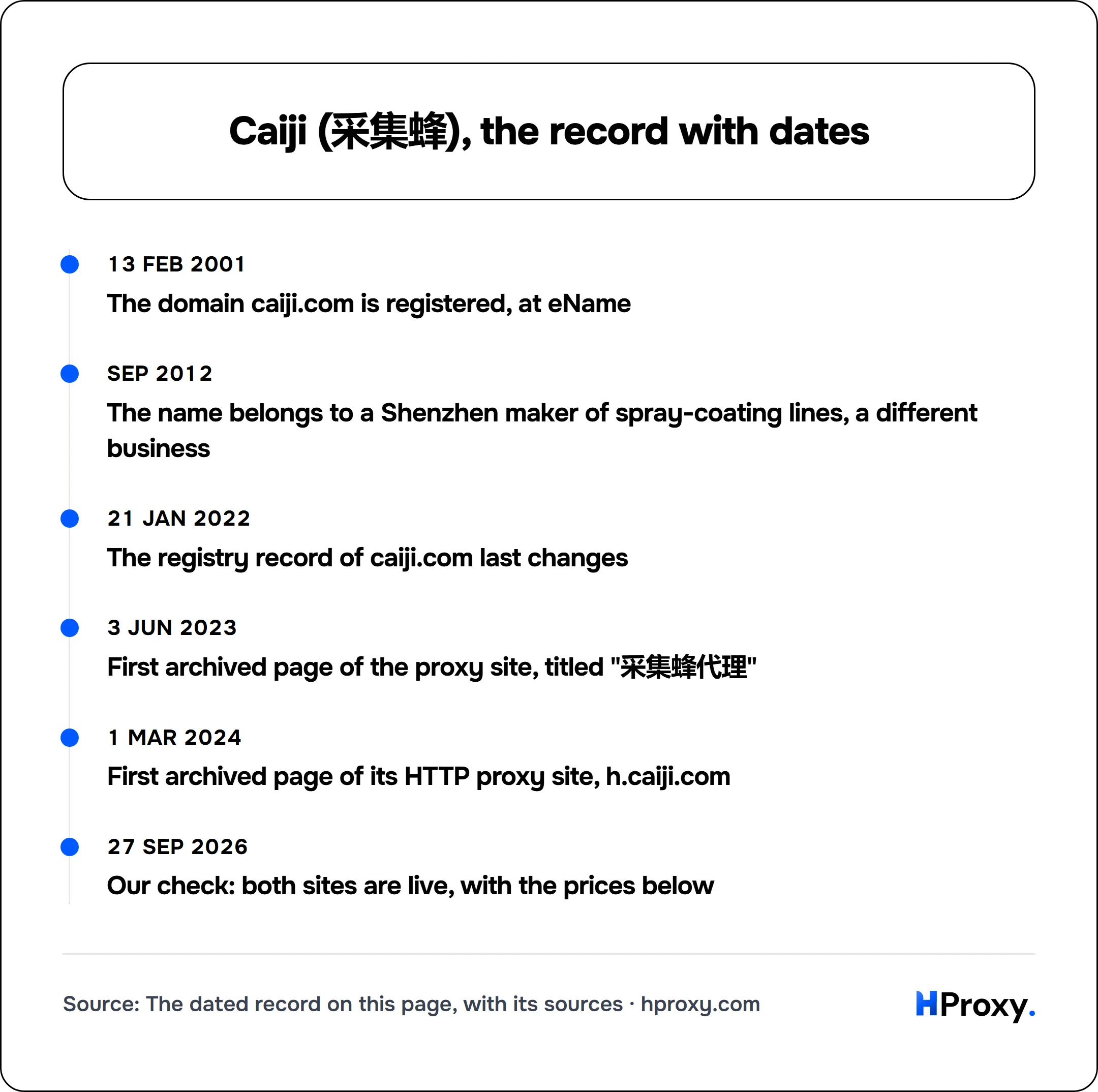
The record, with dates
| date | what happened |
|---|---|
| 13 February 2001 | The domain caiji.com is registered, at eName. |
| September 2012 | The name belongs to a Shenzhen maker of spray-coating lines, a different business. |
| 21 January 2022 | The registry record of caiji.com last changes. |
| 3 June 2023 | First archived page of the proxy site, titled "采集蜂代理". |
| 1 March 2024 | First archived page of its HTTP proxy site, h.caiji.com. |
| 27 September 2026 | Our check: both sites are live, with the prices below. |
13 Feb 2001
The domain caiji.com is registered, at eName
Sep 2012
The name belongs to a Shenzhen maker of spray-coating lines, a different business
21 Jan 2022
The registry record of caiji.com last changes
3 Jun 2023
First archived page of the proxy site, titled "采集蜂代理"
1 Mar 2024
First archived page of its HTTP proxy site, h.caiji.com
27 Sep 2026
Our check: both sites are live, with the prices below
Sources: the Verisign registry, the Internet Archive, the Caiji footer (with its licence number 苏ICP备2022006260号-1) and our own check.
The footer of both sites names the operator: 江苏励合传媒有限公司 (Jiangsu Lihe Media), a company in Nanjing that calls itself a big data and marketing business.
What it sells, and what it costs
| product | how it is sold | price in yuan |
|---|---|---|
| the Caiji app, a fixed IP in a Chinese city | per device, by time | ¥27 for 30 days, ¥79 for 90 days, ¥238 for a year. |
| HTTP, HTTPS and SOCKS5 traffic | per GB; unused traffic never expires | ¥30 a GB (5 GB for ¥150), down to ¥8 a GB (1,000 GB for ¥8,000). |
| single IPs that live for minutes | per IP, from a balance that never expires | ¥0.01 for 1 to 5 minutes, ¥0.02 for 5 to 10, ¥0.06 for 10 to 15. |
| packs of 500 IPs a day | per day, week, month or year | ¥15 a day, ¥70 a week, ¥150 a month, ¥1,460 a year. |
| a dedicated pool, 11,000+ IPs a day | per day, month or quarter | ¥345.6 a day, ¥6,912 a month, ¥10,368 a quarter. |
The app site claims 220+ city lines and 11 million IPs, and the HTTP site claims 70+ city lines and 510,442 IPs in its pool that day. The two counts do not match, and both are its own; we did not test them. Caiji says the IPs come from its own server rooms and from home broadband lines that dial in again for a new address. New accounts get 5,000 free IPs.
The fine print
- The real-name check. Its privacy policy cites the Cybersecurity Law of China: before any use, you give your real name and a Chinese ID card number, checked with Alipay. If you refuse the check, you cannot use the service.
- Refunds. Its user agreement says that once a product is sold, there are no refunds. Kuaidaili, another seller from China, refunds unused time within 72 or 120 hours.
- Payment. WeChat Pay and Alipay, on both of its sites.
- Coverage. Every region on its maps is in China, so it has nothing to offer for IPs in other countries.
- Use. It markets its IPs for scraping, price tracking and game studios, and also for forum posts, votes, likes and app store ratings. Its terms bind users to the laws of China, and it keeps records it may share with the courts.
Where Caiji is the stronger choice
- Cheap IPs inside China for Chinese sites: single IPs from ¥0.01 each, and traffic down to ¥8 a GB.
- An app for phones and computers that keeps one device on a fixed Chinese city IP, from ¥27 a month.
- Traffic and a balance that never expire, so a slow month costs nothing.
- Payment by WeChat Pay and Alipay, and support in Chinese from 9:00 to 23:00.
Where HProxy is different
| Caiji, 27 September 2026 | HProxy | |
|---|---|---|
| identity | A real-name check with a Chinese ID card number, before any use. | No documents at sign-up or at an ordinary checkout. |
| where the IPs are | China only. | Many countries; Lite reaches China by country and rotates. |
| smallest traffic purchase | 5 GB for ¥150. | 1 GB of Lite at $0.50/GB. |
| does traffic expire | Never. | Never: the balance does not expire. |
| city and ISP targeting | A choice of Chinese cities. | Premium, $1.49 for one GB. |
| payment | WeChat Pay and Alipay. | Card, Alipay, crypto and local wallets. |
We screen card payments too, and we ask for identification when a payment looks wrong or the law requires it. The difference is the default: an ordinary order with us needs no documents.
Five alternatives, priced the same day
Every rate below comes from each vendor pricing page, read from our server on 27 September 2026. A rate you cannot reach is not a price.
| provider | entry rate | lowest published rate | worth knowing |
|---|---|---|---|
| DataImpulse | $1 per GB: 5 GB for $5, for new users | $0.80 per GB at 1 TB for $800 | Traffic never expires. State, city, ZIP and ASN filters count at double the rate. |
| Evomi | $0.99 per GB pay as you go, from 15 GB | $0.49 per GB on the 100 GB plan at $49 a month | It claims 77,248+ China IPs on China Telecom, Unicom and Mobile lines. |
| Webshare | $3.50 for 1 GB a month, half a $7 list price | $1.40 per GB: 3,000 GB for $4,200 a month | Monthly traffic does not roll over. |
| SOAX | $5 per GB on the free Sandbox plan, tier 1 | from $0.85 per GB on the $3,000 a month plan | Credits on Sandbox and monthly plans expire after 60 days. |
| HProxy | $0.50/GB for 1 GB of Lite, country targeting | $0.44/GB at 2,000 GB+ | City and ISP targeting on Premium: $1.49 for one GB. |
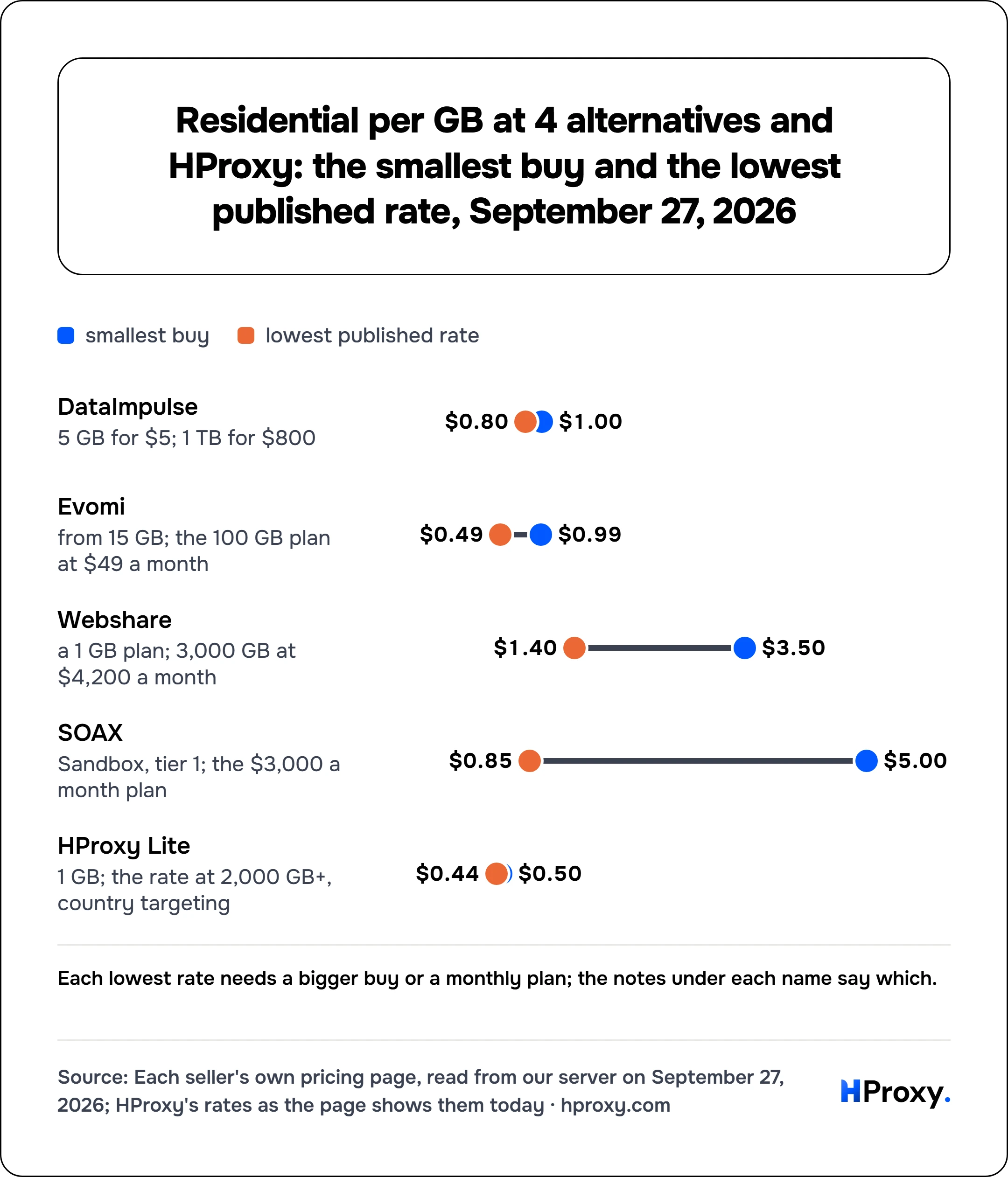
- smallest buy
- lowest published rate
Prices here are in dollars and those of Caiji in yuan. We print both as each seller prints them, without converting.
Which one to pick
- You work inside China, hold a Chinese ID card and need China IPs for Chinese sites: Caiji is built for that job.
- You need IPs outside China, or you cannot pass its ID check: a seller such as ours, with no documents at sign-up.
- You need China IPs by the GB, with no documents at sign-up: a residential line that reaches China by country, such as our Lite at $0.50/GB for 1 GB.
- You need city or ISP targeting from one GB: our Premium pool at $1.49 for one GB.
Whichever seller you pick, test what you get with our free proxy checker. It checks HTTP and SOCKS proxies with no sign-up.
The limits of this record
We did not buy from Caiji, so nothing here measures its network, and we did not try its ID check. Its pool counts are its own claims, and its two sites disagree on the number of cities. Its prices carry a label for a limited offer, so they may change soon. Prices are in yuan as printed, not converted, and this page is due for a check by 27 December 2026.
Sources
Read on 27 September 2026, from our server:
- Caiji: the app site and its plans page, the HTTP site and its four price pages, the privacy policy, the user agreement and the about page.
- Verisign, registry record for caiji.com, and the Internet Archive captures of caiji.com and h.caiji.com.
- PrivateProxyReviews, Proxygraphy and ResiProx China lists, the Evomi China page and the Kuaidaili refund rules.
- DataImpulse, Evomi, Webshare and SOAX pricing pages, the DataImpulse targeting docs and the Webshare help center.
- HProxy, our China page, our KYC and payment pages, and our product catalogue.