
Buying a residential proxy for Canada is a narrower decision than the generic "best proxies" search suggests, because the reasons to want a Canadian IP specifically are concrete: Canadian prices in CAD, Canadian search results, Canadian stock, and the French-language layer that only Quebec traffic reveals. This guide covers those jobs plainly, what a Canadian exit cannot do, and how buying one works here, with every number on the public pricing page.
What a Canadian exit IP actually changes
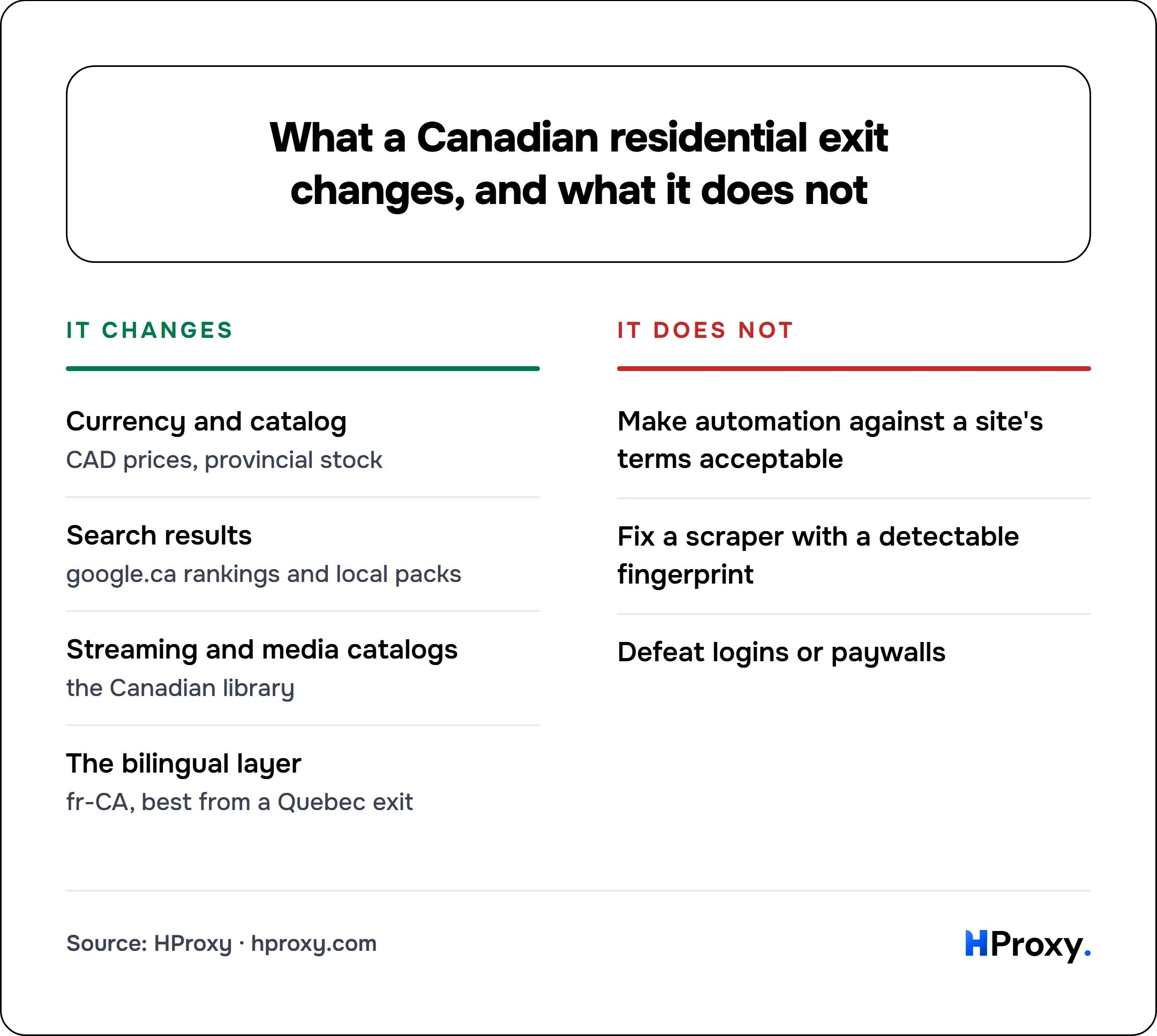
A residential proxy in Canada routes your traffic through a real Canadian home connection, so every site you touch treats the visit as a Canadian household. Four things flip the moment that happens:
- Currency and catalog. Canadian retailers price in CAD, run their own promotions, and gate stock by province. The .ca storefront a Canadian sees is not the .com storefront with a currency toggle; assortments and prices genuinely differ.
- Search results. google.ca ranks its own way, local packs are Canadian, and ads target Canadian users. Rank tracking for a Canadian client from a US or European IP reports someone else's results.
- Streaming and media catalogs. Canadian libraries are licensed separately, and broadcasters gate to Canadian IPs. A Canadian exit sees the actual Canadian catalog, which is the whole point of geo-testing it.
- The bilingual layer. Canada serves content in English and French, and sites localize by region signals, not just browser language. Testing what a Montreal visitor gets in French is a real QA job that only a Canadian, and ideally a Quebec, exit performs honestly.
The jobs, by name
Retail price and stock monitoring. Canadian storefronts of the big retailers, and the Canadian-only chains, get monitored for CAD pricing, provincial availability, and promotion timing. These are exactly the defended targets where a datacenter IP draws a challenge page and a residential one reads as a shopper.
google.ca rank tracking. Position tracking for Canadian keywords needs Canadian exits, city-level ones if local packs matter. With city targeting, a Toronto exit and a Vancouver exit can disagree, and that disagreement is the data.
Quebec French testing. Confirming the fr-CA experience: the redirect behavior, the translated catalog, the province-specific legal text. A Montreal residential exit shows what an anglophone office in another country cannot see.
Marketplace and classifieds monitoring. Canadian classifieds and resale platforms localize listings by metro area, so watching a market means exiting from that metro, not from Canada in general.
Ad verification. Confirming Canadian campaigns serve in Canada, on real residential connections, the way the audience actually sees them.
What a Canadian proxy does not do
House honesty, stated once: a Canadian IP changes where you appear to be, and only that. Automation against a site's terms stays unacceptable, a scraper with a detectable fingerprint stays detectable, and logins and paywalls stay in place. If a job fails from your own IP for reasons other than location, it will fail from a Canadian one too. What the clean exit buys you is the first gate: being treated as a normal Canadian visitor instead of a flagged server.
It changes
Currency and catalog
CAD prices, provincial stock
Search results
google.ca rankings and local packs
Streaming and media catalogs
the Canadian library
The bilingual layer
fr-CA, best from a Quebec exit
It does not
Make automation against a site's terms acceptable
Fix a scraper with a detectable fingerprint
Defeat logins or paywalls
How buying it works here
The Canadian slice is part of the standard pool, not a separate product with its own price tag:
- Top up the wallet from $2 by Visa, Mastercard, PayPal, Alipay, Bitcoin or Ethereum. The balance never expires.
- Generate residential credentials in the dashboard and set the country to Canada. For a specific city like Toronto, Montreal or Vancouver, or a Canadian ISP, use Residential Premium. The Canada proxies page shows the coverage in detail.
- Pay per gigabyte from $0.44 per GB on Lite or $1.00 per GB on Premium, no subscription. Rotating per request for scraping jobs, sticky sessions for anything that needs one IP to hold.
Before spending anything, the free proxy list's Canada slice is live and re-verified every few minutes: enough to prove your code path end to end. Run any exit through the proxy checker to confirm it really reports a Canadian location before you trust it. That test-on-free, run-on-residential split is the cheapest way to buy proxies in any country, and the wider method for judging providers is in best place to buy residential proxies.
Sizing a Canadian job
Canadian monitoring jobs are usually lighter than people budget for. Lean page fetches with images blocked run thousands of loads per gigabyte, so a daily price sweep of a few hundred .ca product pages sits comfortably in single-digit gigabytes a month. Measure twenty representative requests, multiply out, and buy that, the arithmetic is worked through in how much residential proxies cost. With a non-expiring balance, overbuying slightly costs nothing, because September's leftover gigabytes are still yours in December.