Search "best Chinese proxies" and you will get a tidy ranked list: NodeMaven, Webshare, Oxylabs, Bright Data, SOAX, MarsProxies, Decodo, NetNut, IPRoyal. It looks like a survey of China's proxy industry. It is not. Not one company on that list is a Chinese operator. They are Western brands that resell access to Chinese IP addresses, ranked for readers who pay in dollars, and the actual Chinese companies that run this market do not appear anywhere.
We run a competing proxy network and we track every corner of this business, including the parts that are inconvenient for us to talk about. This is one of them: the English-language "Chinese proxy" roundup is one of the most systematically wrong pieces of content in the whole proxy world, and the correction is not a small edit. There is an entire industry of real Chinese operators, with legal entities, telecom licenses and head offices, that these lists never mention, plus a darker export tier the lists quietly launder by naming its Western resellers instead of its actual source. Here is the map those lists never draw.
What the "best Chinese proxy" lists actually show you
Take a concrete example. Pixelscan's April 2026 roundup, titled as a review of nine Chinese proxy providers, lists NodeMaven, Webshare, Oxylabs, Bright Data, SOAX, MarsProxies, Decodo, NetNut and IPRoyal. Every one of those is a Western company.
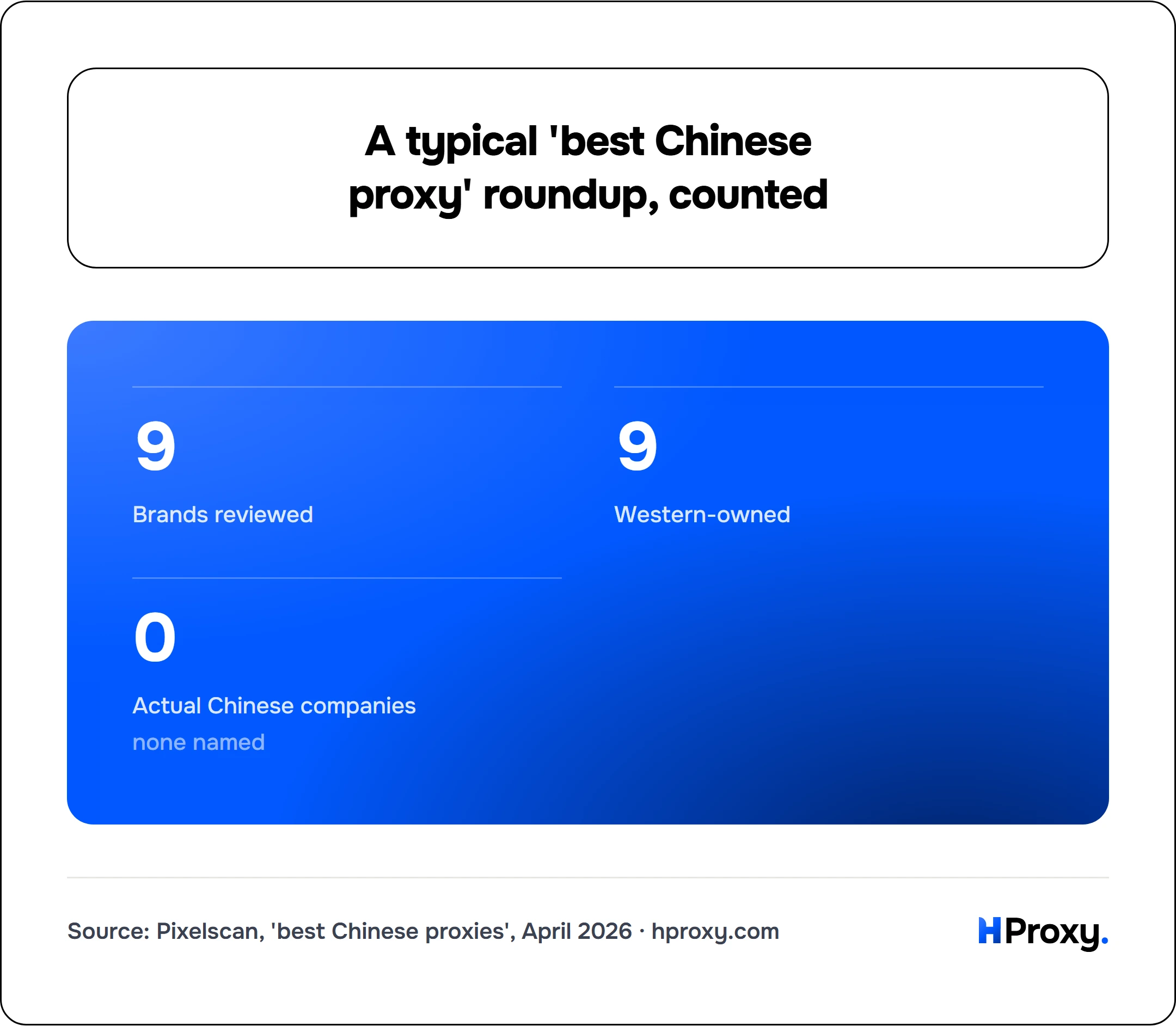
- 9
- Brands reviewed
- 9
- Western-owned
- 0
- Actual Chinese companies
none named
This is not one careless article. Proxyway's own China provider ranking tops out with Decodo, Oxylabs, Bright Data, SOAX and Webshare, and again lists zero Chinese-owned operators in its trust ratings. The pattern holds across nearly every English roundup: the "Chinese proxy" review is a review of Western brands that happen to sell Chinese exits.
And these are not random Western brands. Several of them are close cousins. As we documented in who owns your proxy provider, Oxylabs, Webshare and Decodo all trace back to the same Lithuanian house (Oxylabs owns Webshare, and Decodo is the former Smartproxy from the same portfolio). Bright Data is Israeli. So a "Chinese proxy" list can be three Lithuanian siblings, an Israeli company, and a couple of independents, with the actual Chinese industry left entirely off the page.
The most telling entry is Bright Data. Bright Data deliberately excludes Chinese IPs from its residential network, offering an "all except CN" configuration, most likely to stay clear of China's data-protection law. A provider that removes Chinese IP addresses from its pool has no business anchoring a "best Chinese proxy" ranking, and yet there it sits.
Two different questions hiding in one search
To be fair to the roundups, "Chinese proxy" is genuinely ambiguous, and part of the confusion is baked into the phrase. It can mean two different things:
- A proxy that gives you a Chinese exit IP, so a target site sees a connection from inside China.
- A Chinese proxy company, an operator that is itself based in and run from China.
The Western brands are a real answer to the first question. Oxylabs advertises a large Chinese pool with free city-level targeting, and brands like MarsProxies sell static China IPs. If you are a Western company that needs to see a Chinese e-commerce site as a local user would, buying that access from Oxylabs, Decodo or another Western vendor is a legitimate, well-supported choice, and our head-to-heads with those brands are honest about where they win.
The problem is that the roundups pose the article as an answer to the second question ("Chinese proxy providers") while only answering the first. A reader comes away believing they have seen the Chinese proxy industry, when they have seen the Western resale counter in front of it. The actual industry, the companies sourcing and operating these networks from inside China, is never introduced.
The real Chinese proxy operators
So let us introduce it. These are operators whose corporate identity we could tie to a Chinese business registration or an ICP filing (ICP is the Internet Content Provider license every legal Chinese website must display). Pool sizes are the numbers each vendor advertises, and vendors inflate them universally, so read them as claims, not audited figures. What is verifiable is the company behind each brand.
| Operator | Registered entity | Base | Notable |
|---|---|---|---|
| Kuaidaili | Jishan Technology (Beijing) Co., Ltd. | Beijing | Founded 2013, holds both MIIT B1 (IP-VPN) and B2 licenses |
| Xiequ | Beijing Xiequ Information Technology Co., Ltd. | Beijing | Trading since 2006, university joint lab, no overseas nodes |
| Xiaoxiangdaili | Xiangzhi Technology (Wuhan) Co., Ltd. | Wuhan | Founded 2017, full B1 and B2 telecom licenses |
| Xiongmaodaili | Hangzhou Mengqi Technology Co., Ltd. | Hangzhou | Holds a domestic VPN business permit, rare in this market |
| Qingguo (qg.net) | Qingguo Network | Quanzhou, Fujian | State "Gazelle Enterprise" designation, 2022 to 2025 |
| Zdaye | Shenyang Xiaotukeji Co., Ltd. | Shenyang, Liaoning | Founded 2012, National High-Tech Enterprise certificate |
| Shenlong | Nanjing Xiaobei Information Technology Co., Ltd. | Nanjing, Jiangsu | Runs split domestic and overseas brands |
| Cloud Proxy (ip3366) | operating as 云代理 | Anhui | Holds a B1 IP-VPN license |
Two things stand out. First, this is not a fringe of anonymous sites. MIIT is China's Ministry of Industry and Information Technology, and its B1 (IP-VPN) and B2 (value-added telecom) licenses are the real regulatory bar. Most proxy brands worldwide operate without anything like it, yet Kuaidaili and Xiaoxiangdaili hold both, and Xiequ pairs a 2006 founding with a joint research lab at Beijing Jiaotong University and a client list that reportedly includes state-linked names. In compliance terms, several of these Chinese operators are more formally licensed than the Western brands the roundups prefer.
Second, they are almost entirely invisible in English. They run Chinese-language sites, price in RMB, and take support over WeChat and QQ rather than email or a Western-style dashboard. That is the whole reason the review market skips them: they never courted it. It is a language and payment gap masquerading as an absence.
Jiangsu: the province that quietly runs the industry
Here is a detail you will not find in any English roundup, because it only emerges once you read the corporate filings. The registrations cluster hard in one province: Jiangsu.
Of the operators whose business records we traced, at least eight are registered in Jiangsu, spread across Nanjing, Changzhou and Xuzhou. Nanjing alone accounts for several of them.
| Operator | Registered city | Registered entity |
|---|---|---|
| Shenlong | Nanjing | Nanjing Xiaobei Information Technology Co., Ltd. |
| Caiji | Nanjing | Jiangsu Lihe Media Co., Ltd. |
| Wandouip | Nanjing | Nanjing Siyanrui Network Technology Co., Ltd. |
| Quanmin IP | Nanjing | Nanjing Lizheng Network Technology Co., Ltd. |
| Xiaoxiongip | Changzhou | Xiaoxiong Cloud (Jiangsu) Network Technology Co., Ltd. |
| LajiaoHTTP | Xuzhou | Jiangsu Yanbo Shuhai Network Technology Co., Ltd. |
That concentration is the kind of structural fact a genuine "state of the Chinese proxy market" article would lead with. A shortlist of Western resellers cannot surface it, because none of those resellers is registered anywhere near Jiangsu. This is a research snapshot rather than a full census, and it is still enough to place the industry's center of gravity somewhere no English list has ever pointed.
The part the roundups really should warn you about
Now the uncomfortable half. Not naming the real Chinese operators is one failure. The bigger one is that the roundups also skip the single most important thing a China-facing buyer needs to understand: a large slice of the export-facing "Chinese residential" supply is sourced the way botnets are sourced.
This is a separate tier from the licensed domestic operators above. It is a set of brands fronted by Hong Kong shell companies, and in January 2026 Google's Threat Intelligence Group and partners disrupted the hub behind it, a network called IPIDEA. IPIDEA sat behind a cluster of consumer proxy brands (360Proxy, 922Proxy, ABCProxy, Cherry Proxy, IP2World, LunaProxy, PIA S5 Proxy, PyProxy, TabProxy and others), and its residential pool was built partly from ordinary devices infected through bundled SDKs, the small software kits developers embed in apps.
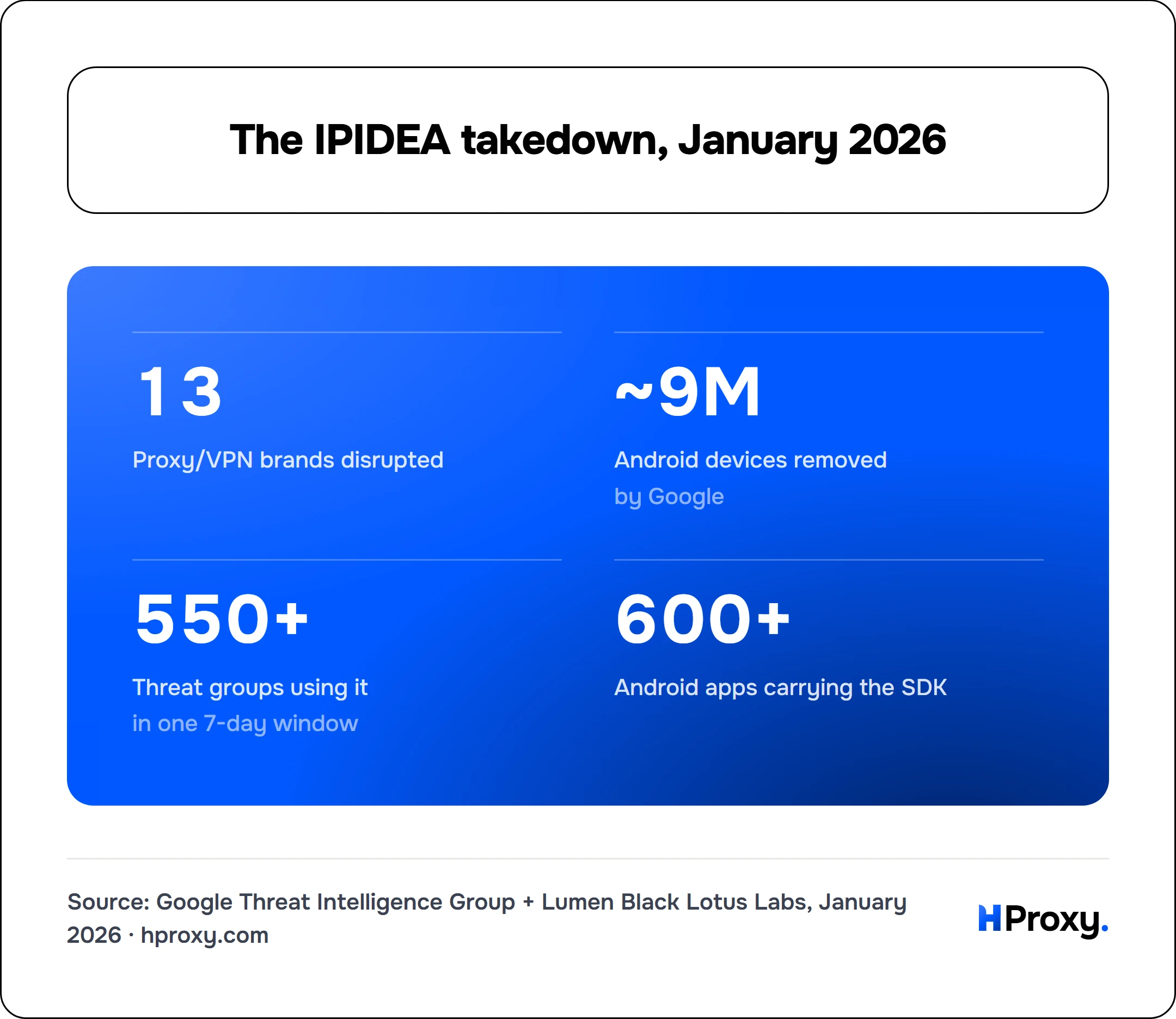
- 13
- Proxy/VPN brands disrupted
- ~9M
- Android devices removed
- 550+
- Threat groups using it
- 600+
- Android apps carrying the SDK
by Google
in one 7-day window
None of this is new in shape. 911 S5 came first: the residential-proxy botnet whose operator was arrested in 2024 after building a pool from 19 million hijacked devices, a story we told in full in what happened to 911 S5. When 911 S5 stopped in July 2022, the end date the US Justice Department gives, 922Proxy opened within weeks with its own pitch: a "Perfect replacement for 911". When IPIDEA fell, researchers noted that killing a brand is not the same as killing a network, and successors were expected within months. We watched the same template play out on smart TVs in the NetNut botnet takedown.
The academic record backs the scale. A peer-reviewed study presented at the ACM Computer and Communications Security conference in 2022 identified 399 distinct Chinese residential-proxy services and found that around 80% of the Chinese residential proxy IPs it observed carried at least one malicious traffic flow, and that 91% of them lived less than ten days. That is the export tier the roundups are indirectly selling when they rank a brand reselling "China residential" without a word about where those IPs come from.
The point is not "Chinese proxies are malware." It is more precise and more useful than that. The licensed domestic operators (Kuaidaili, Xiequ and the rest) mostly serve scraping inside China and are not the botnet story. The export-facing, shell-fronted tier is. A roundup that cannot tell these apart, and mostly hides both behind Western resellers, is not equipped to keep you out of the one that matters. And you should apply the same sourcing question to a Western brand, because a botnet-sourced IP is burned before you send a single request no matter whose logo is on the invoice. Our how to vet a proxy provider guide turns that sourcing question into a checklist.
The limits of this map
A few limits on everything above, because this is exactly the kind of piece that gets waved away if it overstates.
The pool sizes are vendor claims, and this market inflates them as a rule. Chinese corporate-registry data is genuinely hard to verify from outside the country, since the registries require a Chinese login, so the operator identities here rest on ICP filings and the companies' own published registrations rather than a paid registry pull. A handful of the smaller brands we came across could not be tied to a verifiable entity at all, and those are not in the tables above. The map is also dated: rebrands, closures and takedowns happen constantly in this corner of the market, so treat every specific as true as of mid-2026 and check the primary source if a detail is load-bearing for you.
What does not change is the structural claim, and it is the one thing the English roundups get wrong every single time: there is a real, large, mostly licensed Chinese proxy industry, it is centered in Jiangsu and Beijing, and it is not on any "best Chinese proxy" list you have read.
Where HProxy fits
We are not a Chinese proxy provider, and we are not going to pretend to be one to catch the search traffic. HProxy is an independent, Western network priced at $0.44/GB pay as you go, with a balance that never expires. We wrote this for the same reason we wrote the ownership map: it is the kind of accuracy a provider with something to hide would never publish, and we would rather compete on being able to tell you plainly what we are, what we are not, and where our IPs come from.
If what you actually need is a Chinese exit IP, now you know the real choice: a Western reseller of China access, or one of the genuine Chinese operators above, and in both cases the question that decides your safety is how the pool is sourced, not whether the brand sounds Chinese. If you want to see a network before you trust anything anyone says about it, run any provider's IPs through our free proxy checker to see the real exit and the network behind it, browse the live free China proxy list, and start on residential proxies when you are ready.
Sources
- Pixelscan, best Chinese proxies roundup (the nine Western brands listed as "Chinese proxy providers", April 2026)
- Proxyway, China proxy providers (top ratings led by Decodo, Oxylabs, Bright Data, SOAX, Webshare; no Chinese-owned operators)
- Google Cloud Threat Intelligence, Disrupting the largest residential proxy network (IPIDEA cluster, 13 brands, ~9M Android devices, 550+ threat groups, SDK sourcing)
- Help Net Security, IPIDEA proxy network disrupted (takedown date and scope, January 29, 2026)
- Mingshuo Yang et al., An Extensive Study of Residential Proxies in China, ACM CCS 2022 (399 Chinese RESIP services; ~80% carried malicious traffic; 91% lifespan under 10 days)
- Bright Data, proxy network FAQs at docs.brightdata.com/proxy-networks/faqs ("all except CN" residential configuration; Chinese IPs excluded)
- Kuaidaili, company and licensing (Jishan Technology Beijing; B1 and B2 licenses; 2013 founding)
- Xiequ, xiequ.cn (Beijing Xiequ Information Technology; 2006; university joint lab; clean regulatory posture)
- Xiaoxiangdaili, about page (Xiangzhi Technology Wuhan; B1 and B2 licenses)
- KrebsOnSecurity and U.S. Treasury, 911 S5 sanctions (May 2024: the sanctions over 911 S5, which closed in July 2022)
- U.S. Department of Justice, 911 S5 botnet dismantled and its administrator arrested (29 May 2024: the indictment dates the 911 S5 sales through July 2022)
- Internet Archive, the 922proxy.com homepage of 23 August 2022 (922Proxy's own "Perfect replacement for 911" pitch)