Every proxy provider page, ours included, is built from advertised prices and claimed pool sizes. Those two materials cannot tell you what you actually need to know, so this page spends most of its length on what they leave out.
What we know about AlterLab, and what we do not
Their site is alterlab.io.
We have no verified current rate for AlterLab on file. Printing a guess would make this page worse than useless, so the price row below is empty and the reading list is not.
Check the reachable rate, the minimum, the expiry terms and the failure billing, and date your note. A price without those four attached is not a price.
The site, as it reads today
Their homepage title, read on 9 September 2026: "AlterLab, Web Scraping API , Scrape Any Website, Get Clean Data". The blurb under their search result reads: "Web scraping API that handles JavaScript rendering, anti-bot challenges, and data extraction in one API call. Pay-as-you-go from $0.0002/request in USD , no monthly subscription. 195+ proxy countries, Python and Node.js SDKs. 5,000 free requests to start."
Also on the page, stated plainly:
The product lines named on that page are residential and a scraping or SERP API. They advertise 195 countries or locations. Payment methods mentioned: cards. The page offers some form of free trial. Their pricing page is titled "Web Scraping API Pricing , Free Trial, Pay-as-You-Go, AlterLab".
Every line above is a quotation from their marketing rather than a measurement by us. It is included because it is checkable, not because it is evidence of performance.
What AlterLab publishes
A crawl of 540 pages on 19 June 2026 returned 63 blog pages, 2 pricing pages, 11 use-case pages and 26 integration pages.
Site size is a signal about marketing budget rather than network quality, and the two are frequently unrelated. It is useful for a different reason: a provider with many pricing pages is usually segmenting hard, and a provider with none is selling by quotation.
How recently the site moved
Our crawl of their site found 390 pages carrying a date, 22 of them articles. The oldest is from June 2026 and the newest from August 2026. 390 of them carry a date inside the last twelve months.
Timestamps are not quality, and a company still publishing is at least a company still trading. That is worth more than it sounds in a market where providers disappear without notice.
What you still do not know after reading their site
Shared or dedicated changes everything
Ask how many accounts can sit on one address at once. Where the answer is unlimited or unspecified, price the plan as shared regardless of what the product is called.
Who pays for the requests that fail
Some vendors bill every request, some bill only successful ones, and the difference is the whole comparison once a target starts blocking. A cheap rate with a fifty percent success rate is twice its advertised price.
The limit that stops the job
A plan with generous traffic and a low thread limit is a slow plan. Find both numbers before you size anything, because the smaller of the two is your actual ceiling.
The two of us, on the questions that matter
Compare on these rows and ignore the feature lists on both sites:
| Question to ask | AlterLab | HProxy |
|---|---|---|
| Entry price | Not verified by us, read their page | From $0.44/GB, pay as you go |
| Does unused balance expire? | Read their current terms | Never |
| Minimum commitment | On their own terms page | None |
| Identity checks | Not published clearly, ask before paying | Card orders are screened, and verification is sometimes requested |
| Targeting | Check the current terms, this one moves | Country, city and ISP |
| Free way to evaluate | Their terms page answers this | Free proxy list and proxy checker |
A table like this can rank the things that are written down. It cannot rank the thing that matters most, which is how the network behaves against the site you care about.
The test that beats this page
It is a small amount of money for an answer that is actually about your target.
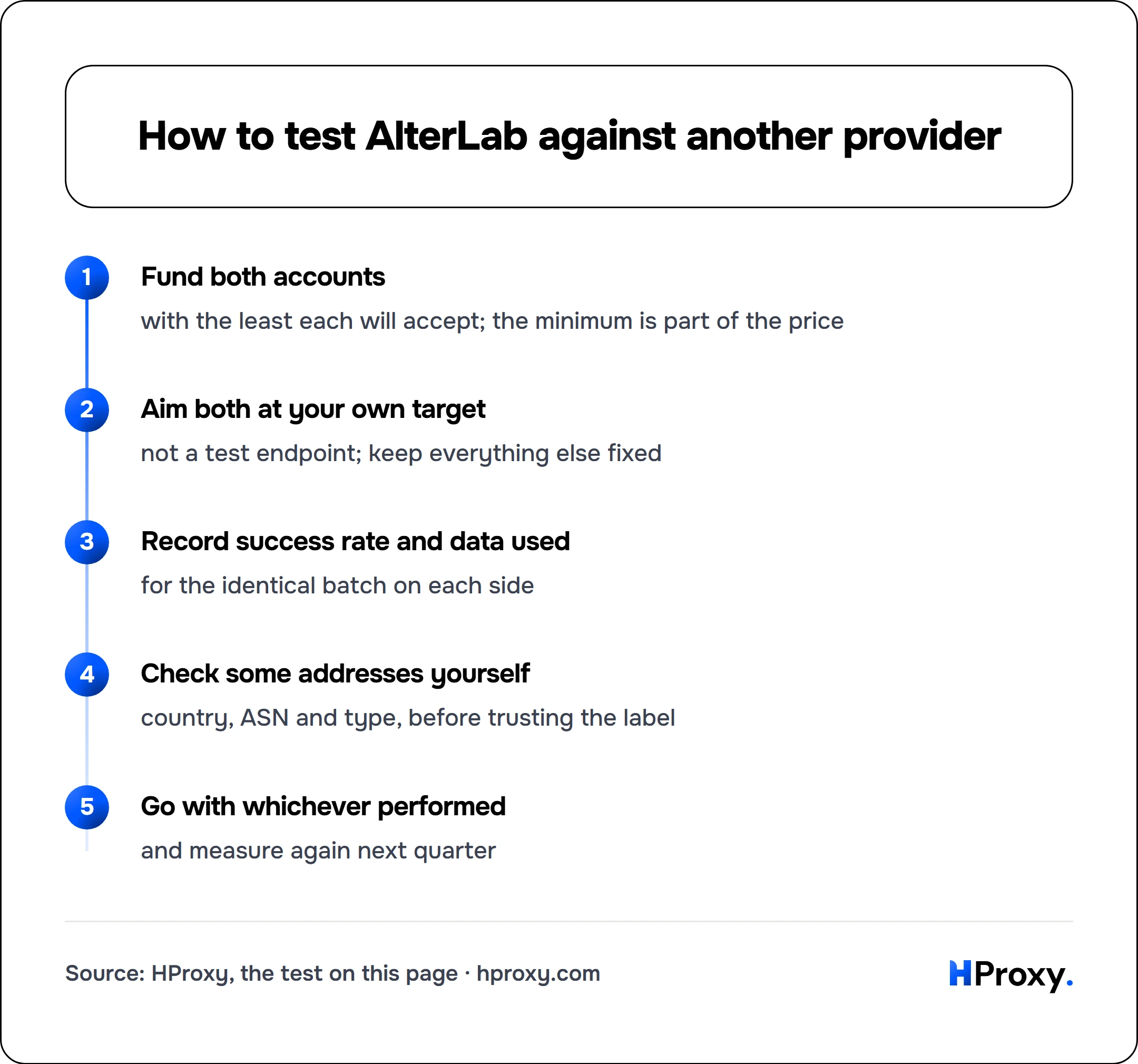
- Fund both accounts with the least money each will accept, and note what that minimum was, because it is part of the comparison.
- Aim both at the page that matters to you rather than a test endpoint, and keep every other variable fixed.
- Record the success rate and the data consumed for the identical batch on each side.
- Check some of the addresses yourself for country, ASN and type before you trust the label on the plan.
- Go with whichever performed, then measure again next quarter. Networks change underneath you.
Fund both accounts
with the least each will accept; the minimum is part of the price
Aim both at your own target
not a test endpoint; keep everything else fixed
Record success rate and data used
for the identical batch on each side
Check some addresses yourself
country, ASN and type, before trusting the label
Go with whichever performed
and measure again next quarter
The rest of the shortlist
Buyers comparing this name usually have two or three of these open in other tabs:
- Xkdaili (星空代理) alternatives
- YiLu Proxy alternatives
- You Proxy alternatives
- Youproxy alternatives
- YourPrivateProxy alternatives
Our own position
Our end of it is a wallet, four proxy types and no contract. Residential begins at $0.44 per GB and the balance does not expire. The free proxy list and checker are open to anyone, and they are the fastest way to see how we treat measurement before you spend anything.