Zyte advertises from $0.06 per 1,000 successful responses. The same page publishes a rate of $16.08 per 1,000, which is 268 times higher. Both are real, and three things decide which one applies to you. Your monthly commitment, whether the request needs a browser, and the tier Zyte assigned your target. This page lays out that grid and shows what moves you across it, from figures read on 9 September 2026.
We sell competing proxies and scraper endpoints, so weigh our reading accordingly. The grid is theirs and the arithmetic is ours.
The short version
The advertised $0.06 needs a $500 monthly commitment, an HTTP response rather than a browser one, and the easiest of five website tiers. On pay as you go the cheapest published rate is $0.13. Zyte assigns your website's tier automatically, reviews it quarterly and gives two weeks notice of a change, so your unit price is not something you choose. In exchange, bans and rate limits cost nothing at all.
What Zyte publishes
The pricing page is a grid rather than a ladder. Rows are commitment levels, columns are request types, and each cell spans five website tiers.
Zyte API published rates, per 1,000 successful responses
| Minimum commitment | HTTP response body | Browser rendered |
|---|---|---|
| Pay as you go | $0.13 to $1.27 | $1.01 to $16.08 |
| $100 per month | $0.10 to $0.95 | $0.75 to $12.00 |
| $200 per month | $0.08 to $0.76 | $0.60 to $9.60 |
| $500 per month | $0.06 to $0.61 | $0.48 to $7.68 |
| Enterprise | further discounts, contact sales | further discounts, contact sales |
zyte.com pricing page, read 9 September 2026
Read the corners of that grid before anything else. The cheapest published cell is $0.06 and the dearest is $16.08, and both appear on the same page.
Dividing one by the other gives 268. That is the full published span of what a thousand responses can cost you here.
Where the headline sits
The site advertises "From $0.06 per 1,000 successful responses". That figure is the cheapest corner of the grid, and reaching it needs three things at once.
It needs a $500 monthly commitment, which is the deepest discount level short of enterprise. It needs an HTTP response rather than a browser rendered one. It needs the easiest of the five website tiers.
On pay as you go, the cheapest published rate is $0.13 per thousand. That is more than double the headline, and it is what a new customer actually pays.
None of this is hidden. The grid is published in full, which is more than most of this market manages. The headline simply reports its best cell.
Three things move your price
The grid has three axes, and you control fewer of them than you might expect.
Commitment you choose. Moving from pay as you go to a $500 monthly commitment cuts every published rate by between 52 and 54 percent.
Request type you mostly choose. A browser response costs about eight times an HTTP one on the easiest tier. On the hardest tier the gap widens to about thirteen times.
Website tier you do not choose at all. Their documentation states that every pairing of website and request type belongs to a tier. That tier sets the base cost, and Zyte assigns it automatically.
What each axis is worth
| Change | Effect on the rate |
|---|---|
| Pay as you go to $500 commitment | 52 to 54 percent cheaper |
| HTTP body to browser rendered, easiest tier | about 8 times dearer |
| HTTP body to browser rendered, hardest tier | about 13 times dearer |
| Easiest website tier to hardest, HTTP | about 10 times dearer |
| Easiest website tier to hardest, browser | about 16 times dearer |
our own arithmetic on advertised figures, 9 September 2026
The website tier is the largest single factor, and it is the one assigned to you.
The tier is assigned, reviewed and can change
This is the term that deserves the most attention, and it is easy to miss. It sits in the documentation rather than on the pricing page.
New combinations of website and request type start on a temporary tier. They stay there until enough data is gathered for a permanent assignment.
Assignments are then reviewed quarterly. Affected customers receive two weeks notice of any tier change.
So your unit price can move without you changing anything about your job. A target that gets harder to reach becomes more expensive to reach, and the vendor decides when.
That is defensible as engineering, since a harder site genuinely costs more to serve. It is still a budgeting fact worth knowing before you build a forecast on today's rate.
The billing rule is the best in this market
Their documentation draws a line most vendors do not. You are not charged for rate-limiting responses, and you are not charged for unsuccessful responses.
A response counts as successful when it provides the requested data ban-free. It also counts as successful when the target returns a bad response for any reason but a ban.
So a 404 from the target site is charged, and a ban is not. That line is drawn by engineering rather than by billing, which is rare here. It puts Zyte ahead of every rival we priced this week.
We have now read four vendors' definitions of a chargeable request. They are worth setting side by side, because the differences are money.
How four vendors define a chargeable request
| Vendor | What you are charged for |
|---|---|
| Zyte | successful responses only; bans and rate limits are free, target 404s are charged |
| ScrapingBee | 200, 404 and 410; Auto-Mode costs nothing if every configuration fails |
| ZenRows | successful requests, with 404 and 410 counted as usable results |
| ScraperAPI | 200 and 404, plus requests you cancel before 70 seconds have passed |
four vendor pricing pages and documentation, all read 9 September 2026
Every one of the four bills a 404. Only Zyte states plainly that a block costs you nothing.
No overage penalty
One more term is worth quoting, because it removes a common trap. Exceeding your minimum commitment is charged at your current discounted rate, never at an additional fee.
That matters because the commitment here is a discount level rather than an allowance. Nothing expires and nothing is forfeited if you undershoot the number you committed to.
Compare that with the bundle vendors in this batch, where an unused allowance is simply lost. We worked that arithmetic through in the SerpApi teardown.
The proxies are inside the price
Zyte bundles datacenter, residential and rendering into one automated API, and charges only for what a request needed. That is convenient, and it has one consequence for comparison.
You cannot separate the proxy cost from the request cost, because the split is not published. A Zyte rate is therefore not comparable to a per-gigabyte residential price at all.
The comparison that does work is against another per-request API, which is what the table below does. Anyone weighing a bundled API against raw proxies must price their own bandwidth first. Our headless browser bandwidth study sets out that method.
The comparison, converted to one number
Every row is money for one thousand browser rendered requests, which is what a defended target needs.
Cost per 1,000 rendered requests
| Where you buy it | Plan or tier | Per 1,000 requests |
|---|---|---|
| Zyte, easiest tier | $500 commitment | $0.48 |
| Zyte, easiest tier | pay as you go | $1.01 |
| ScrapingBee, premium and rendering | Startup, $99 | $2.48 |
| ZenRows, rendering and premium | Launch, $57 | $5.70 |
| ScraperAPI, ultra premium rendered | Business, $299 | $7.48 |
| Zyte, hardest tier | pay as you go | $16.08 |
| HProxy scraper API | no plan | published on our scrapers page |
five vendor pricing pages and our own arithmetic, 9 September 2026
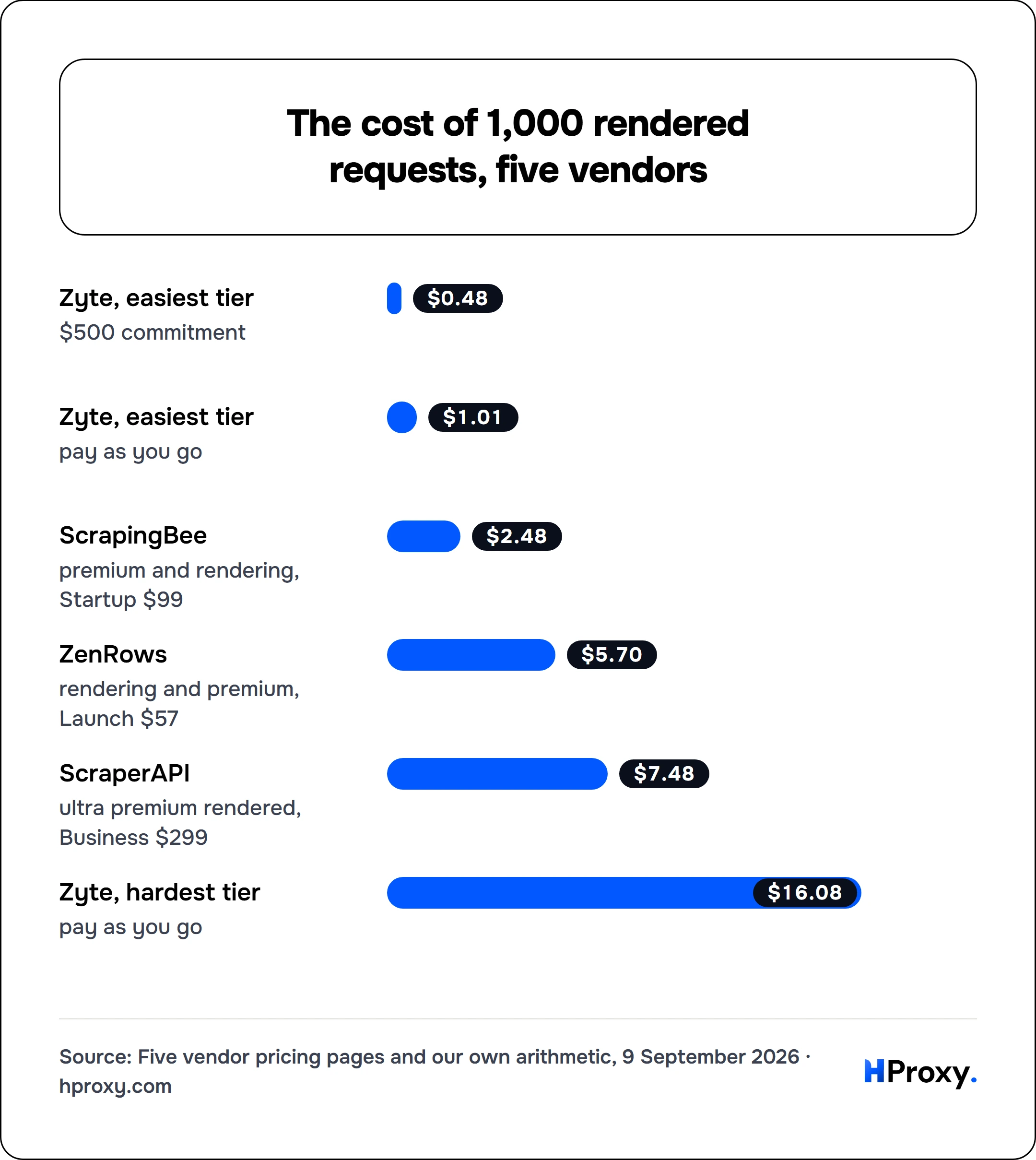
Zyte occupies both ends of that table, which is the honest summary of this pricing model. Our own unit is one successful call from a balance that does not expire. The rate is fixed rather than assigned.
What is metered on top
The base rate covers the response. Several features are billed separately, and the documentation publishes most of them.
Charges beyond the base tier
| Feature | Published cost |
|---|---|
| Screenshot | $0.002 each |
| Automatic extraction | $0.0004 to $0.0016 per data type |
| Automatic extraction, serp | no charge |
| Custom attributes, extract method | fixed $0.001 |
| Custom attributes, generate method | $0.002 per 1k input tokens, $0.01 per 1k output |
| Actions | by CPU and network consumption, no rate published |
| Network captures | by output size, no rate published |
docs.zyte.com Zyte API pricing, read 9 September 2026
A screenshot at $0.002 is $2.00 per thousand, which can exceed the base rate it sits on top of. On the easiest HTTP tier at a $500 commitment, a screenshot costs more than thirty times the response itself.
Who this pricing suits
Zyte suits people scraping easy targets in volume who can commit $500 a month. At $0.06 per thousand HTTP responses, nothing else we priced this week comes close.
It suits anyone whose blocks are expensive elsewhere. Bans and rate limits cost nothing here, which on a hard target can outweigh a higher rate.
It suits people who need a firm forecast less well. The tier is assigned rather than chosen, and it can move on two weeks notice.
It suits low volume on hard targets poorly. Pay as you go on the hardest browser tier is $16.08 per thousand. That is the dearest published rate in this whole batch.
The same conversion for rivals sits in our ScrapingBee, ZenRows and ScraperAPI teardowns.
What we could not verify
The five website tiers are not published individually. Only the endpoints of each range appear, so we could not price the three tiers in between.
We could not determine which tier any specific website falls into. Their pricing page offers a calculator, and it needs your target rather than listing tiers.
Actions and network captures are billed on consumption with no published rate. We could not convert either into money.
We did not price Zyte Data or Scrapy Cloud, which sit on separate tabs of the same page. Each is a different product and deserves its own teardown.
Rates and tier assignments both move, and this vendor says so itself. Every figure here was read on 9 September 2026, so check the live pages before committing.
Sources
- Zyte, pricing page, read 9 September 2026. The commitment levels, the HTTP and browser ranges, the "From $0.06 per 1,000 successful responses" headline and the five-tier statement.
- Zyte, pricing page, read 9 September 2026. The $5 free credit, the 30 day trial, and the statement that exceeding a commitment is charged at the current discounted rate.
- Zyte documentation, Zyte API pricing, read 9 September 2026. Tier assignment being automatic, the quarterly review and the two weeks notice of a change.
- Zyte documentation, Zyte API pricing, read 9 September 2026. Screenshot, automatic extraction and custom attribute costs, stated as before volume discount.
- Zyte documentation, errors and responses, read 9 September 2026. The definitions of successful and unsuccessful responses, and the statement that rate-limiting and unsuccessful responses are free.
- ScrapingBee, ZenRows and ScraperAPI pricing pages and documentation, read 9 September 2026, for the comparison rows and the definitions table.
- Our own arithmetic on those published figures, 9 September 2026, shown in every table above.