GimmeProxy is gone. From May 2015 it did one thing: every call to its API returned one random public proxy that it had checked, in JSON, with no registration. The Internet Archive holds those answers month after month until January 2022, one last answer on 30 January 2025, and nothing after. The site was rebuilt as a template in August 2025, replaced by a placeholder in 2026, and on 6 September 2026 the domain answers "404 page not found". About 40 people a month still search for the name (Keyword Planner, September 2026), and the wrappers on npm, GitHub and CRAN still point at the dead endpoint. This is the record, and what to use now.
Every date below comes from the Internet Archive's captures of the site, of its API endpoint and of its developer's blog. The rest comes from the .com registry and from requests we made ourselves on 6 September 2026. Where the record is silent, this page says so.
What GimmeProxy was
The domain was registered on 21 April 2015 (registry record, read 6 September 2026). On 4 May 2015 its developer, a freelance web developer, announced it on a personal blog. The post describes the itch. Free lists were "not so FREE": sites let you see a few proxies and then "try to sell you full updated list for $3-20 per month". Proxies "advertised as 'checked' 3 minutes ago" did not work. So: "I decided to build my own free rotating proxy api." The first version took any string as a user id and returned one proxy as ip, country, type and a ready-made curl option.
The first archived homepage, dated 31 July 2015, carries the line the site kept for ten years: "New proxy with every request, no registration, no hassle."
By April 2016 the developer reported "700-800 working proxies at any given moment" and "60 requests per second to more than 1300 machines every day, peaking to 150 requests per second". The same post announced a filter API: country, port, and how recently the proxy was checked. The capture of 1 June 2016 shows 746 active proxies, 1,180,145 requests in the previous 24 hours, and a free limit of 20 requests a minute. In December 2016 the developer published three posts on how it was built: Node.js, Redis and Elasticsearch. A scraper run by cron every 30 minutes collected proxies "from websites like hidemyass or gatherproxy".
That last detail is worth holding on to. GimmeProxy did not find proxies. It read other people's public lists, checked them, and served the survivors one at a time. The value was the check.
What the site printed, year by year
| Capture | Proxies counter | Requests counter | Free plan | Paid keys |
|---|---|---|---|---|
| 1 June 2016 | 746 active | 1,180,145 in 24 hours | 20 requests a minute | an API key on request |
| 1 June 2018 | 7,242 active | 3,292,682 in 24 hours | 240 requests a day | €39, €119 and €399 a month |
| 1 June 2020 | 17,242 active | 3,392,682 today | 240 requests a day | €79.99, €99.99 and €179.99 a month, marked New Year Sale |
| 1 June 2022 | 17,242 active | 3,392,682 today | 240 requests a day | the same, still marked New Year Sale |
| 1 June 2023 | 17,242 active | 3,392,682 today | 240 requests a day | the same, still marked New Year Sale |
| 1 June 2024 | 7,380 working | 2,674,322 today | not shown | the same, still marked New Year Sale |
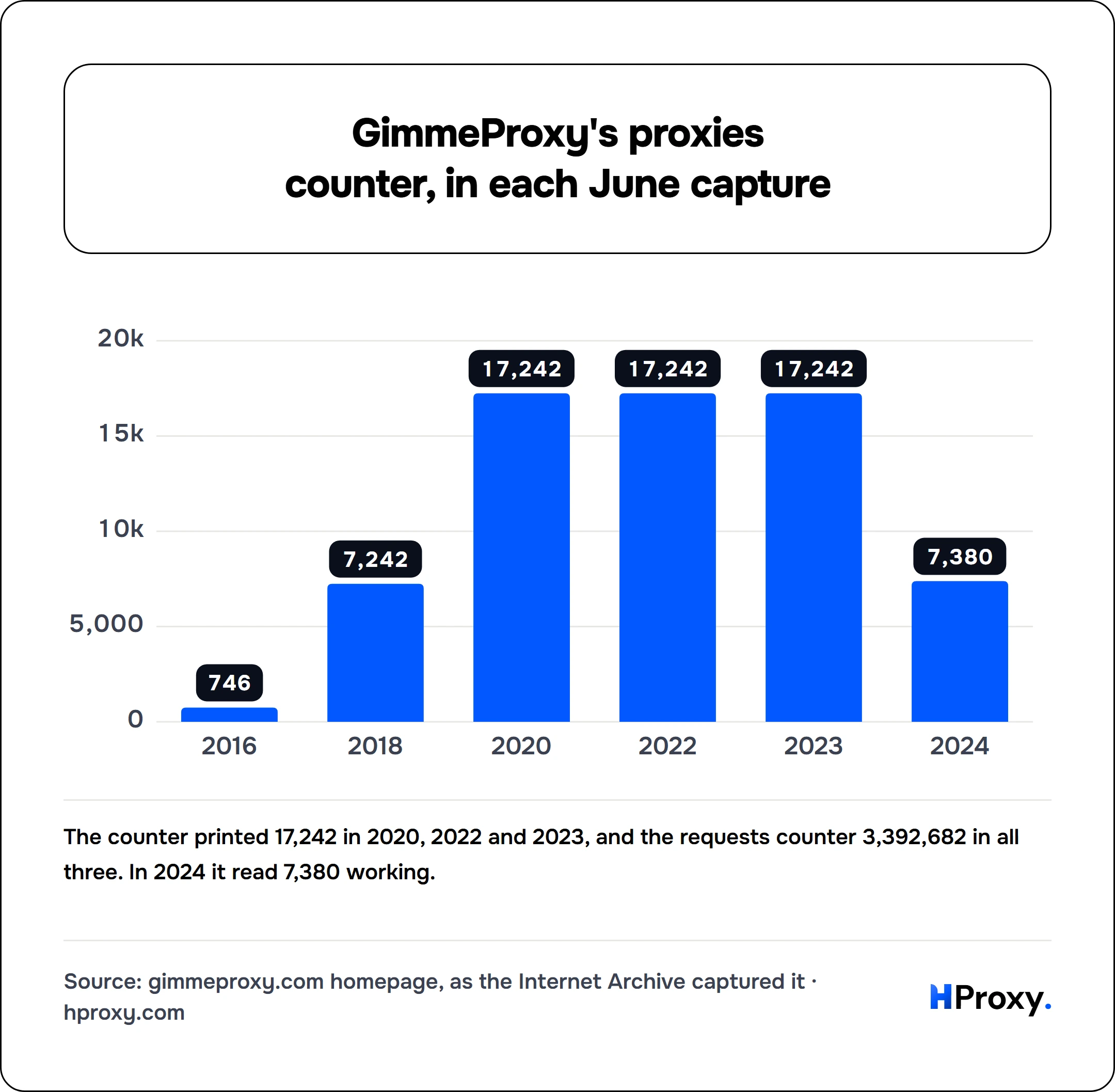
Source for every row: the counters, plan table and free plan line printed on the Internet Archive capture of that date, read on 6 September 2026. The 2018 page also sold a 48-hour evaluation key for €9.95.
Two things in that table date the decline better than any outage. The counters read 17,242 proxies and 3,392,682 requests on 1 June 2020, on 1 June 2022 and on 1 June 2023, to the digit. A live counter does not do that. And the New Year Sale that was on the page by June 2020 was still on the page in June 2024. Prices moved in one direction over the years. In February 2017 a user of the API wrote in a public bug tracker that it "costs $15 a month". By June 2018 the cheapest key was €39. By June 2020 it was €79.99, as a sale price.
When it stopped, from the API's own captures
The Internet Archive holds 102 monthly captures of the homepage, from 31 July 2015 to 13 April 2026, and separately 46 monthly captures of the API endpoint. The chart shows the homepage captures per year.
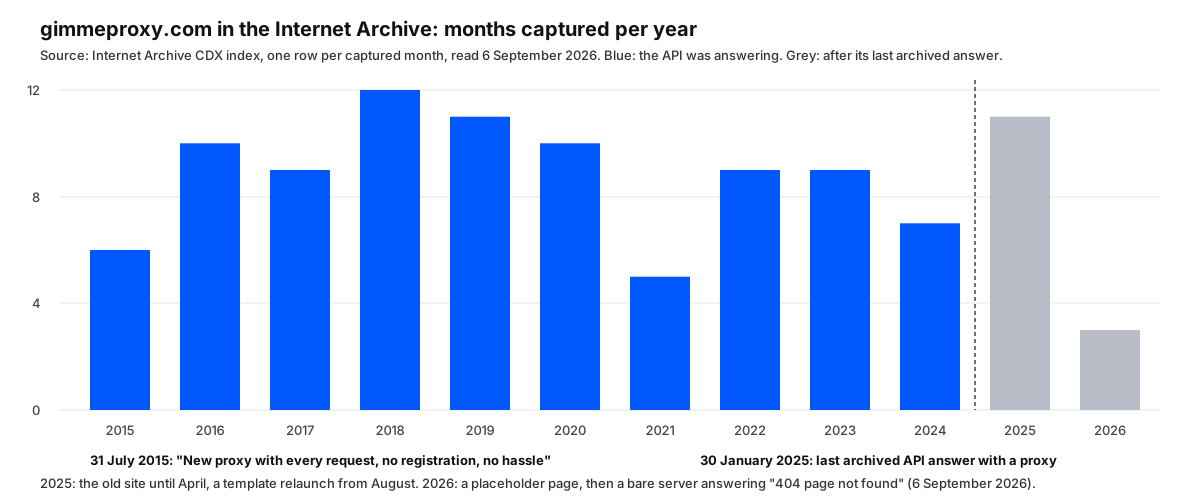
The API captures are the better clock. From 2 September 2015 to 8 January 2022 the archive holds 44 monthly responses with a proxy in them. The capture of 1 March 2023 is an error. Then come two responses on 30 January 2025. The one we read carries a SOCKS5 proxy checked 194 seconds earlier, by the response's own field. Nothing follows.
The homepage tells the rest. The old site, prices and all, was still archived on 24 April 2025. On 10 August 2025 the capture is a new page titled "Free Proxy API Service for Developers", promising "99.9% Uptime" and a "global CDN", with the same /api/getProxy path. On 18 February 2026 it is a generic page titled "API Service" that tells the reader to "contact your system administrator" for documentation. The 13 April 2026 capture is a 427-byte version of the same text.
On 6 September 2026 the name still resolves. The nameservers are at Cloudflare and the address belongs to a hosting company's network. The server presents a placeholder certificate that its own software generated on 5 July 2026. Every request we made, over http and https, to the homepage and to /api/getProxy, got the same three words: "404 page not found". The registration was updated on 22 March 2026 and runs to 21 April 2027. Someone is paying for a name that serves nothing.
The developer's blog went the same way. The posts that describe GimmeProxy survive in the archive, and the domain that hosted them now serves an unrelated placeholder.
What the record does not say
No capture explains why the API stopped, and the developer's blog has no closing post. Whether the August 2025 relaunch ever returned a proxy is unknown. The archive holds no API response after 30 January 2025, and absence from the archive is not proof of absence. The counters and prices come from one capture per year. The $15 a month figure is one user's statement in 2017, not a price table. Who paid for keys, and how many did, is not in any record we hold.
What to use instead
GimmeProxy's developer described the job in 2015: "get list of proxies somewhere, check them and choose one at a time by random." The replacement for a one-proxy-per-call API is a list you trust enough to do exactly that in your own code. On 6 September 2026 we fetched every free list that was still alive and took up to 200 entries from each. Each entry had to relay a real request and come back with an exit address that was not ours.
| List | Entries tested | Relayed a request |
|---|---|---|
| free-proxy-list.net | 200 | 86 |
| monosans proxy-list (GitHub) | 200 | 62 |
| iplocate free-proxy-list (GitHub) | 200 | 51 |
| proxifly free-proxy-list (GitHub) | 200 | 36 |
| geonode free list | 200 | 15 |
| hide.mn list | 64 | 0 |
No list relayed more than half of what it published. That is the base rate of free proxies, not a fault of any one site. Whatever list you pick, check an entry before you use it.
Our own free proxy list is served by a free API that returns every live proxy in one call, as text, JSON or CSV, with no key. It filters by protocol, country, anonymity and lifetime uptime. So the random pick happens in your code, from a set that was just verified, instead of one proxy at a time from a remote counter. The same week as this test we found our own verifier accepting decoy servers that answer every request and forward nothing, and we replaced it. Since 6 September 2026 a proxy is marked alive only when our test request came back through it, on that protocol, carrying a code we sent. The proxy checker applies the same test to any list you paste in.
Free lists have a ceiling that no amount of checking removes. Every address on them is public, shared with everyone who found the same list, and already known to the sites people most want to reach. When a job needs an exit that stays up, keeps a session and has not been handed around, that is a paid proxy, billed by the gigabyte. GimmeProxy sold faster access to shared public proxies for €39 to €399 a month. A paid proxy today charges by the gigabyte for an exit that is yours for the session.
Sources
- The developer's blog posts of 4 May 2015, 15 April 2016 and 23 December 2016 (256cats.com), read from the Internet Archive on 6 September 2026.
- Internet Archive captures of gimmeproxy.com dated 31 July 2015, 1 June 2016, 1 June 2018, 1 June 2020, 1 June 2022, 1 June 2023, 1 June 2024, 16 February 2025, 24 April 2025, 10 August 2025, 18 February 2026 and 13 April 2026, read on 6 September 2026.
- Internet Archive captures of gimmeproxy.com/api/getProxy, 46 monthly rows from 2 September 2015 to 30 January 2025, read on 6 September 2026.
- Internet Archive CDX index for gimmeproxy.com, one row per captured month, read on 6 September 2026.
- A public issue of 7 February 2017 by a user of the API (GitHub, codeforsanjose/findahome, issue 2).
- The .com registry record for gimmeproxy.com (whois), read on 6 September 2026.
- Google Ads Keyword Planner, monthly searches for "gimmeproxy", September 2026.
- HProxy measurements on 6 September 2026: DNS, TLS and HTTP requests to gimmeproxy.com from our server, and the same-hour relay test of alive free lists.