
Cool-proxy.net is gone. It listed free HTTP proxies from at least November 2007, and it had a habit no other dead list in our records shares: it did not stop answering. Its data froze on 1 December 2022, and the site kept serving that same snapshot, rows and all, for at least eighteen months. The name was dropped, picked up by a parking registrant on 17 November 2025, and on 6 September 2026 it does not answer. About 110 people a month still search for "cool proxy" (Keyword Planner, September 2026). This is the record, and what to use now.
Every date below comes from the Internet Archive's captures of the site and of its data feed, the .net registry, and requests we made ourselves on 6 September 2026. Where the record is silent, this page says so.
What Cool-proxy.net was
The first archived capture is dated 14 November 2007 and titled "cool-proxy.net - List of free and anonymous proxy servers". The pitch is in the first lines: "Cool-proxy.net is your list of working free web proxy servers. You will need them to surf internet anonymously, faster or access web pages as a person from another country. List of proxy servers is being constantly checked and updated."
By 1 June 2014 the page was titled "HTTP proxy list | Cool-proxy.net" and had become a proper table. The anonymity filter that day read "No (757) Yes (1264)": 2,021 entries. Each row carried a flag, a country, a rating, an anonymity mark, a working percentage, a response time in seconds, a measured download speed in kilobytes per second and a last-check time. For a free list in 2014 that was a lot of measurement, and the download speed column was rare. The 1 June 2018 capture shows the same table, still rendered with its rows.
Then the site changed how it was built. The captures from 2021 to 2024 are the same 11,850-byte page: the table headers, template placeholders such as "{{proxy.download_speed_average / 1000 | number:0 }}", and no rows. The rows came from a separate feed at proxies.json, which the page loaded on the fly. That feed is where the story is.
| Capture | What the archive shows |
|---|---|
| 14 November 2007 | "List of free and anonymous proxy servers", checked and updated constantly, in its own words |
| 1 June 2014 | "HTTP proxy list", 2,021 entries with working percentage and download speed |
| 1 June 2018 | the same table, rendered with rows |
| 2021 to 2024 | an application shell with no rows; data loaded from a JSON feed |
| 22 May 2026 | a parking page |
| 6 September 2026 | no response |
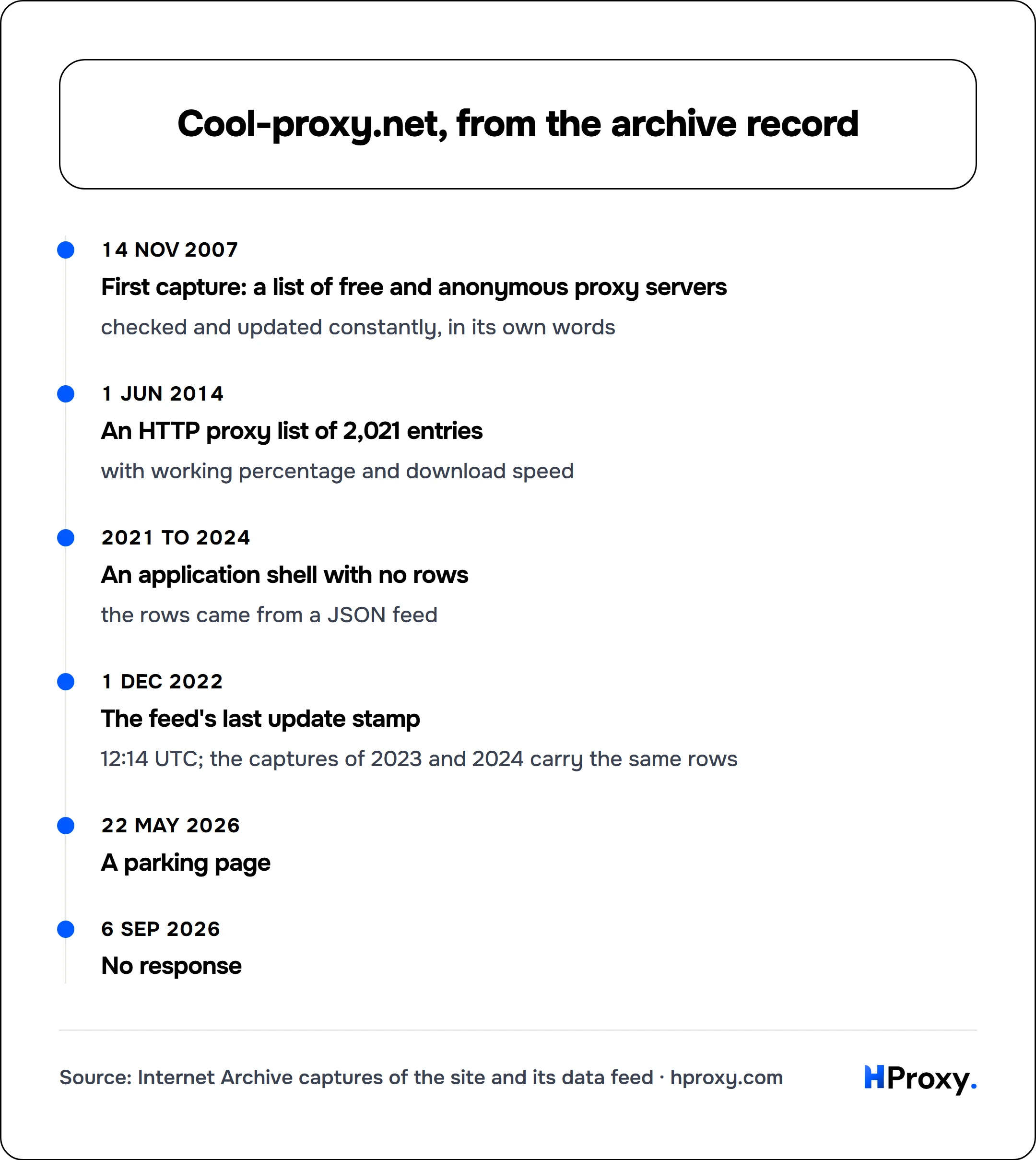
14 Nov 2007
First capture: a list of free and anonymous proxy servers
checked and updated constantly, in its own words
1 Jun 2014
An HTTP proxy list of 2,021 entries
with working percentage and download speed
2021 to 2024
An application shell with no rows
the rows came from a JSON feed
1 Dec 2022
The feed's last update stamp
12:14 UTC; the captures of 2023 and 2024 carry the same rows
22 May 2026
A parking page
6 Sep 2026
No response
Source for every row: the Internet Archive capture of that date, and our own request on 6 September 2026.
When it died, from the data feed
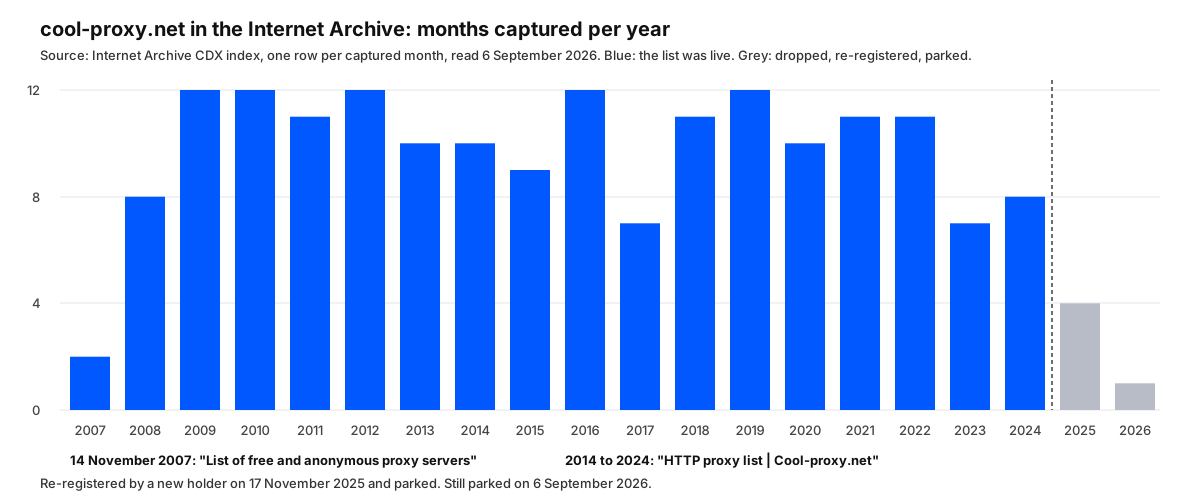
The Internet Archive holds 180 monthly captures of the homepage, from 14 November 2007 to 22 May 2026. The chart shows the months captured per year, and for this site the homepage captures do not date the death: the shell kept answering. The feed does.
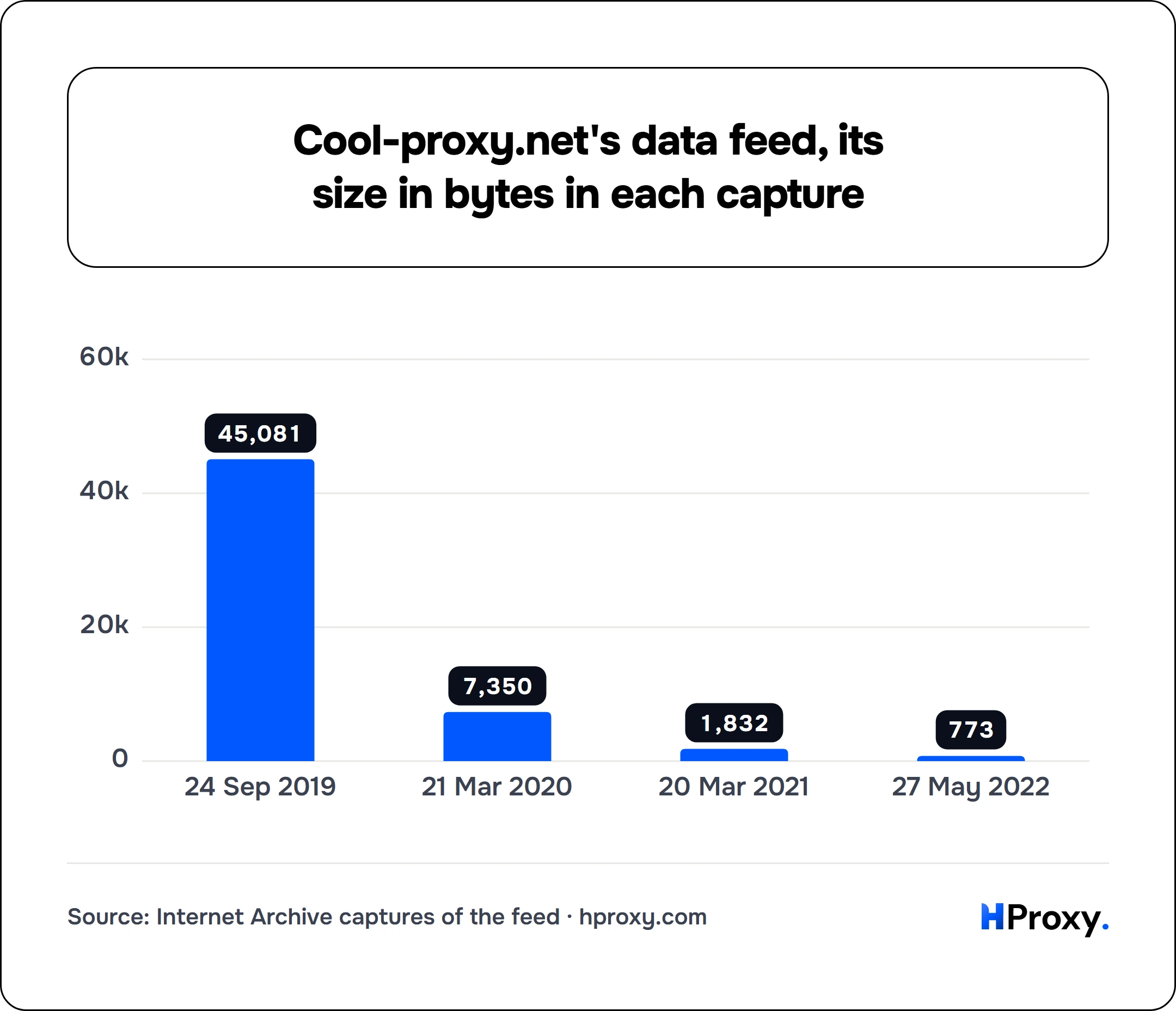
The archive holds one capture a year of proxies.json. Their sizes fall every year, and the update stamps inside them stop.
| Feed capture | Size | Update stamp in the first row |
|---|---|---|
| 24 September 2019 | 45,081 bytes | 24 September 2019 |
| 21 March 2020 | 7,350 bytes | not read |
| 20 March 2021 | 1,832 bytes | 23 June 2021 (from the June 2021 capture) |
| 27 May 2022 | 773 bytes | not read |
| 1 March 2023 | same rows | 1 December 2022, 12:14 UTC |
| 1 June 2024 | same rows | 1 December 2022, 12:14 UTC |
Source: the archived responses of proxies.json, read on 6 September 2026; the stamps are the feed's own update_time field.
So the list shrank from about 45 kilobytes of proxies in 2019 to under a kilobyte in 2022, and its last update is stamped 1 December 2022. The captures of March 2023 and June 2024 return that same December 2022 row first. A script that read the feed in 2024 got a list of proxies that had not been checked in a year and a half, with a working percentage of 99.9998 next to them. Nothing in the response said so.
The registry closes the story. The record read on 6 September 2026 shows the current registration dated 17 November 2025, through Gname 289 Inc, expiring 17 November 2026, on parking nameservers. A domain first archived in 2007 with a registration date in 2025 has been dropped and registered again. The 22 May 2026 capture is a parking page. On 6 September 2026 requests over http and https receive no response at all.
What the record does not say
No capture carries a closing note. The feed stopped and nobody said why. Who ran the site from 2007 to 2025 is not in the record we hold, because the original registration disappeared when the name was dropped. Whether the site ever charged for anything is unknown; no capture we read shows a price. The freeze date rests on the first row of two archived feed responses, and the 2025 capture of the homepage is compressed in a way the archive could not render, so the month the site finally went offline in 2025 is not pinned.
What to use instead
The honest replacement for a free proxy list is a free proxy list that proves its entries answer, and that tells you when they were last checked. On 6 September 2026 we fetched every free list that was still alive and took up to 200 entries from each. Each entry had to relay a real request and come back with an exit address that was not ours.
| List | Entries tested | Relayed a request |
|---|---|---|
| free-proxy-list.net | 200 | 86 |
| monosans proxy-list (GitHub) | 200 | 62 |
| iplocate free-proxy-list (GitHub) | 200 | 51 |
| proxifly free-proxy-list (GitHub) | 200 | 36 |
| geonode free list | 200 | 15 |
| hide.mn list | 64 | 0 |
No list relayed more than half of what it published. That is the base rate of free proxies, not a fault of any one site. Whatever list you pick, check an entry before you use it, and read the last-check time before you trust a working percentage. Cool-proxy.net's feed is the reason: a percentage without a date is a number about the past.
Our own free proxy list was part of the same test, and the same hour showed us something we had to fix. Our verifier had been accepting decoy servers that answer every request and forward nothing. Since that day a proxy is marked alive only when our own test request came back through it, carrying a code we sent, on every protocol, and every row shows when that last happened. The free API serves the same rows with the same stamps. The proxy checker applies the same test to any list you paste in.
Free lists have a ceiling that no amount of checking removes. Every address on them is public, shared with everyone who found the same list, and already known to the sites people most want to reach. When a job needs an exit that stays up, keeps a session and has not been handed around, that is a paid proxy, billed by the gigabyte. The free list stays the place to test first.
Sources
- Internet Archive captures of cool-proxy.net dated 14 November 2007, 1 June 2014, 1 June 2018, 1 June 2021, 1 March 2023, 1 September 2023, 1 June 2024, 1 March 2025 and 22 May 2026, read on 6 September 2026.
- Internet Archive captures of cool-proxy.net/proxies.json dated 24 September 2019, 21 March 2020, 20 March 2021, 27 May 2022, 1 March 2023 and 1 June 2024, read on 6 September 2026.
- Internet Archive CDX index for cool-proxy.net, one row per captured month, read on 6 September 2026.
- The .net registry record for cool-proxy.net (whois), read on 6 September 2026.
- Google Ads Keyword Planner, monthly searches for "cool proxy", September 2026.
- HProxy measurements on 6 September 2026: requests to cool-proxy.net over http and https, and the same-hour relay test of alive free lists.