Not every proxy service that disappears from the conversation gets seized by the FBI. Some just go quiet. Storm Proxies is the clearest example we know: around 2016 it was one of the most recommended budget proxies on the internet, the cheap rotating option that showed up in every SEO forum and every "best proxies under $20" list. It is still online today. It is still selling the same plans at the same prices. And it has barely changed in years.
We run a residential proxy network, so most of the graveyard stories on this blog are about crime: 911 S5, VIP72, RSOCKS, botnets that rented out hacked machines until law enforcement stepped in. Storm Proxies is a different and much more common kind of ending, and it is worth telling, because it is the one most likely to happen to a service you actually use. There is no scandal here. There is no takedown. Storm Proxies simply stopped keeping up, and the market walked past it.
What Storm Proxies was, and why everyone used it
Storm Proxies launched around 2016 as a budget proxy provider built around one idea: rotating proxies without the complexity. A backconnect rotating proxy (a single address you connect to that quietly swaps the real exit IP behind it on a schedule or every request) was exactly what a lot of people needed for SEO tools, sneaker checkouts, and casual scraping, and Storm Proxies sold it in the simplest possible package.
The pricing is what made the name. Instead of charging per gigabyte, Storm Proxies sold a fixed number of rotating ports on a flat monthly fee with unlimited bandwidth. Its smallest rotating residential plan started around $14 a month. For a hobbyist or a small operator, that was a genuinely good deal in 2016: you paid a predictable amount, you pointed your tool at a Storm Proxies port, and the rotation happened for you. It became a default recommendation for GSA Search Engine Ranker, ScrapeBox, and a hundred other budget workflows.
For a while, that simplicity was a feature. The problem is that the entire market moved, and Storm Proxies did not move with it.
The model that aged out
To understand what happened to Storm Proxies, you have to understand what the rest of the industry did between 2016 and now. The whole residential proxy market shifted from flat-fee, port-based access to metered, pay-as-you-go access with far more control. Here is the gap that opened up.
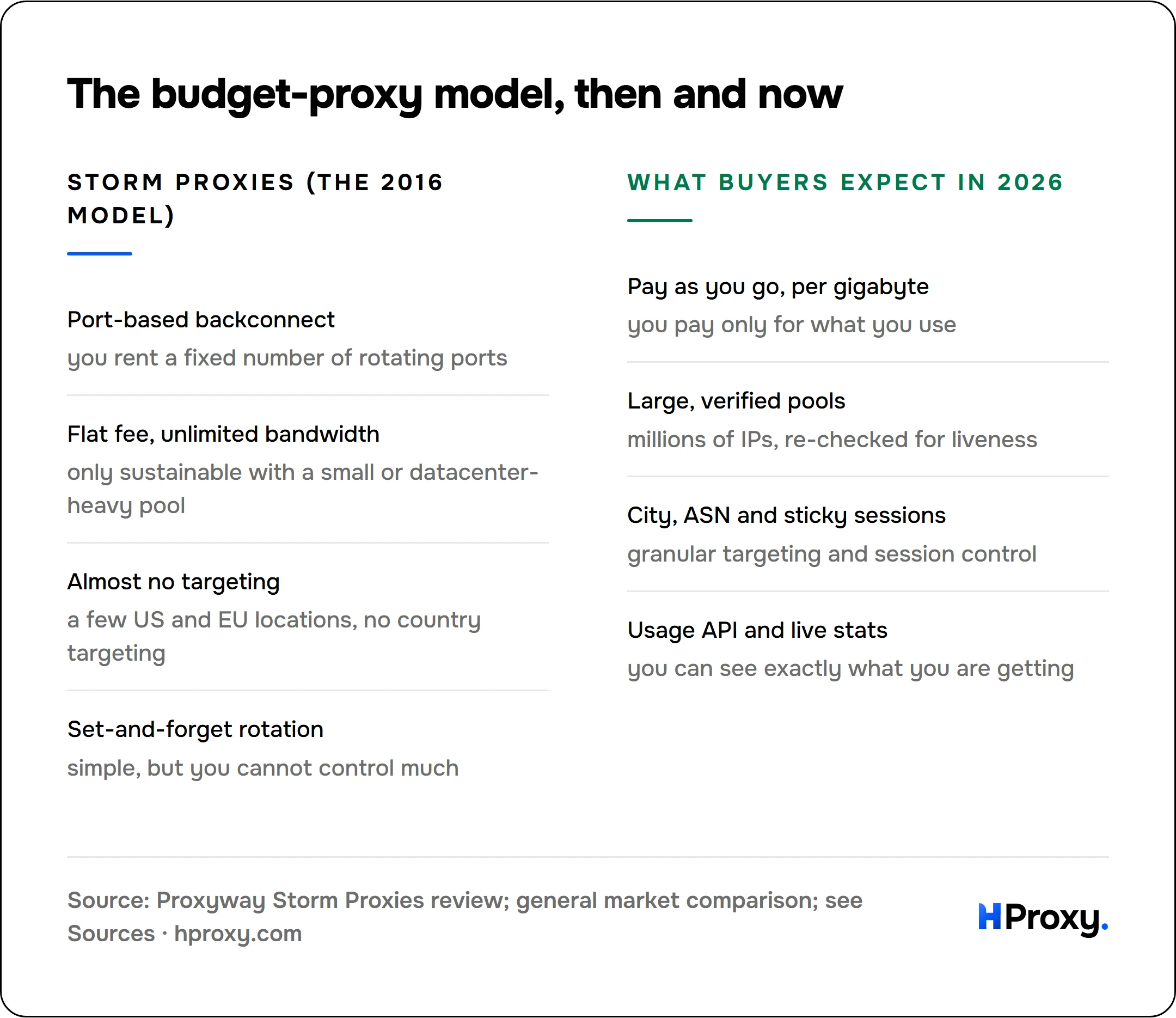
Storm Proxies (the 2016 model)
Port-based backconnect
you rent a fixed number of rotating ports
Flat fee, unlimited bandwidth
only sustainable with a small or datacenter-heavy pool
Almost no targeting
a few US and EU locations, no country targeting
Set-and-forget rotation
simple, but you cannot control much
What buyers expect in 2026
Pay as you go, per gigabyte
you pay only for what you use
Large, verified pools
millions of IPs, re-checked for liveness
City, ASN and sticky sessions
granular targeting and session control
Usage API and live stats
you can see exactly what you are getting
None of those newer expectations existed as standard in 2016. All of them are table stakes now. A modern residential network is judged on how big and fresh its verified pool is, how precisely you can target a city or a network, whether you can hold a sticky session for a login, and whether you can see your own usage. Storm Proxies was not built for any of that, and it never retrofitted it. It kept selling the 2016 product into a 2026 market.
The tell in the numbers
The clearest evidence that Storm Proxies stopped investing is the gap between what it advertises and what independent testers actually measure.
Storm Proxies markets pools of roughly 700,000 IP addresses for its rotating products. When Proxyway ran an extended test, the reality was much smaller: over three weeks they saw a little over 84,000 unique IPs, roughly one new address every twentieth successful request. Their tests also showed only about 68% of requests reaching the target, below the market average, with slower response times than competitors. And the review itself carries a quiet, damning note: it was last updated in 2021, because there has been nothing substantial to update since.
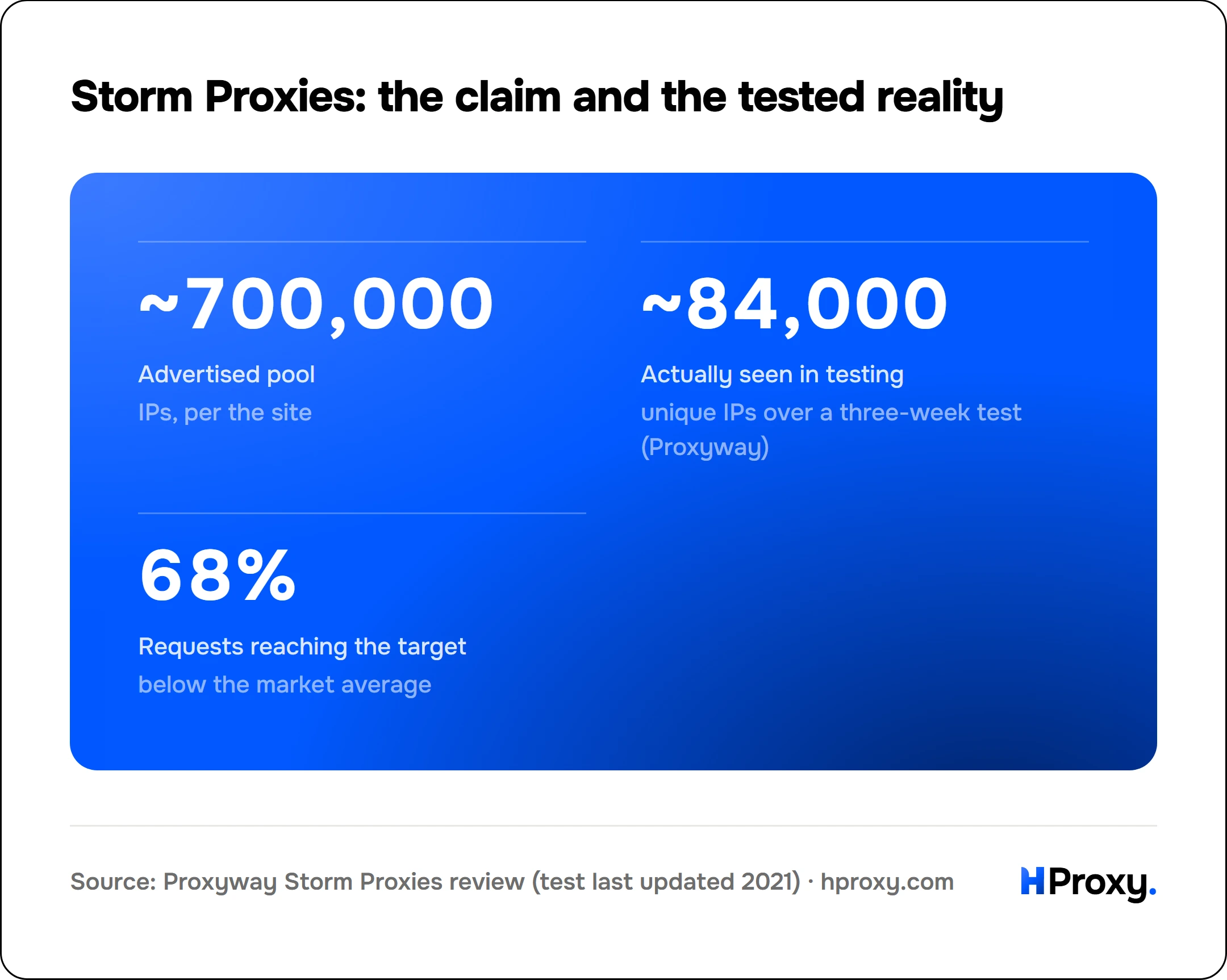
Storm Proxies: the claim and the tested reality
- ~700,000
- Advertised pool
- ~84,000
- Actually seen in testing
- 68%
- Requests reaching the target
IPs, per the site
unique IPs over a three-week test (Proxyway)
below the market average
Source: Proxyway Storm Proxies review (test last updated 2021)
We want to be fair about what this does and does not mean. A pool that tests smaller than advertised is common across the whole industry, and it is not proof of anything sinister. But combined with frozen documentation, no new features, and reviews that stopped being refreshed years ago, it paints a consistent picture: a service coasting on a reputation it earned in a different era.
Why "still has a website" is not "still a good product"
One thing to be clear about, and it has nothing to do with crime. There is no public evidence tying Storm Proxies to a botnet, to malware, or to any law-enforcement action, and we are not implying one. Its decline is ordinary. A service can quietly stop growing its pool, stop refreshing dead IPs, stop answering support, and stop shipping features, all while the storefront stays online and the prices stay attractive. From the outside, a stagnant service and a healthy one can look identical until you actually route traffic through them.
The one economic point worth internalizing is the unlimited-bandwidth model itself. Real residential bandwidth has a real cost, because someone is hosting the exit connection. Selling unlimited bandwidth for a flat $14 only works if the pool is small, heavily datacenter, or both. That is just the arithmetic, and it is exactly why the flat-fee, unlimited-bandwidth model faded across the industry: it does not scale to a large, fresh residential pool. It survives where the arithmetic actually works, on per-IP products: our own unlimited plans are ISP, datacenter and mobile, and residential stays on the gigabyte. If you understand the difference between datacenter and residential proxies, you can usually read a pricing page and tell which corner a provider is quietly living in.
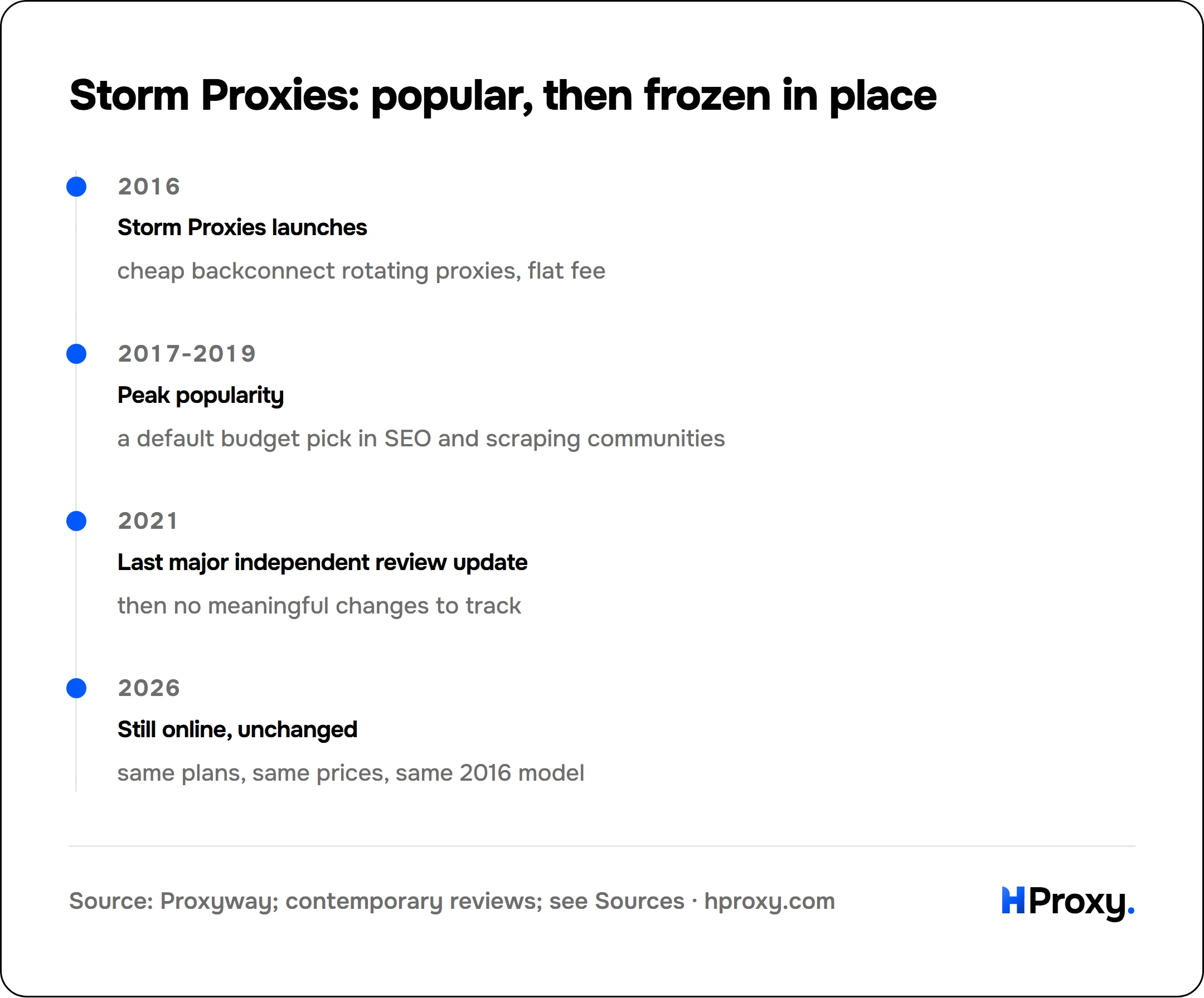
2016
Storm Proxies launches
cheap backconnect rotating proxies, flat fee
2017-2019
Peak popularity
a default budget pick in SEO and scraping communities
2021
Last major independent review update
then no meaningful changes to track
2026
Still online, unchanged
same plans, same prices, same 2016 model
What Storm Proxies teaches a buyer
The lesson is subtler than the botnet cases, and more useful day to day. A proxy provider does not have to die dramatically to become the wrong choice. It can simply stop trying. When you are evaluating any service, especially a cheap one with a great old reputation, look for signs of whether it is still alive as a product, not just as a domain:
- Check the date on the evidence. If every review, changelog, and blog post about a provider stops around a certain year, the product probably did too.
- Measure the pool yourself. Do not trust the headline IP count. Our free proxy checker makes a real connection through a proxy and reports its exit location, anonymity grade, and the network the IP belongs to, so you can see what is actually behind the marketing.
- Read the pricing model, not just the price. Flat-fee unlimited bandwidth is a signal about pool size and type. Pay-as-you-go per gigabyte is a signal that the provider expects you to actually use a large pool and only bills you for it. We break the economics down in how much proxies cost.
- Prefer providers you can leave. A service that only bills you for what you use, with a balance that does not expire, costs you nothing to test and nothing to abandon if it goes quiet the way Storm Proxies did.
Where a maintained network fits
Storm Proxies is proof that a proxy service can fade without doing anything wrong. It was a good budget option in 2016, it is still online, and it simply never grew up. That is a completely normal way for a product to end, and it is the failure mode you are most likely to run into, because it does not make the news. The service does not tell you it has stopped investing. You find out when the pool feels thin and support goes silent.
If you understand what a rotating proxy is and you just need cheap throwaway rotation, our free proxy list is honest about being mostly short-lived datacenter IPs, re-checked every few minutes, and it costs nothing. When you need residential IPs that hold up, we sell them at $0.44/GB pay as you go with a balance that never expires. No flat-fee lock-in, no 2016 pool sold as if it were current, and nothing to strand if you ever decide to walk away.
Sources
- Proxyway, "In-Depth Storm Proxies Review & Performance Tests": the product lineup, the ~$14 entry pricing, the advertised versus tested pool size (about 84,000 unique IPs over three weeks against a claimed ~700,000), the ~68% success rate, the limited targeting, and the note that the review was last updated in 2021.
- TechRadar, "Storm Proxies review": independent coverage of Storm Proxies' budget rotating-proxy offering and its limitations.
- HProxy domain-status research (2026): the Storm Proxies brand domains remain registered and locked, consistent with a service that is still online rather than shut down.