Comparison

Spys alternatives: the list halved in thirty minutes

Spys.me relayed 25.0 percent of a random sample on 9 September 2026. Thirty minutes later the same test gave 13.3 percent. What that means for anyone reading a free list.

HProxy Team··6 min read
HProxy.Comparison

Skip the dead lists.

Our free proxy list re-checks every exit every few minutes across 100+ countries, with a live last-checked time, so you copy IPs that worked moments ago, not a stale text dump.

Open the free proxy list

Spys still works, and it rots faster than any list in our audit. On 9 September 2026, 25.0 percent of a random Spys.me sample relayed a real request. Thirty minutes later on the same day, the figure was 13.3 percent. Nothing broke in between. A published proxy list is a photograph, and the pool it shows keeps dying. The useful field on a free list is the time of the last check. The row count tells you almost nothing.

The half hour that halved the list

We ran the audit twice on 9 September 2026, thirty minutes apart, from one datacentre in Germany. Spys.me moved further than anything else in the set. It fell from 25.0 percent to 13.3 percent on 9 September 2026.

That is a drop of 11.7 points, the largest in the whole audit. The median list moved 2.5 points between the two runs on 9 September 2026. Our 9 September 2026 samples held up to 120 rows, which carries about 3.4 points of error. A swing of 11.7 points is therefore real churn rather than sampling noise.

The file did not change its promise in that half hour. The addresses behind it died.

Every list we could parse that day

We tested eleven lists from one machine on 9 September 2026. For each one we fetched the machine-readable file its publisher serves. Then we sampled up to 120 rows at random and opened every one. A row counted as working only if a real page came back through it. The exit address in the reply had to be one that was not ours.

ListAddresses publishedFirst runThirty minutes later
ProxyNova (decoded)26 of 37 rows53.8%not re-run
free-proxy-list.net30034.2%38.3%
ProxyScrape624 to 67126.7%33.3%
Spys.me40025.0%13.3%
monosans (GitHub)61920.8%12.5%
iplocate (GitHub)646 to 71818.3%16.7%
Geonode500not parsed7.5%
TheSpeedX (GitHub)3,0247.5%5.0%
Proxifly (GitHub)2,3852.5%4.2%
FreeProxy.World50not parsed2.0%
clarketm (GitHub)4000.8%0.0%

In the first run on 9 September 2026, 163 of 961 sampled rows relayed a request. That is 17.0 percent. The second run on 9 September 2026 gave 158 of 1,131, which is 14.0 percent.

Spys sits above the market and still perishes

Being above average is the fair thing to say about Spys.me. Its 25.0 percent on 9 September 2026 beat the 17.0 percent overall rate of that audit. It ranked fourth of the nine lists we could measure in the first run.

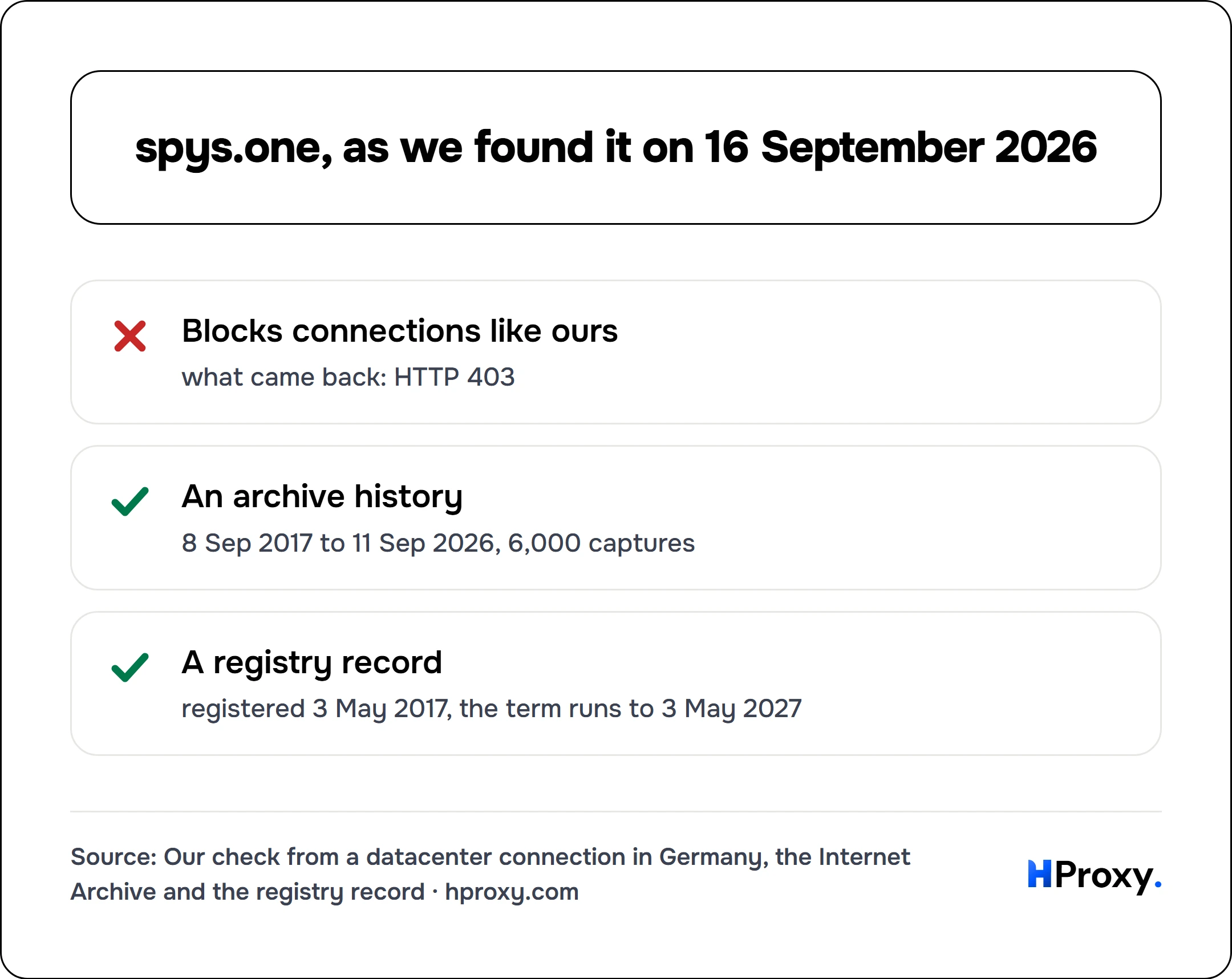
It also serves a plain text file, so a script can read it. Spys.one is bot-walled in our own records, so a script cannot read that half. Neither fact is undone by the fall. Spys.me is not a bad list, it is a perishable one. Nobody tells the reader that difference.

Why free proxies die so fast

We run a free pool of our own, so we watch these addresses until they stop answering. Queried on 5 September 2026, the pool had seen 763,409 addresses since it opened. 691,179 of them had a recorded death by 5 September 2026.

The median life on 5 September 2026 was 144.5 hours, about six days. A quarter of the deaths came within 21.8 hours, measured on 5 September 2026. Three quarters came within 563.9 hours, again on 5 September 2026. On 5 September 2026, 22.6 percent died inside the first hour. 39.0 percent lasted one to seven days on 5 September 2026. 17.0 percent were still answering after a month on 5 September 2026.

That first hour is what a stale list is mostly made of. The daily flow says the same thing twice over. Our pool gained 64,251 addresses and lost 53,192 on 26 August 2026. On 5 September 2026 it gained 3,329 and lost 36,826. Supply arrives in waves and leaves in waves. A file rebuilt once a day cannot track that.

Why a timestamp beats a count

A count is the easiest number to print and the least useful to read. On 9 September 2026 TheSpeedX published 3,024 addresses and 7.5 percent of our sample worked. Spys.me published 400 rows on 9 September 2026, and 25.0 percent worked. The longer file worked less often.

Overlap is the second reason a bigger file is not more supply. Our pool reads 116 sources, counted on 5 September 2026. On 5 September 2026 the average live address sat on 17.86 of those sources. On 5 September 2026, 94.7 percent of live addresses appeared on more than one source. Lists copy each other, so a new name is rarely a new address.

What separates one list from another is how often it checks. On 5 September 2026 all 72,230 addresses in our rotation had been checked inside 24 hours. On 5 September 2026, 14,762 of them had been checked within five minutes. Freshness is a running cost, and it is the only thing holding a list together.

What survives is still weak

Working once is not the same as working for an hour. On 5 September 2026 the median live proxy passed 45.5 percent of its own checks. Only 401 of 9,452 live entries passed ten checks at 90 percent on 5 September 2026.

Speed thins the pool again. Median latency was 1,050 milliseconds on 5 September 2026. On 5 September 2026, 24.1 percent answered under 500 milliseconds. On 5 September 2026, 28.1 percent took longer than three seconds.

Reputation decides most jobs before speed gets a vote. Of live entries with fraud data on 5 September 2026, 89.3 percent were flagged for recent abuse. Their average fraud score was 72.5 on 5 September 2026. None were residential, and 82.9 percent sat on datacenter address space on 5 September 2026. An address like that connects and still fails on a site that checks.

How to work with a list that rots

Fetch the file again right before the run, not once a day. Check every address yourself, and drop it on the first failure. Store the time of your own check beside each row. Treat any rate older than an hour as a guess.

Two lists in our audit beat Spys.me on 9 September 2026. On 9 September 2026 free-proxy-list.net reached 34.2 percent and ProxyScrape reached 26.7 percent. Both of them also moved between our two runs on 9 September 2026. Two more sites answered with an error instead of a list. On 9 September 2026 OpenProxy.space returned HTTP 521 and proxy-list.download returned HTTP 502.

Switching lists buys a few points and changes nothing about the decay. If a job has to keep running, our paid proxies are billed by the gigabyte from $0.44/GB.

Method and limits

Every figure above comes from one datacentre in Germany on 9 September 2026. A home line or a school network may see other results. Some operators treat a datacentre address differently to a home one.

We opened each address, spoke its protocol and fetched a real page through it. A port check would have passed rows that relay nothing at all. Random sampling matters here, because a list that sorts good rows first would flatter itself.

The Spys.me figures rest on 120 rows drawn from 400 on 9 September 2026. Sample sizes differ by list, since several publish fewer than 120 rows. Our pool figures were queried on 5 September 2026 and rest on 115,078,758 checks. The next run of this audit will get its own dated page.

Sources

  • Our market audit of eleven public proxy lists, 9 September 2026, run twice, thirty minutes apart from one German datacentre.
  • The Spys.me plain text file and the Spys.one bot wall, both as recorded on 9 September 2026.
  • Our own free proxy pool, queried 5 September 2026: 763,409 addresses seen, 691,179 deaths recorded, 115,078,758 checks.
  • The audit script and its raw output, kept with the research folder for this article.

Frequently asked questions

Does Spys still work?
Yes, and for less time than the file suggests. On 9 September 2026, 25.0 percent of a random Spys.me sample relayed a real request. Thirty minutes later on the same day the figure was 13.3 percent. Our whole audit on 9 September 2026 averaged 17.0 percent. Spys.me sits above that average, and it decays faster than the rest.
Why can a script not read Spys.one?
Spys.one is bot-walled in our own records, so a request from a plain tool does not get the list. Spys.me serves a plain text file, which our 9 September 2026 audit could parse. If you need a list a machine can read, that file is the readable half of the brand.
How often should I refetch a free proxy list?
Closer to every few minutes than every day. Spys.me fell from 25.0 percent to 13.3 percent in thirty minutes on 9 September 2026. On 5 September 2026 all 72,230 rotating addresses in our own pool had been checked inside 24 hours. On 5 September 2026, 14,762 of them had been checked within five minutes.
Is a bigger list a better list?
No. On 9 September 2026 TheSpeedX published 3,024 addresses and 7.5 percent of the sample worked. Spys.me published 400 rows on 9 September 2026, and 25.0 percent worked. On 5 September 2026 the average live address in our pool sat on 17.86 sources. Lists copy each other, so a longer file is often the same addresses again.
Which free lists beat Spys on the day you tested?
Three of them did. On 9 September 2026 ProxyNova reached 53.8 percent, from a decoded sample of 26 rows. On 9 September 2026 free-proxy-list.net reached 34.2 percent and ProxyScrape reached 26.7 percent. Those last two also moved between our two runs that day, so read them as perishable too.
Can I make a free list stable by checking it myself?
Only partly. Checking removes the dead rows, which is the easy half of the problem. On 5 September 2026 the median live proxy passed 45.5 percent of its own checks. Only 401 of 9,452 live entries passed ten checks at 90 percent on 5 September 2026. Quality does not survive checking, it only becomes visible.

Get proxies that are alive right now

Our free proxy list re-checks every exit every few minutes across 100+ countries, with a live last-checked time, so you copy IPs that worked moments ago, not a stale text dump. When the location has to survive a real check, the paid network holds up.

129M+ proxy checks run · 100+ countries · HTTP / HTTPS / SOCKS · re-checked every few minutes · no signup