SocksList.net is gone, and unlike most dead proxy lists it said so. It ran a SOCKS proxy list from October 2007 and sold a private list for $30 a month from at least 2012. In November 2021 it posted a one-line notice naming 1 December 2021 as its shutdown date. The notice is still what the archive holds for 2022. The domain is parked by the same registrant who registered it in 2007. About 90 people a month still search for the name (Keyword Planner, September 2026), and they land on nothing. This is the record, and what to use now.
Every date below comes from the Internet Archive's captures, the .net registry, and requests we made ourselves on 6 September 2026. Where the record is silent, this page says so.
What SocksList.net was
The domain was registered on 23 August 2007 (registry record, read 6 September 2026). The first archived capture, dated 12 October 2007, is titled "Sockslist.net - Socks proxy list. Proxy tools: whois, socks checker, proxy checker, IP Country, HTTP headers." Its opening lines are a list of what the site meant to rank for: "Free proxy servers. Anonymous proxy servers. Free proxy list. Socks list: Socks4, Socks5. Fresh proxy list. Fresh SOCKS proxy list."
By 1 June 2012 the site had a business. The title now began "Socks proxy list: buy socks list" and the counters read "Free socks: 57 Total socks: 448". Above the table sat the offer: "Try private area to get more good socks in comfortable way ($30 per month access)". It accepted credit cards, Western Union, Web Money, Liberty Reserve, LiqPay and bank wire. The free list was the shop window. The private list was the shop.
The price never moved in the captures we read. The payment methods did, and they date the era as well as any calendar: by June 2016 Liberty Reserve was gone and PayPal, Perfect Money and BitCoin were in. The totals grew and the free share shrank.
| Capture | Free socks | Total socks | Price of the private list | Payment methods listed |
|---|---|---|---|---|
| 1 June 2012 | 57 | 448 | $30 a month | credit cards, Western Union, Web Money, Liberty Reserve, LiqPay, bank wire |
| 1 June 2016 | 72 | 1,344 | $30 a month | PayPal, credit cards, Western Union, Web Money, LiqPay, Perfect Money, BitCoin |
| 1 June 2019 | 63 | 16,326 | $30 a month | the same as 2016 |
| 1 June 2021 | 164 | 8,192 | $30 a month | the same as 2016 |
Source for every row: the counters and the offer printed on the Internet Archive capture of that date, read on 6 September 2026. The 2019 total is far above the other years and may include entries the site kept after they died; the page does not say.
When it died, in its own words
The Internet Archive holds 136 monthly captures of sockslist.net, from 12 October 2007 to 25 June 2026. The chart shows the months captured per year.
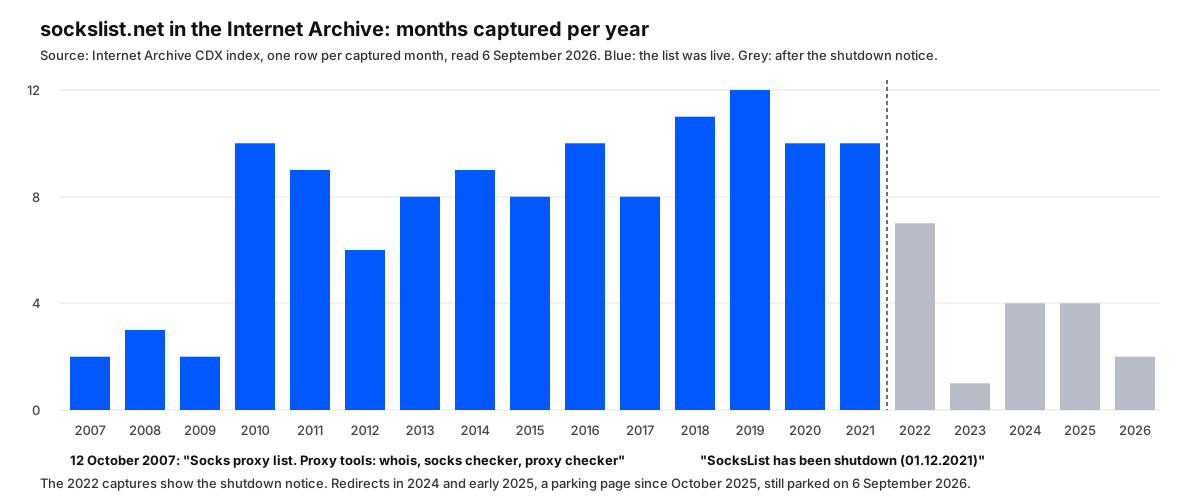
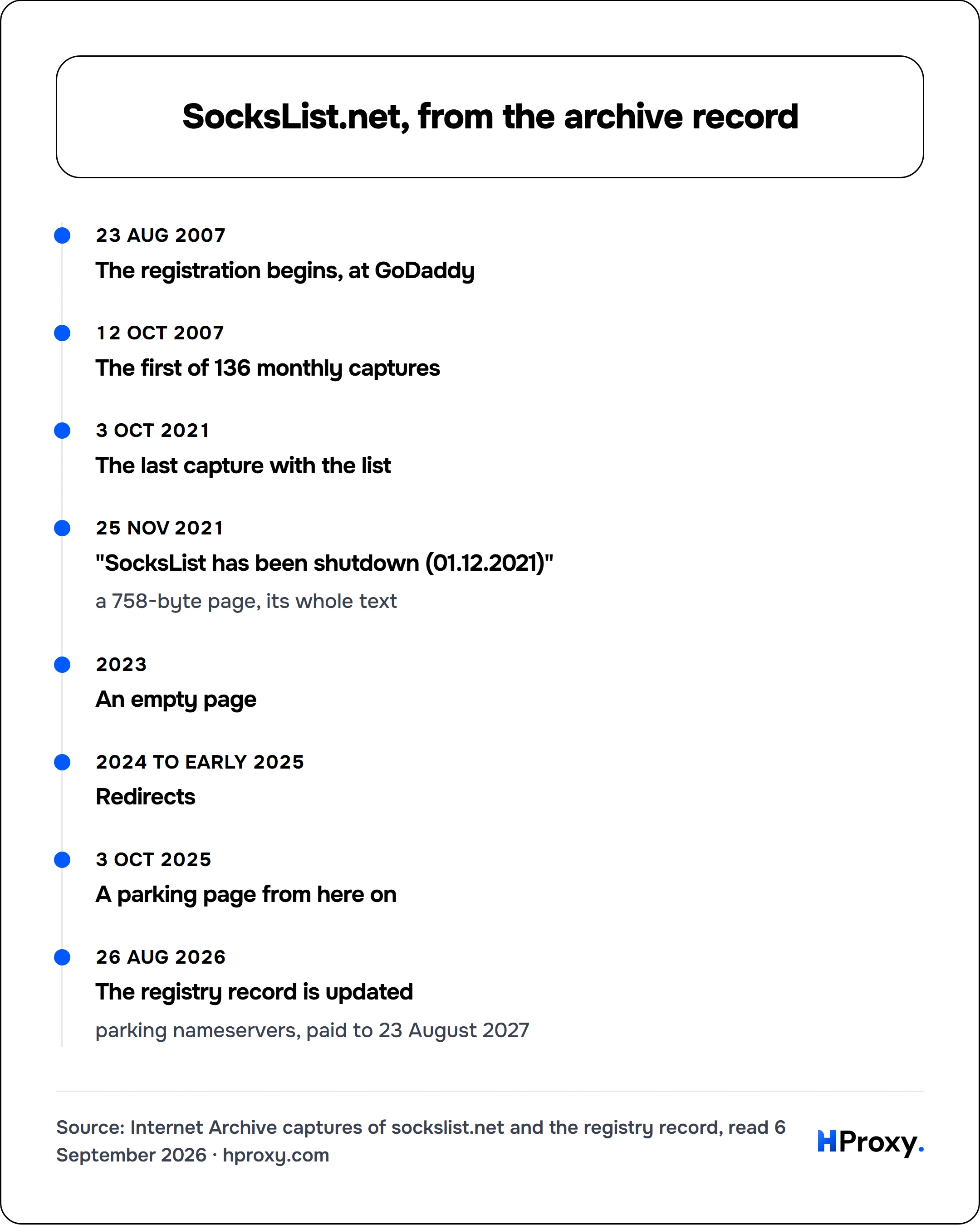
The last capture with the list is dated 3 October 2021. The capture of 25 November 2021 is a 758-byte page titled "SocksList shutdown", and its whole text reads: "SocksList has been shutdown (01.12.2021) Do you want to know about SOCKS? Visit Wikipedia - SOCKS Copyright © 2007-2021". The captures of 9 December 2021 and 1 June 2022 are the same page. So the site announced a date, a week or more ahead, and kept the notice up for at least six months. In this series of dead lists, that is the only one that did.
After the notice the domain went the usual way. The 2023 capture is an empty page. The captures of 2024 and early 2025 are redirects. From 3 October 2025 the captures are a parking page. The registry record read on 6 September 2026 shows the same registration since 23 August 2007, at GoDaddy. It was updated on 26 August 2026, runs to 23 August 2027, and points at parking nameservers. On 6 September 2026 our first request got an empty parking page and a later one got no response at all.
23 Aug 2007
The registration begins, at GoDaddy
12 Oct 2007
The first of 136 monthly captures
3 Oct 2021
The last capture with the list
25 Nov 2021
"SocksList has been shutdown (01.12.2021)"
a 758-byte page, its whole text
2023
An empty page
2024 to early 2025
Redirects
3 Oct 2025
A parking page from here on
26 Aug 2026
The registry record is updated
parking nameservers, paid to 23 August 2027
What the record does not say
The notice gives a date and nothing else. Why the site closed, who ran it, and how many people paid $30 a month for the private list are not in any capture or record we hold. The counters come from one capture per year. The claim that the list was "fresh" is the site's own and was never measured by us.
What to use instead
The honest replacement for a SOCKS proxy list is a free proxy list that proves its entries answer. On 6 September 2026 we fetched every free list that was still alive and took up to 200 entries from each. Each entry had to relay a real request and come back with an exit address that was not ours.
| List | Entries tested | Relayed a request |
|---|---|---|
| free-proxy-list.net | 200 | 86 |
| monosans proxy-list (GitHub) | 200 | 62 |
| iplocate free-proxy-list (GitHub) | 200 | 51 |
| proxifly free-proxy-list (GitHub) | 200 | 36 |
| geonode free list | 200 | 15 |
| hide.mn list | 64 | 0 |
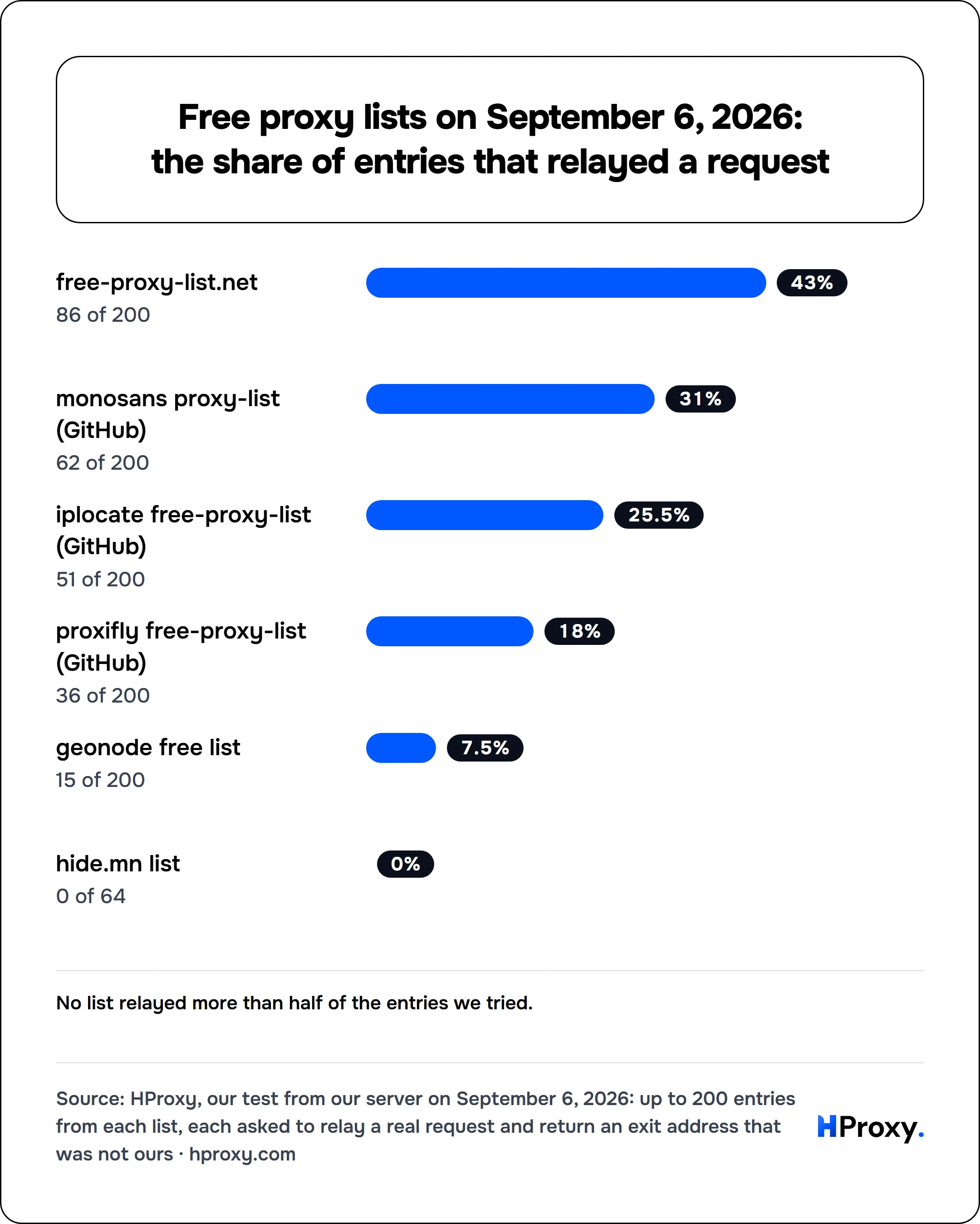
No list relayed more than half of what it published. That is the base rate of free proxies, not a fault of any one site. Whatever list you pick, check an entry before you use it.
SOCKS proxies have one more trap, and SocksList's own text pointed at it. A SOCKS5 proxy "allowing to anonymize UDP protocols as well" is the promise, and most free ones do not keep it. When we tested 600 live free SOCKS5 proxies on 5 September 2026, 384 said yes to a UDP request. Of those, 380 handed back a relay port of zero, which nothing can send to. A SOCKS5 flag on a free list means the handshake works. It does not mean UDP works.
Our own free proxy list has a SOCKS5 page and a SOCKS4 page. The same week as this test we found our verifier accepting decoy servers that complete the SOCKS handshake and relay nothing. We replaced it. A proxy is now marked alive only when our own test request came back through it, on that protocol, carrying a code we sent. The list is re-verifying under that rule as you read this. The proxy checker applies the same test to any list you paste in.
Free lists have a ceiling that no amount of checking removes. Every address on them is public, shared with everyone who found the same list, and already known to the sites people most want to reach. When a job needs an exit that stays up, keeps a session and has not been handed around, that is a paid proxy, billed by the gigabyte. SocksList charged $30 a month for a private list of shared addresses. A paid proxy today charges by the gigabyte for an exit that is yours for the session.
Sources
- Internet Archive captures of sockslist.net dated 12 October 2007, 1 June 2012, 1 June 2016, 1 June 2019, 1 June 2021, 3 October 2021, 25 November 2021, 9 December 2021, 1 June 2022 and 25 June 2026, read on 6 September 2026.
- Internet Archive CDX index for sockslist.net, one row per captured month, read on 6 September 2026.
- The .net registry record for sockslist.net (whois), read on 6 September 2026.
- Google Ads Keyword Planner, monthly searches for "sockslist", September 2026.
- HProxy measurements on 6 September 2026: two requests to sockslist.net, the same-hour relay test of alive free lists, and the SOCKS5 UDP test of 5 September 2026 (600 live free SOCKS5 proxies, RFC 1928 UDP ASSOCIATE).