Scrapfly meters by feature, and it publishes the weights rather than hiding them. A plain datacenter request costs one credit, residential costs twenty-five, and a full-page screenshot costs sixty. That is a clean model, and two things sit under it that the plan cards do not show. Bandwidth is billed on top of a free quota, and overflow credits cost far more. Every figure below was read from their pricing page and billing documentation on 9 September 2026.
We sell competing proxies and scraper endpoints, so weigh our reading accordingly. The weights are theirs and the division is ours.
The short version
Plan credits cost $0.15 per thousand on Discovery and $0.10 on Pro, and the ladder barely moves after that. Pro and Startup carry the identical per-credit price, so the middle rung buys concurrency rather than a discount. Overflow credits on Pro cost $0.35 per thousand, which is 3.5 times the plan rate. Their pricing page says upstream 4xx responses are free, while their billing documentation lists 404 and 410 among twenty-two excluded codes.
What Scrapfly publishes
These are the advertised plans, read from the pricing page on 9 September 2026. The per-credit column is theirs, and the overflow column is the rate for credits beyond the allowance.
Scrapfly plans and the price of one credit
| Plan | Per month | Credits | Per 1,000 credits | Concurrency | Overflow |
|---|---|---|---|---|---|
| Free | $0 | 1,000 on signup | free | 5 | none |
| Discovery | $30 | 200,000 | $0.15 | 5 | none, caps on quota |
| Pro | $100 | 1,000,000 | $0.10 | 20 | $3.50 per 10k |
| Startup | $250 | 2,500,000 | $0.10 | 50 | $2.00 per 10k |
| Enterprise | $500 | 5,500,000 | $0.09 | 100 | $1.20 per 10k |
| Custom | negotiated | negotiated | not published | committed | negotiated |
scrapfly.io pricing page, read 9 September 2026
Two things stand out in that table before any feature weight is applied.
The ladder is the gentlest in this market, spanning only about 1.65 to one from Discovery to Enterprise. Most rivals we priced this week span three to one or more.
The middle of it is flat. Startup costs two and a half times Pro and gives two and a half times the credits. So the per-credit price does not move at all.
So Startup buys concurrency and a better overflow rate. It does not buy cheaper credits, and the plan card does not put it that way.
The overflow costs more than the plan
Extra credits beyond the quota are priced per ten thousand, and they cost more.
Plan credits against overflow credits
| Plan | Plan per 1,000 | Overflow per 1,000 | Overflow costs |
|---|---|---|---|
| Discovery | $0.15 | not offered | the plan simply stops |
| Pro | $0.10 | $0.35 | 3.5 times the plan rate |
| Startup | $0.10 | $0.20 | 2.0 times the plan rate |
| Enterprise | $0.09 | $0.12 | 1.3 times the plan rate |
our arithmetic on advertised figures, 9 September 2026
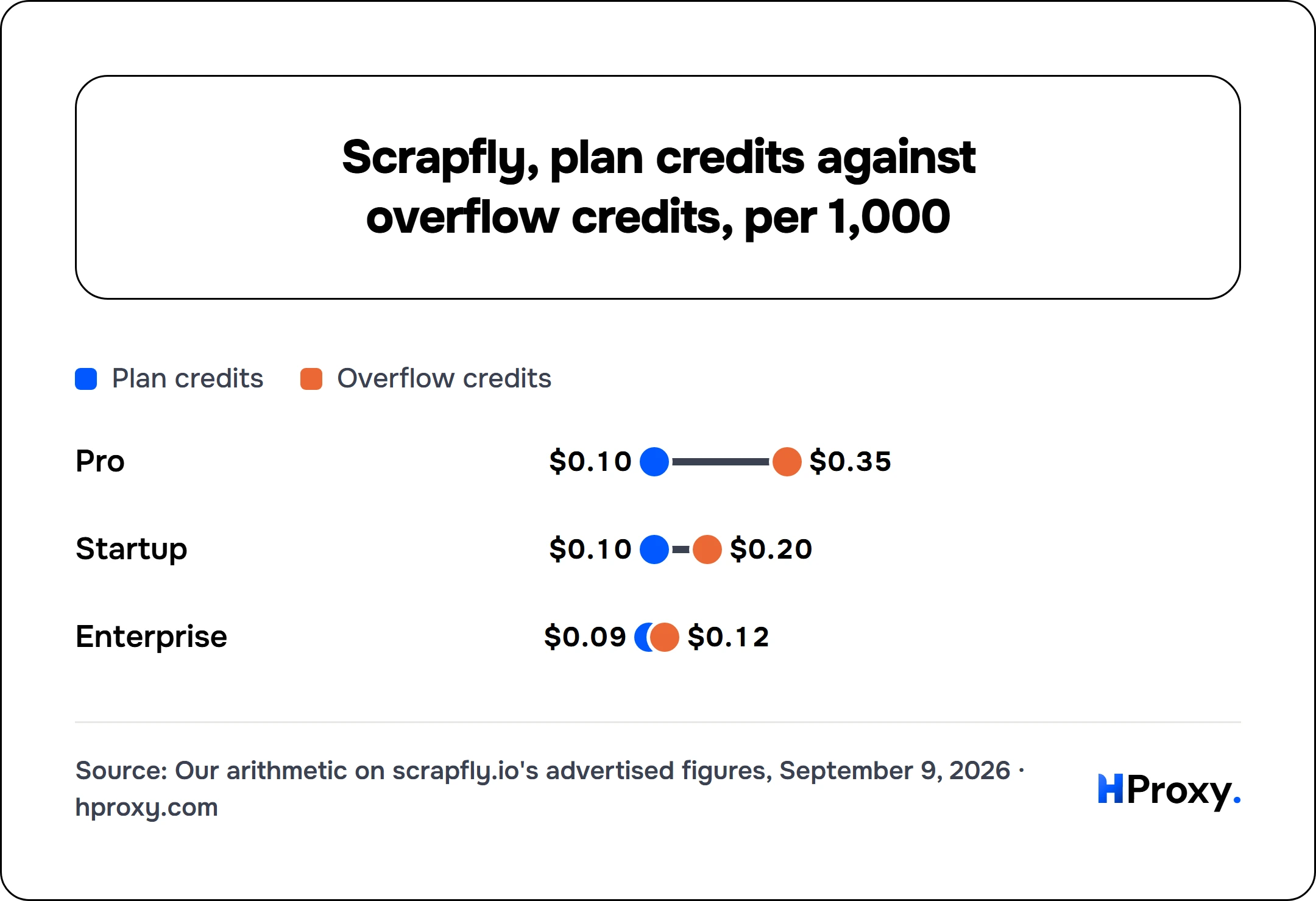
- Plan credits
- Overflow credits
The Discovery row is a different problem rather than a cheaper one. That plan caps on quota, so a busy month stops rather than costing more.
On Pro, running past the quota costs three and a half times the rate you signed up for. We found the same shape at Firecrawl, where top-ups also ran to three times the rate.
The feature weights
The pricing page lists four weights. The billing pages give the underlying rule, and the two do not describe rendering the same way.
Published credit weights
| What the request uses | Credits | Source |
|---|---|---|
| Datacenter proxies | 1 | billing documentation |
| Residential proxies | 25 | billing documentation |
| Browser rendering | plus 5 | billing documentation |
| HTTP scrape on a datacenter IP | 1 | pricing page |
| Adding JS rendering or Unblocker | 5 | pricing page |
| Adding residential proxies | 25 | pricing page |
| Full-page screenshot capture | 60 | pricing page |
scrapfly.io pricing page and billing documentation, read 9 September 2026
The billing pages state that datacenter and residential are mutually exclusive, and that browser rendering adds five credits. Added up, a datacenter request with rendering costs six credits and a residential one costs thirty.
The pricing page instead summarises rendering as five credits total. We could not determine which is charged, and the difference is twenty percent on a very common configuration.
Everything below therefore uses only the weights both sources agree on.
Cost per 1,000 requests, by configuration and plan
| Configuration | Credits | Discovery $30 | Pro $100 | Enterprise $500 |
|---|---|---|---|---|
| Datacenter, no rendering | 1 | $0.15 | $0.10 | $0.09 |
| Residential | 25 | $3.75 | $2.50 | $2.27 |
| Full-page screenshot | 60 | $9.00 | $6.00 | $5.45 |
| Residential on Pro overflow | 25 | not offered | $8.75 | not applicable |
our own arithmetic on advertised figures, 9 September 2026
The last row is the one to remember. A residential request costs $2.50 per thousand inside the Pro allowance and $8.75 per thousand past it.
Bandwidth is billed too, and the plan cards do not say so
This is the part of the model that only appears in the billing pages. Binary responses are billed per 100KB slice rather than per request.
Datacenter proxies cost 3 credits per 100KB and residential proxies cost 10. The first megabyte of a download is free of charge.
Text responses are affected as well. Bandwidth above the initial megabyte is billed as binary bandwidth, and browser rendering includes three megabytes free.
Convert that into a per-gigabyte figure and it sits beside a proxy rate. We treat a gigabyte as one thousand megabytes and state that assumption plainly.
Binary bandwidth, converted to money per GB
| What moves the bytes | Published as | Per GB on Pro |
|---|---|---|
| Datacenter proxies | 3 credits per 100KB | $3.00 |
| Residential proxies | 10 credits per 100KB | $10.00 |
| HProxy residential bandwidth | priced per GB directly | $0.50/GB |
vendor billing documentation and our own arithmetic, 9 September 2026
Our own gigabyte is priced as a gigabyte, from a balance rather than a credit pool. That is a different shape rather than a win, since their number buys the anti-bot work too.
The failure rule, read twice
The pricing page makes a strong and welcome claim. Failed requests cost nothing, and upstream 4xx and 5xx responses and failed scrapes are free.
The billing pages describe the same policy in more detail, and the detail narrows it two ways.
First, the protection has a threshold. If more than 30 percent of traffic fails within one hour, the policy disables and usage is billed.
Second, a list of status codes is excluded from the protection. It contains 400, 401, 402, 404, 405, 406, 407, 409, 410 and thirteen more.
Those two statements are hard to hold together. The pricing page says upstream 4xx responses are free. The billing pages list twenty-two 4xx codes as excluded from the policy that makes failures free.
We could not square them and we make no claim about which governs an invoice. Anyone whose URL list contains dead links should ask before assuming the pricing page wording applies.
The threshold matters on its own terms too. Protection against failures switches off during exactly the hour when failures are worst.
Five vendors, five definitions
We have now read this same term at five companies in one week. The wording differs enough to change a bill.
How five vendors treat a failed or dead request
| Vendor | What their pages say |
|---|---|
| Scrapfly | pricing page says 4xx and 5xx are free; documentation excludes 22 4xx codes and caps protection at 30 percent failures per hour |
| Zyte | bans and rate limits are free, and a target 404 is charged |
| ScrapingBee | 200, 404 and 410 are charged; Auto-Mode costs nothing if every configuration fails |
| ZenRows | only successful requests are charged, with 404 and 410 counted as usable results |
| ScraperAPI | 200 and 404 are charged, and so are requests you cancel before 70 seconds |
five vendor pricing pages and documentation, all read 9 September 2026
Zyte is the only one of the five whose pages agree with themselves and exclude blocks from billing. Our conversions for the other four sit in the Zyte, ScrapingBee, ZenRows and ScraperAPI teardowns.
What the allowance actually holds
Restate the credits as request counts and the plan cards read differently:
Advertised credits, converted to requests
| Plan | Credits | Datacenter | Residential | Screenshots |
|---|---|---|---|---|
| Free | 1,000 | 1,000 | 40 | 16 |
| Discovery | 200,000 | 200,000 | 8,000 | 3,333 |
| Pro | 1,000,000 | 1,000,000 | 40,000 | 16,666 |
| Startup | 2,500,000 | 2,500,000 | 100,000 | 41,666 |
| Enterprise | 5,500,000 | 5,500,000 | 220,000 | 91,666 |
our own arithmetic on advertised figures, 9 September 2026
The free tier is 1,000 credits with no card and no time limit. Against residential requests that is forty scrapes, which tests a parser rather than a pool.
Who this pricing suits
Scrapfly suits people scraping undefended pages in volume. At $0.09 per thousand datacenter requests on Enterprise, that rate competes with anything we priced this week.
It suits buyers who want the weights published rather than quoted. Four sit on the pricing page itself, which is more than most rivals show a visitor.
It suits predictable months better than spiky ones, despite the overflow feature. Running past a Pro allowance costs three and a half times the plan rate, and Discovery simply stops.
It suits large downloads poorly unless you read the billing pages first. Bandwidth billing does not appear on the plan cards at all. Residential binary traffic works out at about $10.00 per gigabyte on Pro.
The wider market spread sits in what scraping APIs really charge. The multiplier habit is set out in why 250,000 credits is not 250,000 requests.
What we could not verify
We found no annual billing option on the page as it rendered for us. Several rivals publish one, so we make no claim either way about whether Scrapfly offers a term discount.
We could not determine whether browser rendering on a datacenter request totals five credits or six. The pricing page and the billing documentation describe it differently, and the gap is twenty percent.
We could not square the pricing page wording on 4xx with the excluded code list. Both are quoted above exactly as we read them.
No standalone credit figure is published for sessions or for the Anti Scraping Protection bypass. The documentation notes only that the bypass may upgrade the proxy pool, which changes the final cost.
Prices and weights both move. Every figure here was read on 9 September 2026, so check the live pages before committing.
Sources
- Scrapfly, pricing page, read 9 September 2026. Plan names, monthly prices, credit allowances, per-credit prices, concurrency limits and overflow rates.
- Scrapfly, pricing page, read 9 September 2026. The four summarised credit weights of 1, 5, 25 and 60, and the statement that upstream 4xx and 5xx responses and failed scrapes are free.
- Scrapfly, pricing page, read 9 September 2026. The free tier of 1,000 credits with no card and no time limit.
- Scrapfly, billing documentation, read 9 September 2026. Datacenter at 1 credit, residential at 25, browser rendering at plus 5, and the two being mutually exclusive.
- Scrapfly, billing documentation, read 9 September 2026. Binary billing at 3 and 10 credits per 100KB, the first megabyte free, and the three megabytes free with browser rendering.
- Scrapfly, billing documentation, read 9 September 2026. The Scrape Failed Protection policy, its 30 percent hourly threshold and its list of excluded status codes.
- Zyte, ScrapingBee, ZenRows and ScraperAPI pricing pages and documentation, read 9 September 2026, for the five-vendor comparison table.
- Our own arithmetic on those published figures, 9 September 2026, shown in every table above.