FOGLDN (fogldn.com) was a sneaker business: from 2017 it sold residential proxies by the month, a bot, a monitor group for shoe releases and a free proxy tester. FOGLDN LTD, the company behind it, has been in creditors' voluntary liquidation since 24 April 2023. Its proxy shop was last archived in January 2022, and since March 2023 fogldn.com has offered one thing, the free FOGLDN Proxy Tester, with banners that send visitors to Ping Proxies, now called Byteful. People still search for it: the brand name draws 390 searches a month, and "fogldn proxy tester" 210. Below, what FOGLDN sold, how it ended, and what to use instead.
What FOGLDN sold, 2017 to 2022
The oldest copies in the Internet Archive, from September 2017, show a company that made tools for buying limited sneakers. Its menu read "A Bot By FOGLDN" and "A Monitor Group by FOGLDN", and every page closed with "Handcrafted by FOGLDN LTD." The bot's manual explained its "built in proxy tester". A copy of 2019 lists what the monitor group, called Acquisition, watched: Supreme, Adidas, Shopify stores and JD, Size? and Footpatrol. Its members got "Discounted FOGLDN residential proxies".
The proxies came as a monthly subscription, from 2 GB to 50 GB. The proxy page of 2018 set strict rules: unused data did not carry over ("Any unused data is discard when your plan renews"), and FOGLDN would "not refund any purchases for any reasons unless we do not deliver the item on time". From 2018 the site also carried password-protected proxy pages named for other sneaker groups and bot makers, among them Shoeplex, K9 Bots, Kickstagram, PrismAIO and Laced Network.
The free tester followed in March 2018. Its page promised "direct and accurate ping times to any website in the world, through any type of proxy", for unlimited proxies at once. Its feature list named sticky and rotating proxies, proxies bound to an IP address or a username and password, and an export of the working ones "to a txt file". Two years later the homepage called it "The Standard for proxy testing. Completely free."
By August 2020 the homepage carried the tag "#nevernotwoke" and the line "Residential Proxies. Residential Success." The residential plans cost £13 a GB each month, from £26 for 2 GB to £91 for 7 GB, and the page promised "Real world IP connections, never displayed as a proxy". One testimonial on the proxy page came from a reseller who credited FOGLDN with "literal thousands of pairs of shoes".
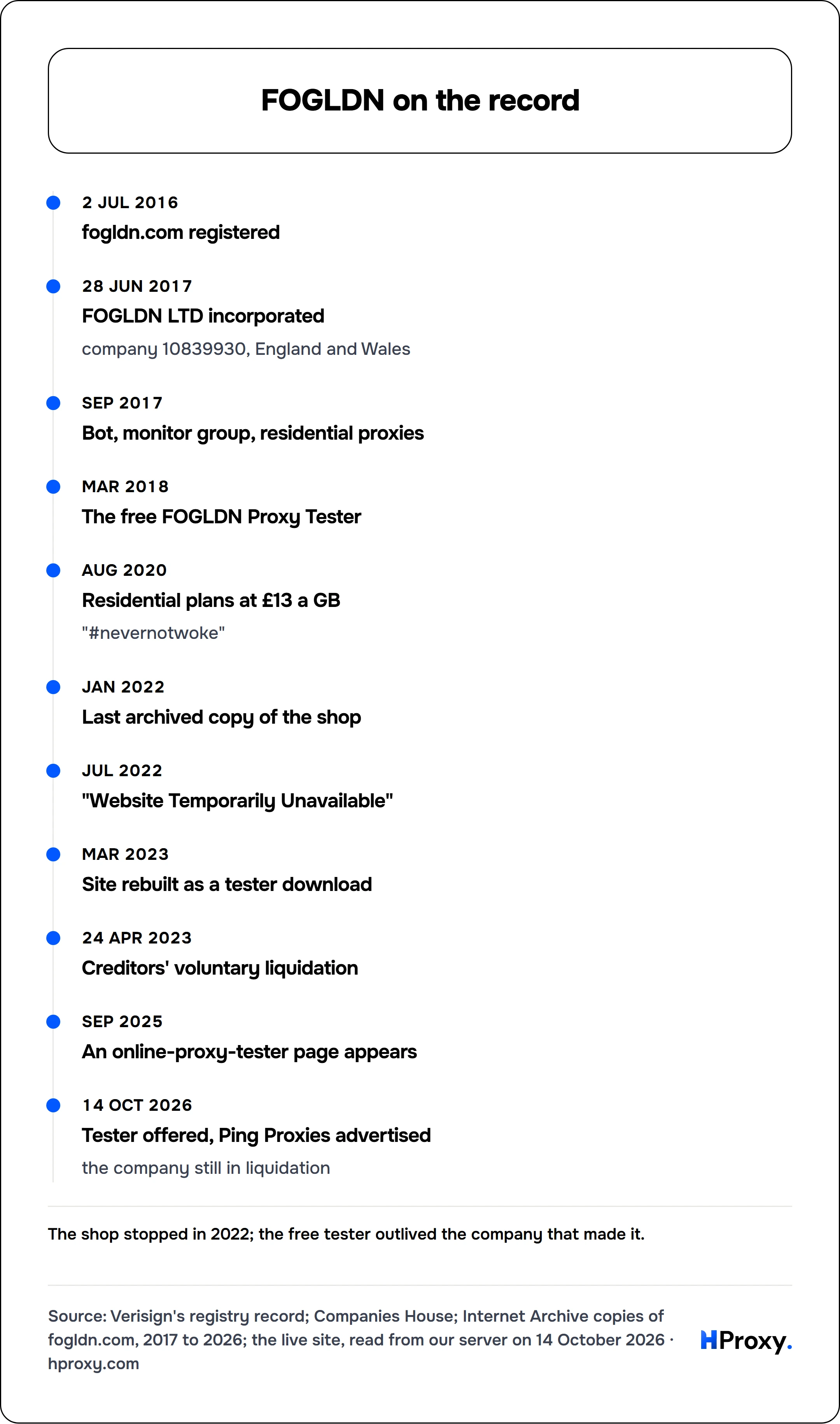
2 Jul 2016
fogldn.com registered
28 Jun 2017
FOGLDN LTD incorporated
company 10839930, England and Wales
Sep 2017
Bot, monitor group, residential proxies
Mar 2018
The free FOGLDN Proxy Tester
Aug 2020
Residential plans at £13 a GB
"#nevernotwoke"
Jan 2022
Last archived copy of the shop
Jul 2022
"Website Temporarily Unavailable"
Mar 2023
Site rebuilt as a tester download
24 Apr 2023
Creditors' voluntary liquidation
Sep 2025
An online-proxy-tester page appears
14 Oct 2026
Tester offered, Ping Proxies advertised
the company still in liquidation
How the shop ended
The archive's copies of the homepage from August 2020, January 2021 and January 2022 show the same plans and the same text. In July 2022 the address showed a hosting company's notice, "Website Temporarily Unavailable". The next copy, of March 2023, is a different site with a single product, the tester, under "© 2023 FOGLDN".
The register tells the company's side. FOGLDN LTD was incorporated on 28 June 2017, with the business code for "Other business support service activities". Its last accounts were made up to 30 June 2021, and its last confirmation statement is dated 24 June 2022; both later filings are marked overdue. Its winding up as a creditors' voluntary liquidation began on 24 April 2023, and the liquidators' latest yearly statement, covering the year to 23 April 2026, was filed on 29 June 2026. A creditors' voluntary liquidation is one that the company's own shareholders start because it cannot pay its debts.
The site's about page, in 2019, said: "Founded in 2017, FOGLDN LTD was created to be there for the sneaker community." The domain itself is a year older, registered on 2 July 2016. Its record was last changed on 2 June 2026, and it now sits with Cloudflare's registrar.
fogldn.com today
On 14 October 2026 each page we read offered the "FOGLDN Proxy Tester", "Version 1.0", for Windows and macOS. The download sits behind a form: "By downloading, you agree to our mailing permission and to be featured in our Used By company section if selected." The footer reads "© 2025 FOGLDN".
The top of each of those pages carries an advert for another company: "Check out the new Ping Proxies online multi-region proxy tester". Its links carry the tags "utm_source=fogldnbanner" and lead to pingproxies.com, which now forwards to byteful.com, Ping Proxies' new name. Byteful is run by Ping Technology Labs LTD in Manchester, as our Byteful page records, and the register lists no officer of FOGLDN LTD among that company's officers. The banners show advertising on the site, and no record we read shows who placed them or why.
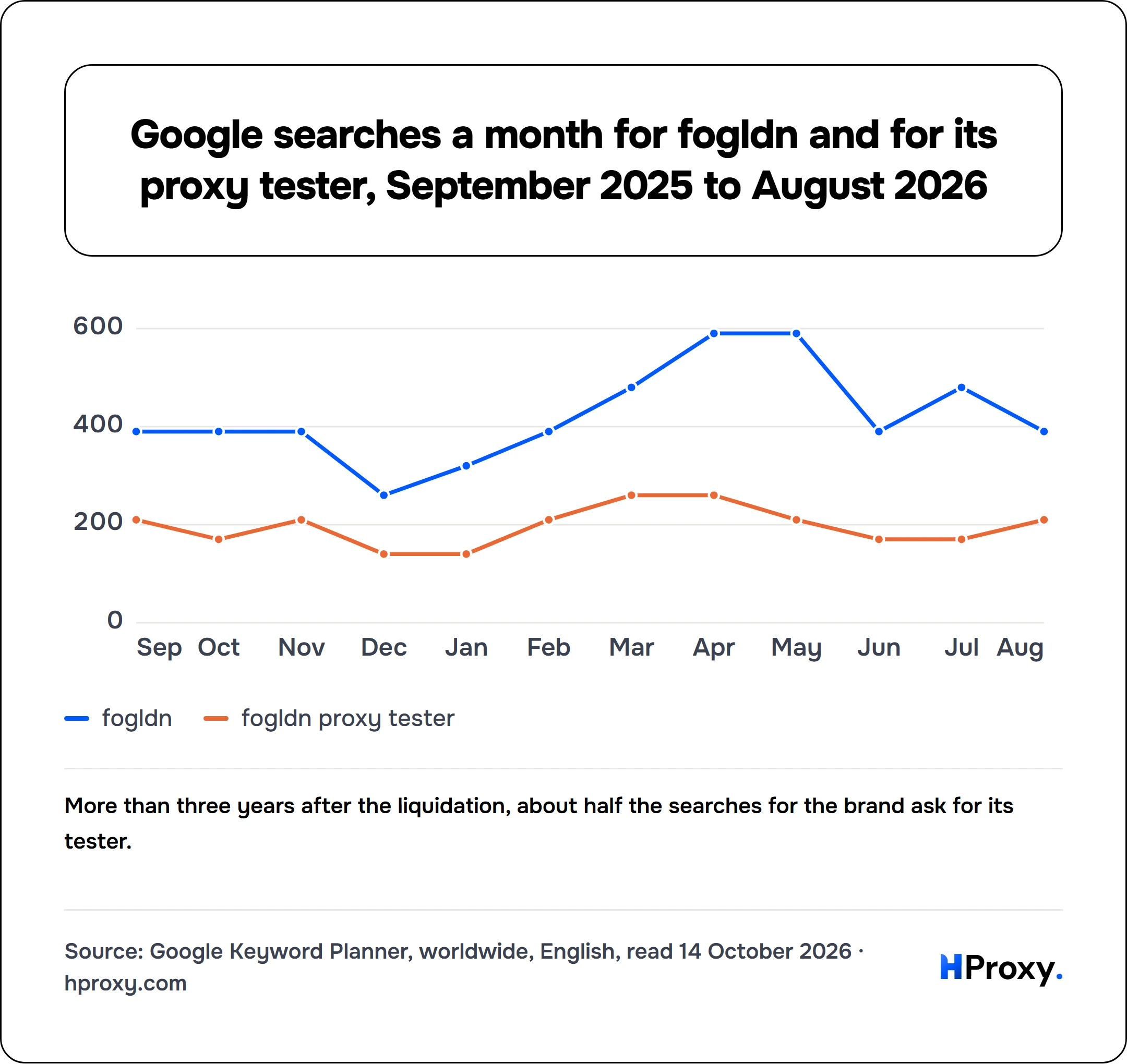
- fogldn
- fogldn proxy tester
What to use instead
| what you need | at FOGLDN today | elsewhere |
|---|---|---|
| a desktop proxy tester | Version 1.0, for an e-mail address | the free HProxy app, no account |
| a tester in the browser | an advert for Byteful's | Byteful's tester, or our online checker |
| residential proxies | none since 2022 | sellers by the gigabyte |
A desktop tester. Our free HProxy app checks a proxy list from your own connection, connects your computer through any proxy and shows the fraud score of the exit. It runs on Windows 10 and 11, macOS and Linux, and asks for no account and no e-mail address.
A tester in the browser. Byteful's tester, the one fogldn.com advertises, says its "global infrastructure spans the United States, Europe, and Asia", and it tests against Google by default. Our online checker tests proxies in the browser, with no download.
Residential proxies. FOGLDN's £13 a GB of 2020 was a monthly plan whose unused data expired. Byteful charged $3.25 a GB, down to $1.75 at volume, when we read it on 27 September 2026. Its pricing FAQ answers "No, we do not currently offer a free trial", while its site menu shows a "Residential Free Trial".
Where HProxy fits
We sell residential traffic too, $0.50 per GB, from a balance that never expires, so a quiet month costs nothing. That suits the stop-and-start pattern of release days better than a plan whose data lapses each month. Before you buy from anyone, run a few of their proxies through the free app above.
What we could not find out
We do not know why FOGLDN LTD went into liquidation, or what its creditors are owed: the liquidators' statements are filed as documents we did not buy or read. We do not know who runs fogldn.com today, who placed the Ping Proxies banners, or whether the domain was sold. Nothing we read says where FOGLDN's residential proxies came from. We did not download the tester or test any proxy. We will look at the register again by 14 January 2027.
Sources
- fogldn.com: its homepage, tester and Windows pages, robots file and sitemap, read from our server on 14 October 2026.
- The Internet Archive's copies of fogldn.com: the bot manual and proxy pages of 2017 and 2018, the tester page of March 2018, the monitor group page of April 2019, the about page and terms of 2019, the homepages of 2020, 2021, 2022, 2023 and 2025, and the hosting notice of July 2022.
- Companies House: FOGLDN LTD (10839930), overview, filing history and insolvency pages, and the officers of FOGLDN LTD and of Ping Technology Labs LTD (12699144), read 14 October 2026.
- Verisign's registry record of fogldn.com, 14 October 2026.
- Byteful's proxy tester and pricing pages, read from our server on 14 October 2026; its prices from our Byteful page, read on 27 September 2026.
- Google Keyword Planner, worldwide: monthly searches for fogldn and fogldn proxy tester, read 14 October 2026.