Proxifier (proxifier.com) is a program that forces other programs through a proxy, even those with no proxy setting of their own. On 12 October 2026 one licence cost $39.95 for Windows or for Mac, and its own feature list covered TCP connections only. The free alternatives that also route UDP are ProxyBridge, for Windows, macOS and Linux, and ProxiFyre, for Windows. On Linux, proxychains-ng and graftcp do the job from the command line. The comparison sets out each one's systems, price and limits.
What Proxifier does, and what it costs
Proxifier sits between your programs and the network. Rules decide, by program, address or port, which connections go through which proxy, a chain of proxies, or straight out. It speaks SOCKS 4, SOCKS 5 and HTTPS, can resolve names through the proxy, and fails over to a backup proxy when one stops answering.
It sells no proxies. Its FAQ answers the question "Do you provide proxy server accounts?" with: "No, we only provide and support the software." You bring the proxy and its login.
Proxifier prices, 12 October 2026
| Edition | Latest version | One licence |
|---|---|---|
| Standard, Windows | 4.14, 23 April 2025 | $39.95 |
| Portable, Windows | 4.14, 23 April 2025 | $39.95 |
| Mac | 3.15, 18 September 2025 | $39.95 |
| Android | 1.18, 15 April 2025 | in-app, $2.99 to $14.99 |
proxifier.com home, buy and changelog pages, read from our server on 12 October 2026; Google Play listing com.proxifier
A licence is perpetual and includes minor updates, from 4.00 to 4.99 for example. It allows one running copy at a time, so you can move it between computers. Volume prices fall to $24.99 a licence from 100 copies. The trial runs 31 days "with no limitations", and the shop promises a 30-day money-back guarantee. Its buy page has offered crypto since at least March 2024.
The Portable edition needs no installation and no admin rights. Its documentation names the cost: it cannot work with background services or programs without a window, console programs included.
Twenty-two years at $39.95
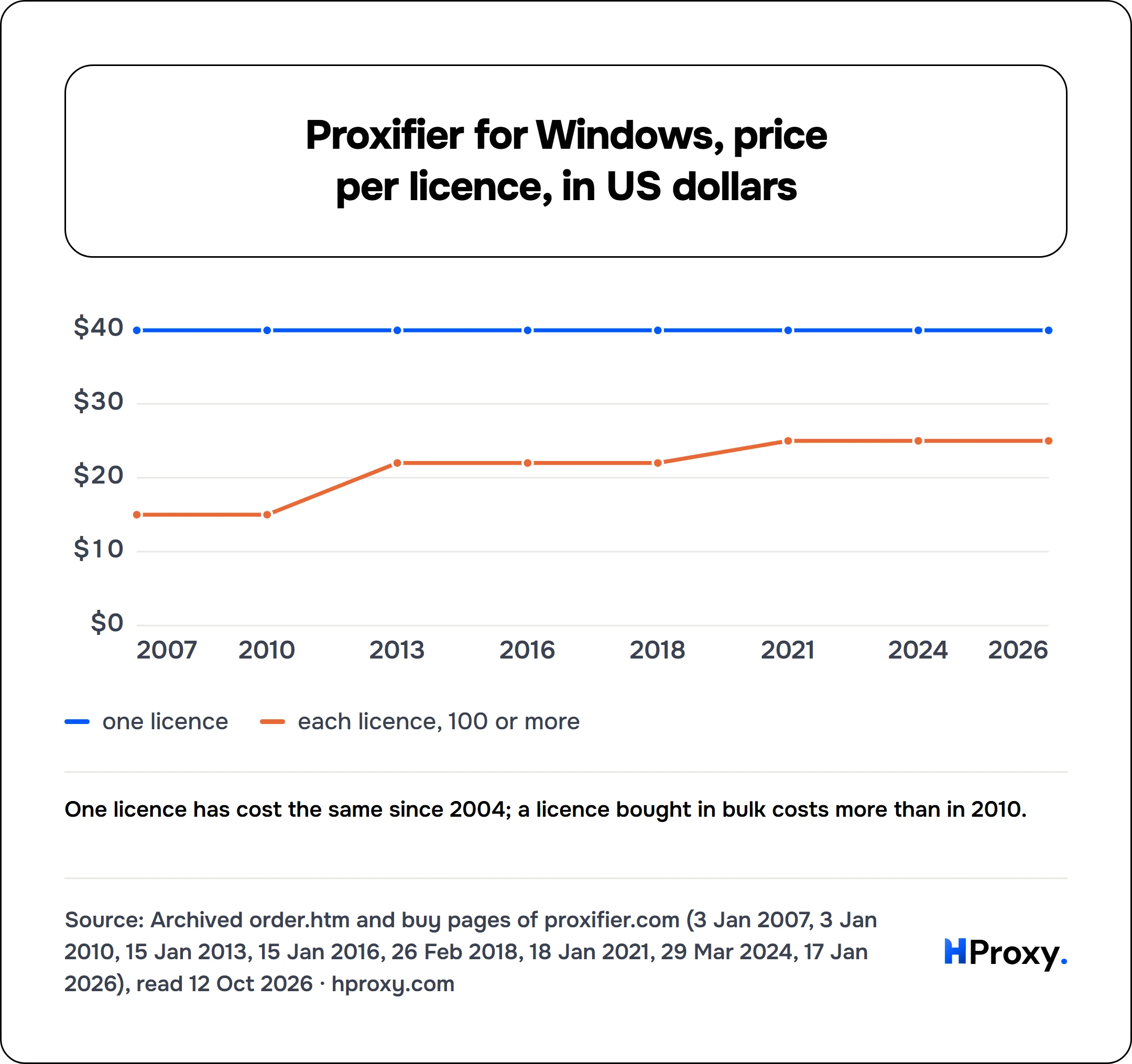
- one licence
- each licence, 100 or more
The oldest order page in the Internet Archive, captured on 13 April 2004, already priced one licence at $39.95. Every capture we read since then shows the same figure. Bulk buyers have paid more over time: from 100 copies a licence cost $15 in 2007 and 2010, $22 from 2013 and $24.99 from 2021.
Who makes Proxifier, and who owns its name
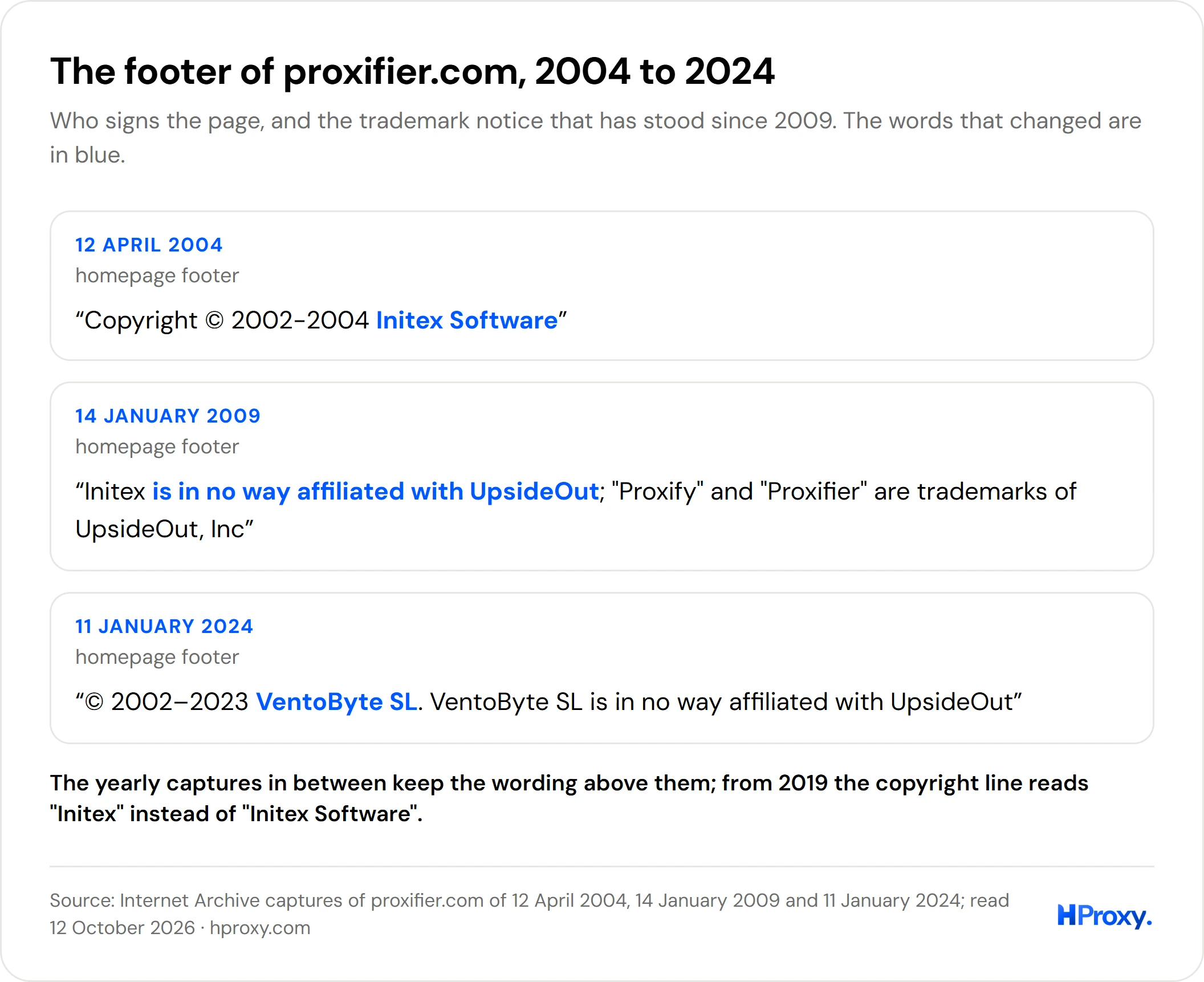
The maker changed its name on the page in 2024. Every archived footer from 2004 to 2018 reads "Initex Software", and from 2019 to January 2023 just "Initex". The capture of 11 January 2024 reads "VentoByte SL". The licence agreement, dated 13 September 2023, is already VentoByte's.
VentoByte's own page gives an address in Gijón, in Asturias, Spain, and the VAT number ES B13735899. It sells one more product, qrvpn, an app for running your own VPN server, at version 1.07 Beta on 12 October 2026.
The name belongs to someone else. The US trademark PROXIFIER, registration 3390680, was filed by UpsideOut, Inc. of New York on 25 October 2006 and registered on 4 March 2008. The trademark office lists UpsideOut and Just Holdings, LLC, also of New York, as its owners, and the same two hold PROXIFY and ANONIFY. Since the capture of 14 January 2009, every Proxifier footer has said that its maker "is in no way affiliated with UpsideOut; 'Proxify' and 'Proxifier' are trademarks of UpsideOut, Inc."
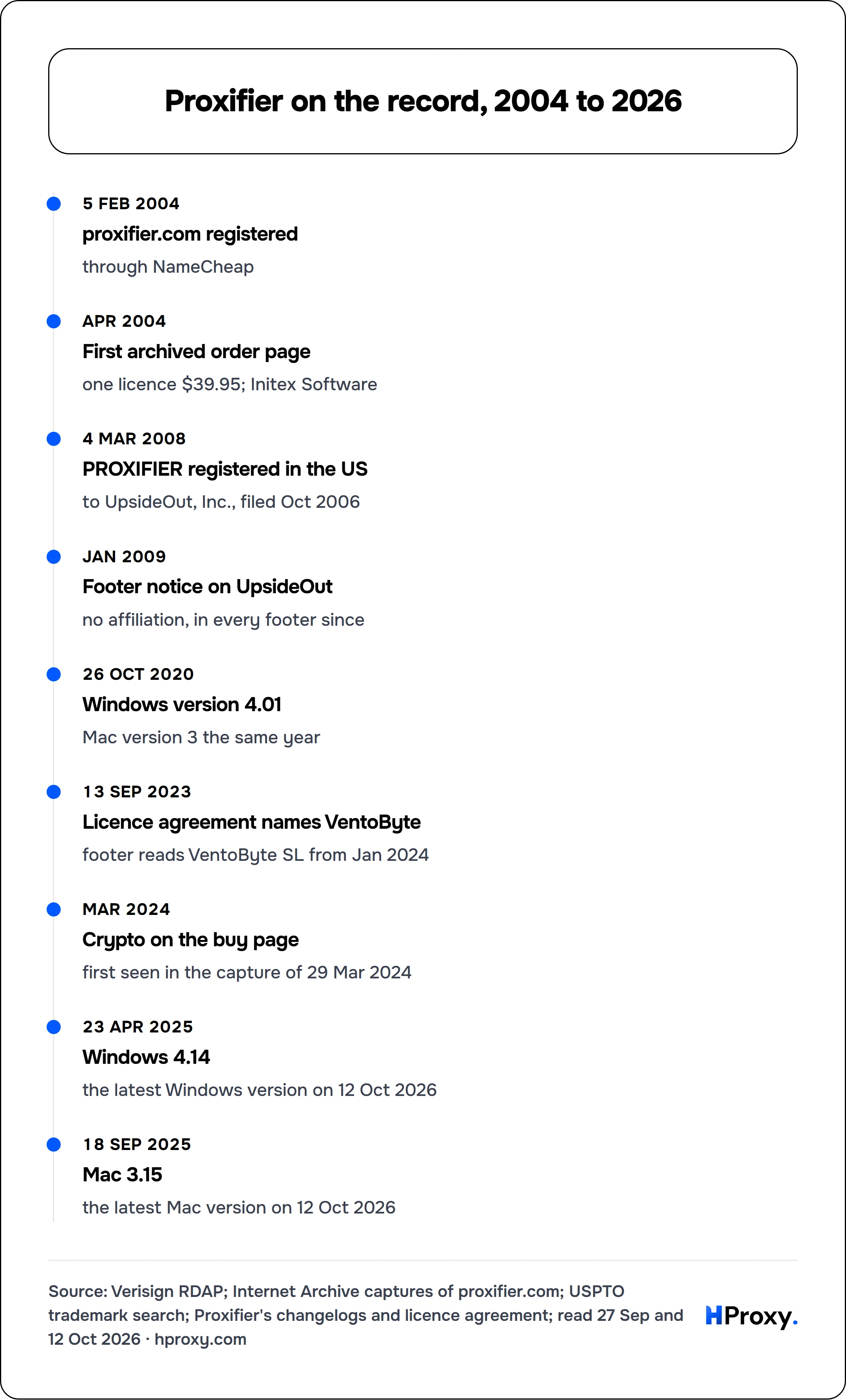
5 Feb 2004
proxifier.com registered
through NameCheap
Apr 2004
First archived order page
one licence $39.95; Initex Software
4 Mar 2008
PROXIFIER registered in the US
to UpsideOut, Inc., filed Oct 2006
Jan 2009
Footer notice on UpsideOut
no affiliation, in every footer since
26 Oct 2020
Windows version 4.01
Mac version 3 the same year
13 Sep 2023
Licence agreement names VentoByte
footer reads VentoByte SL from Jan 2024
Mar 2024
Crypto on the buy page
first seen in the capture of 29 Mar 2024
23 Apr 2025
Windows 4.14
the latest Windows version on 12 Oct 2026
18 Sep 2025
Mac 3.15
the latest Mac version on 12 Oct 2026
Why people look for an alternative
Four limits come straight from Proxifier's own pages. Each system needs its own licence, so a Windows and a Mac machine cost $79.90. There is no Linux version: its requirements list Windows, Windows Server, macOS and Android. Its feature list says it "can process all outgoing TCP connections" and names no UDP, which matters for games, voice chat and QUIC. Its changelogs mention UDP only as traffic to stop. Version 4.11 for Windows, of 16 December 2022, "can now log and block UDP connections". Version 3.6 for Mac, of 26 August 2021, added "an option to block UDP port 443 (QUIC protocol and others)". And its code is closed: the same page says it "does not contain or link any open source, freeware or third-party code".
The searches people type say the same. On 12 October 2026 Google suggested "proxifier alternative open source", "proxifier alternative for linux", "proxifier udp support" and "proxifier discord udp".
The alternatives side by side
We read each tool's own site, documentation and GitHub records from our server on 12 October 2026. We installed none of them for this page, so nothing here is a speed test.
Proxifier and its alternatives, 12 October 2026
| Tool | Runs on | Price and licence |
|---|---|---|
| Proxifier | Windows, macOS, Android | $39.95 a system, closed source |
| ProxyBridge | Windows 10+, macOS 13+, Linux | free, MIT |
| ProxiFyre | Windows | free, AGPL-3.0 |
| proxychains-ng | Linux, BSD, macOS | free, GPL-2.0 |
| graftcp | Linux | free, GPL-3.0 |
| NetDetour, formerly ProxyCap | Windows | 35.95 euros a computer, closed source |
| Surge | macOS and iOS | $49.99 for one Mac, closed source |
Each tool's site, README and GitHub API record, read from our server on 12 October 2026
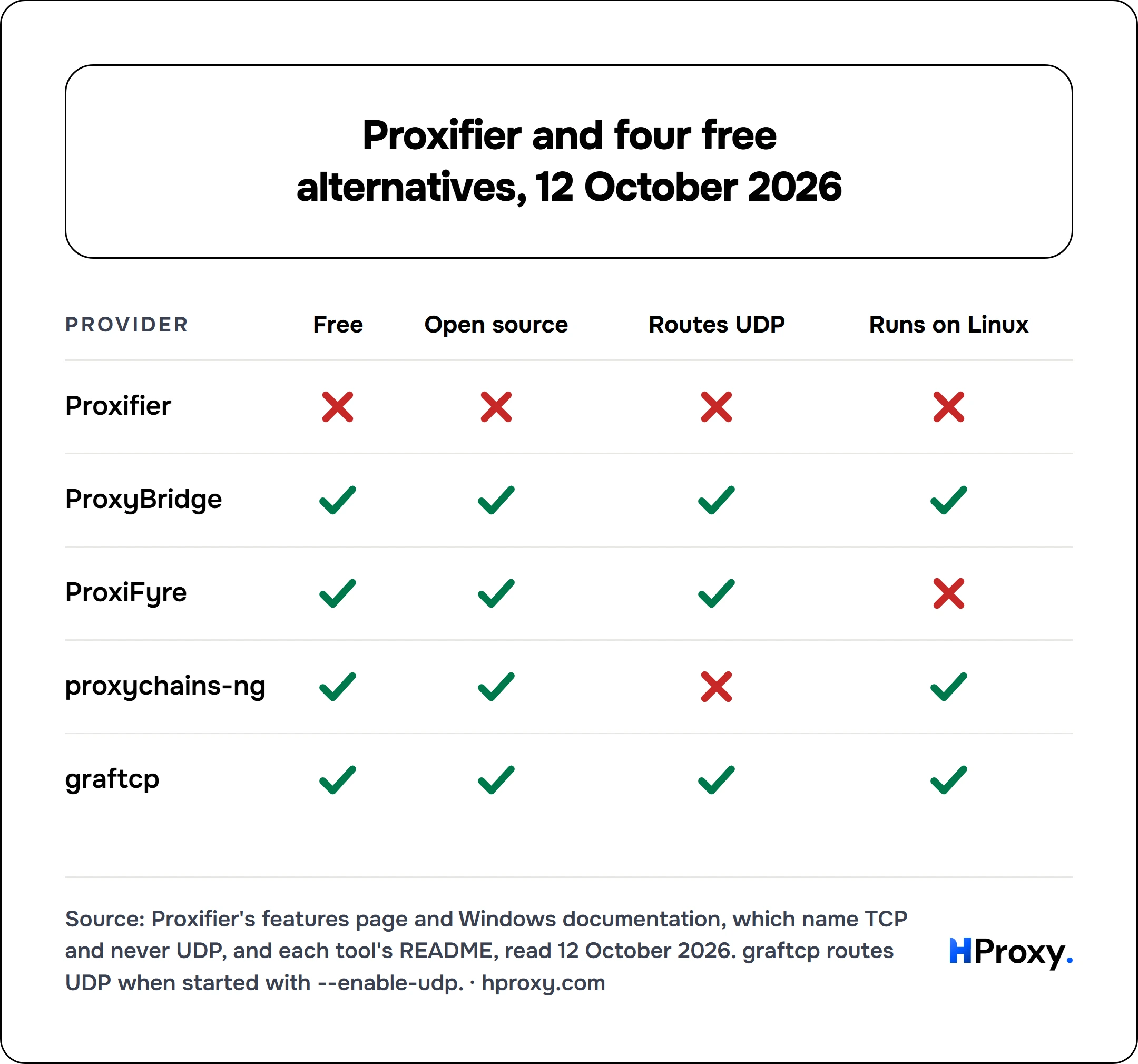
| Provider | Free | Open source | Routes UDP | Runs on Linux |
|---|---|---|---|---|
| Proxifier | no | no | no | no |
| ProxyBridge | yes | yes | yes | yes |
| ProxiFyre | yes | yes | yes | no |
| proxychains-ng | yes | yes | no | yes |
| graftcp | yes | yes | yes | yes |
ProxyBridge
ProxyBridge calls itself a "Proxifier alternative" in its own description. It sends TCP and UDP traffic from chosen programs to an HTTP or SOCKS5 proxy on Windows 10 and later, macOS 13 and later, and Linux kernels with NFQUEUE. It needs admin rights on Windows. The project only began on 13 October 2025, yet GitHub counted 6,688 stars a year later, and version 4.1.0 came out on 11 October 2026. It is MIT licensed and made by the team behind InterceptSuite, a traffic inspection tool.
ProxiFyre
ProxiFyre routes chosen Windows programs, "or all unmatched applications", through one or more SOCKS5 proxies, over TCP, UDP or both. It builds on the Windows Packet Filter driver, which its setup installs, and runs as a Windows service with its own window for the rules. It speaks SOCKS5 only, not HTTP. Its makers leave the packages unsigned on purpose, so Windows may warn about an unknown publisher. Version 2.6.2 came out on 6 October 2026, under the AGPL-3.0 licence.
proxychains-ng
proxychains-ng is the command-line classic for Linux, BSD and macOS. It loads itself into a program before the program starts and redirects its connections "through SOCKS4a/5 or HTTP proxies". Its own README sets two limits: "It supports TCP only", and it works on dynamically linked programs. Its latest release, 4.17, dates from 21 January 2024. Our proxychains guide walks through the setup with a login.
graftcp
graftcp does the same on Linux in a different way. It traces a program's network calls, so it also works on statically linked binaries such as most Go programs, where proxychains-ng cannot hook in. It sends TCP to a SOCKS5 or HTTP proxy and, with one switch each, UDP and DNS. Version 0.8.3 came out on 15 July 2026.
NetDetour, formerly ProxyCap
The ProxyCap site now says that "ProxyCap has been superseded by NetDetour" and forwards there. NetDetour 1.16 runs on Windows, from XP to 11 and Windows Server 2025. A personal licence cost 35.95 euros for one computer and 25.95 euros each from two, VAT included, through PayPal or Bitcoin. A licence covers the major version you buy, with a free upgrade if a new major version comes within 12 months. Its home page mentions UDP only as traffic its rules can block, and the notes for 1.16 announce a coming command-line edition for macOS.
Surge for Mac
Surge describes itself as an "Advanced Web Debugging Proxy for Mac & iOS". Its price data listed a Mac licence at $49.99 for one device, $69.99 for three and $99.99 for five, each with one year of free updates. Its pages we read do not say how it handles UDP through a proxy.
Full-system clients: Clash Verge Rev, v2rayN, Hiddify
These open-source clients can take over all of a computer's traffic through a virtual network adapter, and their rules can send it to a SOCKS or HTTP proxy. They are popular: on 12 October 2026 GitHub counted 150,624 stars for Clash Verge Rev, 117,881 for v2rayN and 33,156 for Hiddify. They are built for many protocols beyond plain proxies, such as Xray, sing-box, Hysteria and Trojan, so their settings cover far more than a proxy and its login.
Two to skip
Netch, a Windows client with 17,699 stars, has had no stable release since version 1.9.7 of 24 June 2022. SocksCap64's site now presents itself as a video game database. Its own announcement forum carries a topic titled "SSTap and SocksCap64 is no longer maintained." Neither is a safe bet for a new setup.
On Android
Proxifier also sells an Android app, listed on Google Play by VentoByte SL with in-app purchases of $2.99 to $14.99. The listing calls it a "lightweight and flexible alternative to VPN" and showed an update of 2 October 2025.
Among the free Android connectors we studied on 12 October 2026, v2rayNG had the most GitHub stars, 63,818. Its newest full release was 2.2.6 of 5 July 2026, and its 2.3 builds have been marked as previews since. It accepts a plain SOCKS or HTTP proxy among many other protocols, and it captures the phone's traffic through Android's VPN service. Android's own code sets the rules for that service. The user allows it the first time, a notice shows while it runs, and only one such connection runs at a time, so it cannot run beside a VPN app. Hiddify runs on Android too.
Where HProxy fits
Every tool on this page needs a proxy to send traffic to, and that is what we sell. Our residential proxies speak HTTP and SOCKS5 with a login, which all of these tools accept. Residential Lite costs $0.50/GB for one gigabyte with country targeting, and Residential Premium adds state, city and ISP targeting from $1.49. Residential Premium also relays UDP over SOCKS5, which the UDP-capable tools above need. There is no subscription, and the balance never expires.
Our free HProxy app for Windows connects your computer through a proxy in one click by setting it as the system proxy. Browsers and most programs follow that setting. The app also opens a local address, such as 127.0.0.1:8080, that takes HTTP and SOCKS5 with no password, for a program that accepts a proxy but not a login. It does not force a program that ignores the system settings: that is the job of Proxifier and the tools above.
To test a proxy before you build rules around it, our free proxy checker runs in the browser. The UDP proxy checker tells you whether a SOCKS5 proxy relays UDP at all. If only a browser needs the proxy, an extension is enough: see our FoxyProxy guide or the SwitchyOmega guide.
Which one to pick
- Windows, free, TCP and UDP: ProxyBridge, or ProxiFyre if your proxy speaks SOCKS5.
- macOS: Proxifier for Mac at $39.95 if you want a paid tool with a long record, or ProxyBridge if you want it free.
- Linux: proxychains-ng for ordinary programs over TCP, graftcp for Go binaries and anything that needs UDP or DNS through the proxy.
- A company fleet on Windows with NTLM or Kerberos proxies, central profiles and signed binaries: Proxifier is built for that job, and its price per seat falls to $24.99.
- Games, voice chat or QUIC through a proxy: not Proxifier, whose feature list stops at TCP. Use ProxyBridge or ProxiFyre, with a proxy that relays UDP.
- Skip: Netch and SocksCap64, for the reasons above.
What we could not find out
We did not install or run any program on this page, so nothing here measures speed, stability or leaks. Proxifier's feature list and all 30 pages of its Windows and Mac documentation never mention UDP. Its changelogs mention it only as traffic to log or block, so we read that as no UDP routing, though no page says so outright. NetDetour's and Surge's pages we read do not say whether they send UDP through a proxy. No record we read explains how Proxifier passed from Initex to VentoByte SL, as a sale, a transfer or a rename. Prices and versions change; this page is due for a check by 12 January 2027.
Sources
- Proxifier: home, buy, features, changelog (Windows and Mac), editions and licence agreement pages (agreement dated 13 September 2023). Read 12 October 2026.
- VentoByte SL, company page, and qrvpn, product page. Read 12 October 2026.
- Internet Archive: proxifier.com homepage, one capture a year from 12 April 2004 to 1 January 2026; order.htm captures of 13 April 2004, 3 January 2007, 3 January 2010, 15 January 2013 and 15 January 2016; buy page captures of 26 February 2018, 18 January 2021, 29 March 2024 and 17 January 2026. Read 12 October 2026.
- Verisign, registry record for proxifier.com. Read 27 September 2026.
- USPTO trademark search: PROXIFIER (serial 77028653, registration 3390680), PROXIFY, ANONIFY and the other marks of UpsideOut, Inc. Read 12 October 2026.
- Google Play, listing for com.proxifier. Read 12 October 2026.
- GitHub: InterceptSuite/ProxyBridge, wiresock/proxifyre, rofl0r/proxychains-ng, hmgle/graftcp, clash-verge-rev/clash-verge-rev, 2dust/v2rayN, 2dust/v2rayNG (with its app manifest), hiddify/hiddify-app, netchx/netch; repository records, releases and READMEs. Read 12 October 2026.
- Android Open Source Project, documentation of the VpnService class. Read 12 October 2026.
- ProxyCap's site and NetDetour's home and buy pages. Read 12 October 2026.
- Surge: its site and its price data. Read 12 October 2026.
- SocksCap64's site. Read 12 October 2026.
- Google's search suggestions and Google Keyword Planner, worldwide. Read 12 October 2026.
- HProxy: our app page, price catalogue and tools, and our study of Android connector apps. Read 12 October 2026.