Comparison

Primeproxy alternatives without a minimum spend

Looking past Primeproxy? Match the units, find the expiry clause, then measure success rate on your own target. This page covers all three.

HProxy Team··3 min read
HProxy.Comparison

Free proxies won't hold up here.

Shared datacenter IPs get flagged and dropped fast. When it has to hold, gaming, streaming, accounts, you need mobile and residential IPs that read as a real device, from $0.44/GB, pay as you go.

Residential proxies

A proxy provider comparison is only as good as its dates. Prices, pools and policies all move, so every number below carries the day it was read, and anything we could not read is marked as unverified rather than filled in.

What is on file for Primeproxy

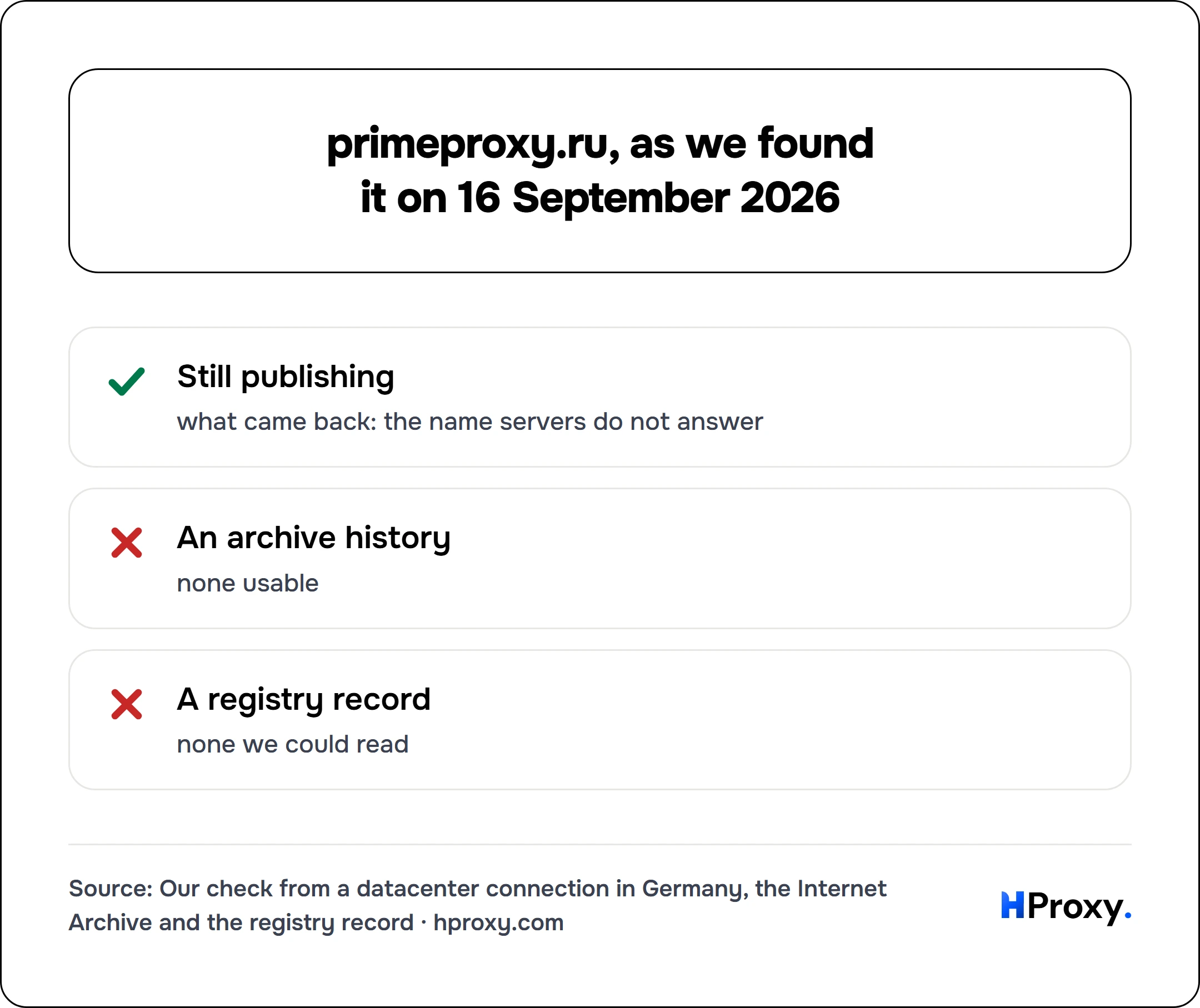
You will find them at primeproxy.ru.

There is no price in this comparison because we do not have one we can date and attribute. What follows instead is the set of questions that decide the cost once you do read their page.

Find the rate available with no commitment, then find the cheapest rate and what it costs to reach. The distance between those two tells you what kind of vendor you are dealing with.

What a pricing page leaves out

Why the pool number is the least useful figure

The number that matters is how many usable exits you can reach in the one country your job needs, this week. A pool total averages that away, which is why two providers with similar totals produce opposite results on the same site.

What the starting rate leaves out

A starting rate is a marketing number. What you pay depends on the tier your volume lands in, the minimum purchase, and what happens to traffic you bought and did not use. An expiring balance quietly raises the price of every unit you did consume.

Concurrency limits decide throughput

Bandwidth is rarely the constraint on a real workload. Concurrent connections, requests per second and per-session caps are, and they are frequently buried in the documentation rather than the pricing page.

The rows that decide it

Six questions, both answers, and an honest blank where we do not hold a current figure:

Question to askPrimeproxyHProxy
Entry priceNot verified by us, read their pageFrom $0.44/GB, pay as you go
Does unused balance expire?Read their current termsNever
Minimum commitmentCheck the current terms, this one movesNone
Identity checksTheir terms page answers thisCard orders are screened, and verification is sometimes requested
TargetingOn their own terms pageCountry, city and ISP
Free way to evaluateNot published clearly, ask before payingFree proxy list and proxy checker

Read the table as a list of questions rather than a scoreboard. The answers on their side move, and the row that decides the outcome, success rate on your target, is not printable by anyone.

What to do instead of reading more comparisons

The steps below take about ten minutes and settle the question properly.

  1. Fund both accounts with the least money each will accept, and note what that minimum was, because it is part of the comparison.
  2. Aim both at the page that matters to you rather than a test endpoint, and keep every other variable fixed.
  3. Write down two numbers per provider: the share of requests that succeeded, and the traffic it cost.
  4. Take a handful of the addresses you were given and verify their country and type against a checker you do not control.
  5. Go with whichever performed, then measure again next quarter. Networks change underneath you.

Where else buyers look

If this one does not fit, these are the nearest comparable providers we have written up, each on the same terms as this page.

What we sell, stated plainly

Our position is narrow. Residential from $0.44 per GB, no subscription, no expiry on the balance, and a public record of what our free network actually does. A provider unwilling to be measured is telling you something, and so is one that asks to be.

Frequently asked questions

What does Primeproxy advertise?
We do not hold a current, sourced price for Primeproxy, so this page does not print one. Read their own pricing page for the rate, the minimum and the commitment, and note the date you read it, because all three move.
How is HProxy different?
The models differ more than the products do. HProxy is pay as you go from a balance you top up when you want, the balance does not expire, there is no subscription unless the optional discount suits you, and residential starts at $0.44 per GB with city and ISP targeting included. Whether that beats a tiered plan depends on your usage pattern, which a short test settles.
Do I have to talk to sales or sign a contract to switch?
Not with us. You can sign up, add funds and send traffic without a call, a minimum or a subscription. Whether another provider requires any of those is on their own pricing page and is worth reading, because a required commitment is part of the price even when it is not part of the rate.
How often should I re-test a provider?
Quarterly is a reasonable rhythm for most workloads, and immediately after a noticeable drop in success rate. Pools are rebuilt, suppliers change and detection improves, so a benchmark from last year describes a network that no longer exists.
Does a bigger pool mean better results?
No. Your job meets only the exits it draws, in the countries it needs, against one target's defences. Freshness and rotation policy move the outcome far more than the headline total, and pool totals across this market are counted generously and rarely audited.

Proxies that don't die mid-job

Residential, ISP, datacenter and mobile, verified by the same engine that runs tens of millions of checks. They read as a real device and hold up under load. Pay as you go, and your balance never expires. $0.44/GB is the 2,000 GB+ rate; a single gigabyte is $0.50/GB, with no minimum order.

129M+ proxy checks run · 100+ countries · HTTP / HTTPS / SOCKS · re-checked every few minutes · no signup