BitBrowser (bitbrowser.net) is an antidetect browser from a Hong Kong company: it gives each browser profile its own fingerprint so that many shop or social accounts can run on one computer. On 12 October 2026 it was the cheapest browser we priced, with 10 profiles free for good and 100 profiles plus 4 members for $15 a month. People leave it for other reasons: it refunds nothing, can ask for an ID card and a face check, and sends disputes to a court in Beijing. The comparison weighs eight alternatives on price, law and refunds.
What BitBrowser sells, and what it costs
The price page prints the package sizes in text and loads the prices from a service of its own at apiservice.bitbrowser.cn. We asked that service the same question the page asks, from our server, on 12 October 2026:
BitBrowser's packages, 12 October 2026
| Profiles | Members included | A month: monthly; yearly |
|---|---|---|
| 10 | free | $0 |
| 50 | 2 | $10; $7 |
| 100 | 4 | $15; $10.50 |
| 200 | 8 | $25; $17.50 |
| 500 | 12 | $50; $35 |
| 1,000 | 20 | $80; $56 |
| 300,000 | 400 | $2,500; $1,750 |
BitBrowser's price service (apiservice.bitbrowser.cn, getWebsitePriceInfo), asked as bitbrowser.net/price asks it, from our server on 12 October 2026
Thirteen packages run from 50 profiles to 300,000. Paying ahead takes 10% off for 3 months, 20% for 6, 30% for 12 and 40% for 24. Each package also caps how often its profiles may be opened in a day, from 5,000 opens on the 50-profile plan upward. The free plan lets you create at most 20 new profiles a day, and cookie export, profile backup and transfer between accounts are among the paid features.
It is built, by its about page, on open-source cores from Chrome and Firefox. Besides the browser it sells cloud phones, with apps for Android and iOS, and cloud computers. The download page offers Windows 10 or later and macOS 12 or later; there is no Linux build.
Two price lists, one in yuan
Ask the price service in Chinese and the same packages come back in yuan, with the dollar figures multiplied by five: ¥50 for 50 profiles, ¥75 for 100, ¥125 for 200. The English price page used those yuan figures too in June 2023; by December 2024 it showed $10, $15 and $25, the dollar prices it still lists.
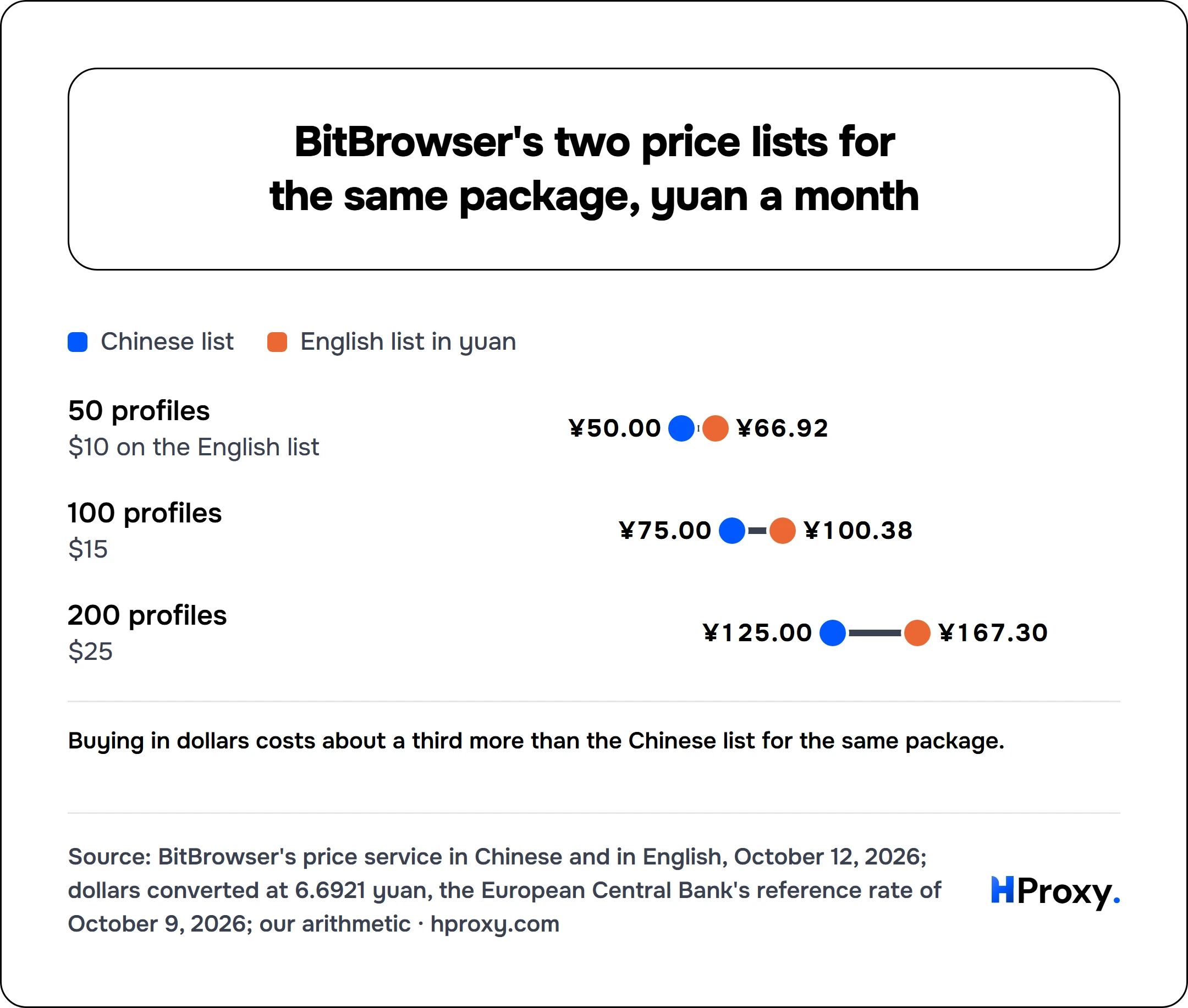
- Chinese list
- English list in yuan
The fine print
BitBrowser's terms are short on comfort. "We do not provide any refund services", they say, and every purchase is final. Free features may not run on virtual machines or servers, only one account per device may use them, and a free account idle for more than six months is treated as abandoned and its data deleted. The company may suspend or close any account "at any time for any reason", with the content in it cleared.
Its KYC page says that before some actions it may ask for the front and back of an ID card, a phone number, a passport and a face check, and that the data is deleted once checked. Deleting an account also needs identity verification. The privacy policy is governed by the laws of the People's Republic of China, and both it and the terms send unresolved disputes to the People's Court of Changping District in Beijing.
Who runs BitBrowser
The about page, the download page and every footer name HongKong Bit-Internet Technology Limited, with copyright running from 2018 to 2026, and the about page places it in "HongKong(China)". The English domain bitbrowser.net was registered on 6 August 2021 through Alibaba Cloud's registrar, and the price service sits on bitbrowser.cn. Version 7.1.5, released on 24 August 2026, added an MCP service and a virtual desktop. The site also publishes its own comparison pages against Dolphin Anty, GoLogin, Incogniton, Linken Sphere, Multilogin and Undetectable.
Why people look for an alternative
Searches for "bitbrowser" reached 18,100 a month worldwide by Keyword Planner's count on 12 October 2026, with 1,900 for "bitbrowser download" and 70 for "bitbrowser alternative". Google's suggestions pair it with AdsPower and GoLogin, ask whether it is safe, free and legit, and look for versions for Mac, Linux, iPhone and phones in general.
Price is rarely the reason, since nothing we priced comes close. The reasons sit in the documents above: no refunds at all, identity checks that may include a face scan, Chinese law and a Beijing court for disputes, rules against free use on servers, and no Linux build.
The alternatives side by side
We took every price and term below from the sellers' own pages and price services on 12 October 2026, always the monthly rate. No browser was installed for this page, so fingerprint quality is outside its scope.
Whose law applies, and money back, 12 October 2026
| Tool | Law and forum in its terms | Refund on a new plan |
|---|---|---|
| BitBrowser | China; Changping District court, Beijing | none |
| AdsPower | Singapore; arbitration in Singapore | none after confirming |
| GoLogin | Texas | 14 days in the EU and US, else 7 |
| Multilogin | United Arab Emirates | unused time, on request |
| Dolphin Anty | Cyprus | outages on its side |
| Incogniton | Dutch law; Amsterdam courts | within 24 hours |
| Kameleo | Hungary | at its discretion |
| Undetectable | Texas | none once started |
Each tool's terms or licence, its privacy policy where it names the law, and its refund rules, read from our server on 12 October 2026
AdsPower
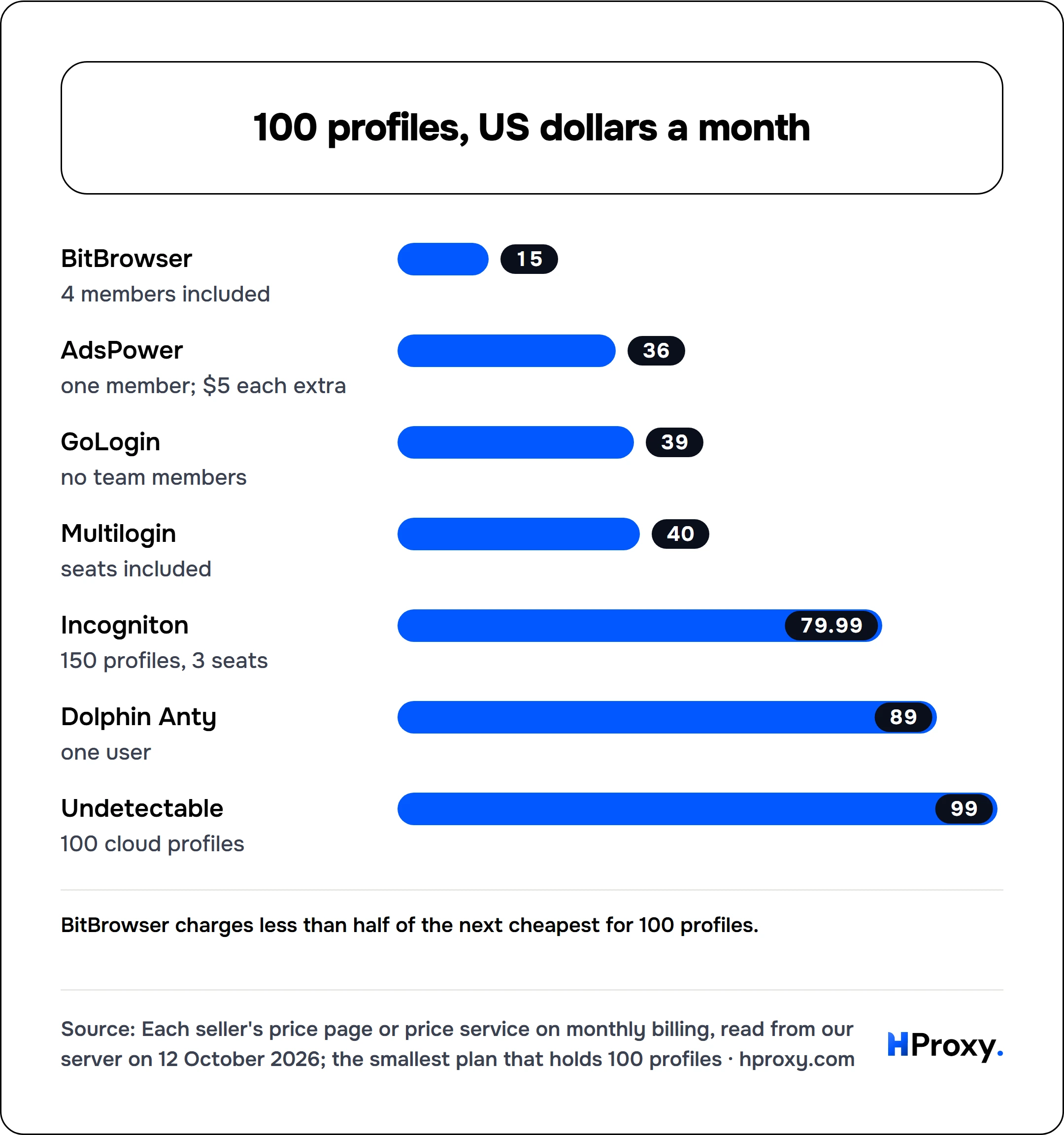
AdsPower is Google's first suggestion after "bitbrowser vs", and it too began on a Chinese site, adspower.net. It costs more, $36 for 100 profiles plus $5 for each member beyond the first, and refunds nothing once a package is confirmed. Its contract is with a Singapore company under Singapore law, with arbitration in Singapore, and it has a Linux build.
GoLogin
GoLogin charges $39 for 100 profiles and keeps 3 free; its terms point to the laws of Texas. It has phone apps for Android and iPhone, and buyers in the EU and the US get 14 days to ask for their money back.
Multilogin
Multilogin asks $40 for 100 profiles with seats included and keeps 5 profiles free. Its terms point to the United Arab Emirates, and it refunds unused time on request. Like BitBrowser it rents Android cloud phones.
Dolphin Anty and Incogniton
Dolphin Anty contracts under Cypriot law; its 100-profile Base plan costs $89, though Starter gives 20 profiles for $10. Incogniton is Dutch, with the courts of Amsterdam named in its terms, charges $79.99 for 150 profiles with three seats, and refunds within 24 hours of a purchase.
Kameleo, Undetectable, Octo Browser and MoreLogin
Kameleo works under Hungarian law and prices by browsers running at once, €59 for 10. Undetectable, under Texas law, asks $49 a month for 50 cloud profiles with unlimited local ones. Octo Browser starts at €10 for 3 profiles and refunds a first payment within 5 days; MoreLogin charges $9 for 10 with 2 free.
Where BitBrowser still leads
- Price at every size: $15 for 100 profiles with four members, against $36 and up elsewhere.
- A free plan without a deadline: 10 profiles, double the 5 that Multilogin and Dolphin Anty keep free.
- Scale: packages up to 300,000 profiles and 400 members.
- Cloud phones and cloud computers from the same account.
Moving your profiles out
Export the cookies and back up the profiles you need while a paid plan is active, since both sit among the paid features; then rebuild each profile in the new browser behind the same proxy it used, so a site keeps seeing the same address. Delete the BitBrowser account afterwards from its client, which first asks for identity verification and for the product data to be cleared.
Where HProxy fits
BitBrowser's plans include no proxies; it keeps a directory of partner proxy sellers instead, and its proxy settings take HTTP, HTTPS and SOCKS5. A few rivals bundle some proxy traffic, but a profile that should keep one address still needs one of its own.
For a profile that should keep one home address, our Residential Premium holds an IP for up to 24 hours at a time, targeted by state, city or ISP, for $1.49 per gigabyte; a fixed ISP address instead runs $2.70/IP a month without a traffic cap. How to pair one address with one profile is in our guide to proxies for antidetect browsers.
Which one to pick
- Stay with BitBrowser if price decides and you can live with no refunds and Chinese law; nothing else comes close at 100 profiles or more.
- For a refund window: GoLogin (two weeks for buyers in the EU and the US) or Incogniton (one day).
- For an EU contract: Incogniton (the Netherlands), Dolphin Anty (Cyprus) or Kameleo (Hungary).
- For Linux: AdsPower, GoLogin, Multilogin or Dolphin Anty.
- For a team on a budget, among the alternatives: AdsPower, with members at $5.
- The poorest swap on price: Undetectable, at $99 for 100 cloud profiles.
What we could not find out
Nothing was installed or tested for this page, and a rival's claims about BitBrowser's behaviour in its own test stay off it. Hong Kong's company register is not open to our server, so HongKong Bit-Internet Technology Limited's number and owners are not given. ixBrowser and RoxyBrowser, which BitBrowser users also look at, are not priced: one price address answered 404, the other is a calculator. Plans, prices and terms here will be read again by 12 January 2027.
Sources
- BitBrowser: home, price, about, terms, privacy, KYC, download, update log, proxy settings and partner pages, read 12 October 2026, and its price service in English and Chinese the same day.
- Internet Archive: bitbrowser.net/price from June 2023 to March 2026.
- The European Central Bank's reference rate of 9 October 2026, through frankfurter.
- The terms, licences, privacy policies and price pages of AdsPower, GoLogin, Multilogin, Dolphin Anty, Incogniton, Kameleo, Undetectable, Octo Browser and MoreLogin, read 12 October 2026.
- Pages about BitBrowser by GoLogin, Multilogin, MoreLogin and Incogniton, and eight proxy sellers' setup guides, read 12 October 2026.
- Search volumes from Google's Keyword Planner and the autocomplete suggestions returned to our server, both 12 October 2026.
- HProxy's own figures: the price tokens of our site when this page was written.