Every proxy provider page, ours included, is built from advertised prices and claimed pool sizes. Those two materials cannot tell you what you actually need to know, so this page spends most of its length on what they leave out.
What is on file for Best Proxies
You will find them at best-proxies.ru.
We price the providers we can source and date, and Best Proxies is not currently one of them. The rest of this page is about what to check when you read their pricing yourself.
Check the reachable rate, the minimum, the expiry terms and the failure billing, and date your note. A price without those four attached is not a price.
Their own description, read this week
On 9 September 2026 the site introduced itself as "Проверка браузера".
Also on the page, stated plainly:
We found no separate pricing page linked from the homepage, which usually means the price arrives by quotation.
Treat all of it as advertising, because it is. Its value is that it is dated and quotable, which is more than most comparison pages offer.
How long Best Proxies has been trading
The Internet Archive holds 20 snapshots of the site, the earliest from March 2012.
None of it predicts success rate. It is here because domain age and archive depth are free to check, and a provider whose public record starts last quarter deserves a smaller first order.
Their published surface
We crawled 534 pages of their site and found 9 blog pages.
Site size is a signal about marketing budget rather than network quality, and the two are frequently unrelated. It is useful for a different reason: a provider with many pricing pages is usually segmenting hard, and a provider with none is selling by quotation.
What a pricing page leaves out
Shared or dedicated changes everything
An address you share carries the reputation of everyone else on it. That is acceptable for some work and fatal for anything involving a login. The price difference between shared and dedicated usually reflects exactly this.
Who pays for the requests that fail
On a hard target, failures are the majority of your traffic. Whether those failures are billed decides the real cost, and the clause covering it is rarely on the pricing page.
The limit that stops the job
Rate limits are often enforced per account rather than per plan, which means buying more traffic does not raise them. Confirm how yours scales before you assume a bigger plan runs faster.
The rows that decide it
Compare on these rows and ignore the feature lists on both sites:
| Question to ask | Best Proxies | HProxy |
|---|---|---|
| Entry price | Not verified by us, read their page | From $0.44/GB, pay as you go |
| Does unused balance expire? | Read their current terms | Never |
| Minimum commitment | On their own terms page | None |
| Identity checks | Not published clearly, ask before paying | Card orders are screened, and verification is sometimes requested |
| Targeting | Check the current terms, this one moves | Country, city and ISP |
| Free way to evaluate | Not published clearly, ask before paying | Free proxy list and proxy checker |
A table like this can rank the things that are written down. It cannot rank the thing that matters most, which is how the network behaves against the site you care about.
The test that beats this page
It is a small amount of money for an answer that is actually about your target.
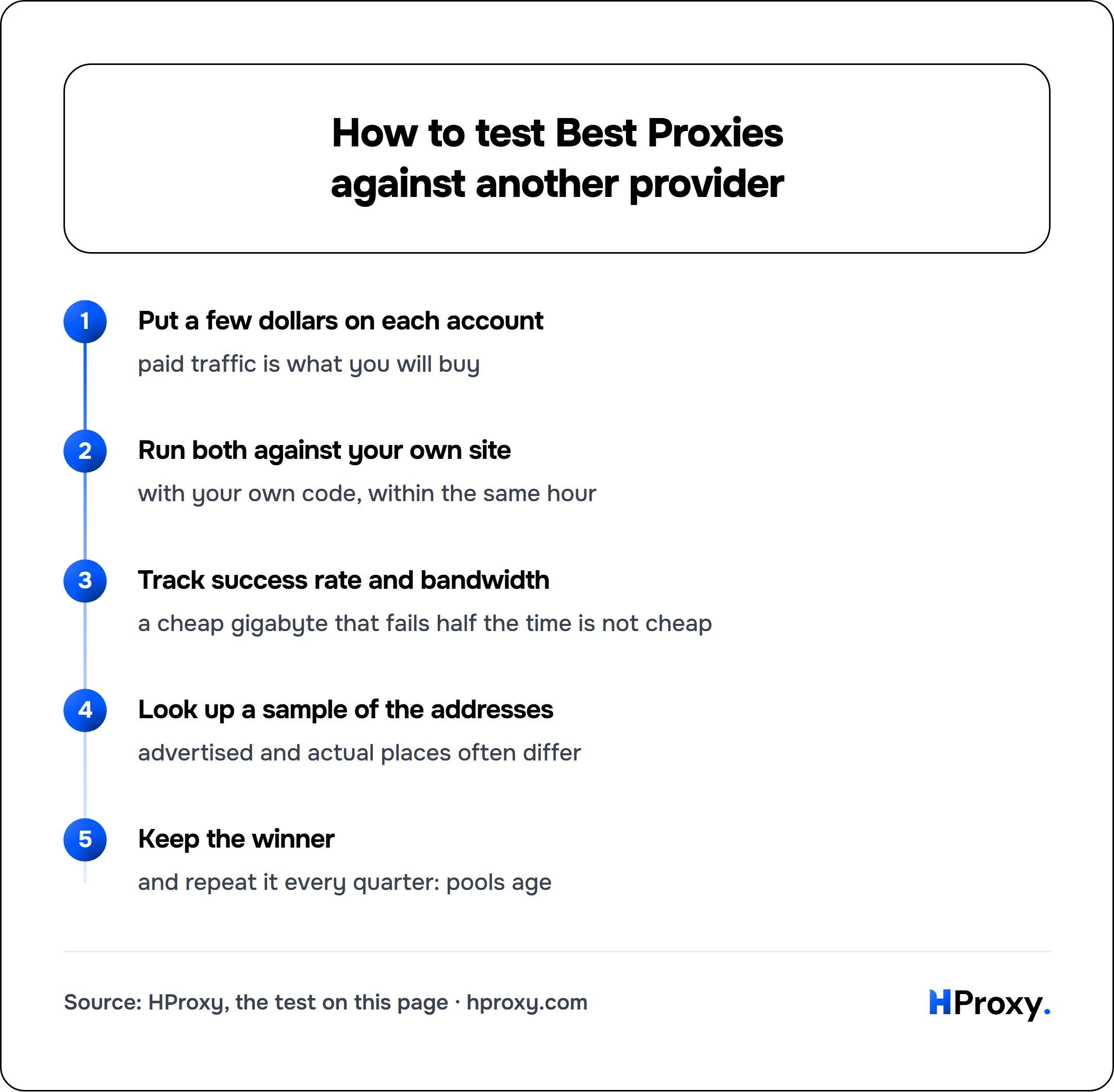
- Put a few dollars on each account. Trials are fine for a first look, but paid traffic is what you will actually be buying.
- Run them against the site you actually care about, using the code you actually run, within the same hour.
- Track the success rate and the bandwidth. A cheap gigabyte that fails half the time is not cheap.
- Run a sample of the addresses through an independent lookup, because advertised geography and actual geography differ more often than the market admits.
- Keep the winner, and repeat the whole thing quarterly, because pools age.
Put a few dollars on each account
paid traffic is what you will buy
Run both against your own site
with your own code, within the same hour
Track success rate and bandwidth
a cheap gigabyte that fails half the time is not cheap
Look up a sample of the addresses
advertised and actual places often differ
Keep the winner
and repeat it every quarter: pools age
Where else buyers look
If this one does not fit, these are the nearest comparable providers we have written up, each on the same terms as this page.
What we sell, stated plainly
If you want our side of it: $0.44 per GB for residential, pay as you go, nothing expires, and the free tools stay free. We would rather you measured than believed us, which is why the test comes before this paragraph rather than after it.