We keep a record of what providers in this market charge and what happens to them over time. This page is the part of that record covering DailiIP, written up for somebody deciding today.
What we can and cannot tell you about DailiIP
The company behind the name sits at dailiip.com.
DailiIP is not in our priced record, so nothing about their rate appears below. That gap is stated rather than filled, which is the only honest option available.
Their pricing page will answer three of the four questions that matter. Send an email for the fourth, which is usually whether blocked requests are billed, and keep the reply.
What the registration record shows
The domain was registered on 17 May 2016, through eName Technology Co., Ltd, which makes it about 10 years old. Those dates come from a registry query on 23 April 2026. The Internet Archive holds 20 snapshots of the site, the earliest from March 2007. Their registration is booked through 17 May 2027.
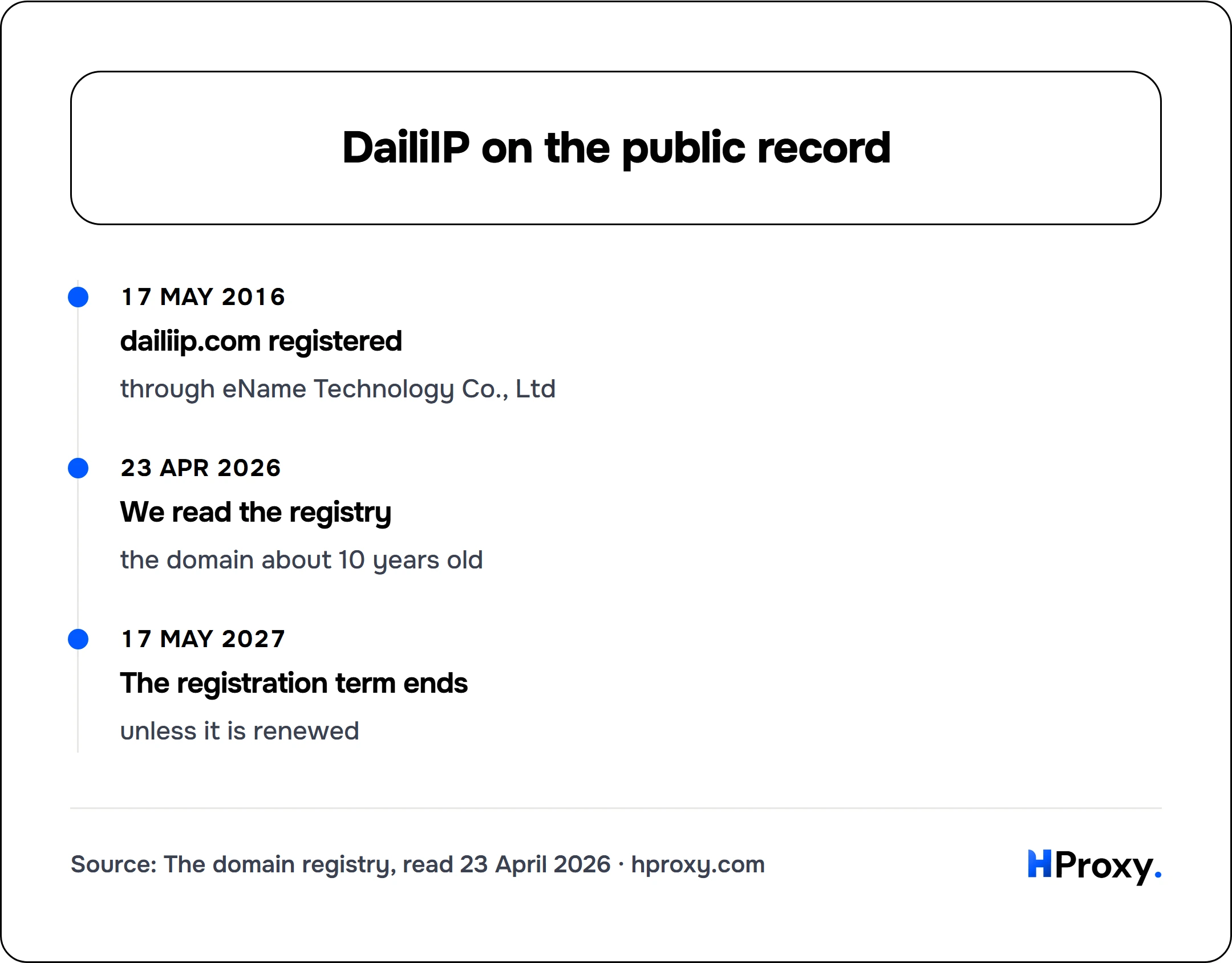
17 May 2016
dailiip.com registered
through eName Technology Co., Ltd
23 Apr 2026
We read the registry
the domain about 10 years old
17 May 2027
The registration term ends
unless it is renewed
Age is not quality. A long registration does not make a network good, and a new one does not make it bad. What it does rule out is the shortest-lived pattern in this market, which is a site that appears, sells, and is gone inside a year.
What the advertised numbers cannot tell you
The reputation you inherit
A shared address arrives with a history you did not create and cannot see. For read-only work it rarely matters. For anything that keeps a session, it is the most common cause of unexplained failure.
Ask whether failed requests are billed
Some vendors bill every request, some bill only successful ones, and the difference is the whole comparison once a target starts blocking. A cheap rate with a fifty percent success rate is twice its advertised price.
Threads, not gigabytes, are often the ceiling
Bandwidth is rarely the constraint on a real workload. Concurrent connections, requests per second and per-session caps are, and they are frequently buried in the documentation rather than the pricing page.
What separates them, in a table
The rows that matter, with our own answers stated plainly:
| Question to ask | DailiIP | HProxy |
|---|---|---|
| Entry price | Not verified by us, read their page | From $0.44/GB, pay as you go |
| Does unused balance expire? | On their own terms page | Never |
| Minimum commitment | Their terms page answers this | None |
| Identity checks | Check the current terms, this one moves | Card orders are screened, and verification is sometimes requested |
| Targeting | Read their current terms | Country, city and ISP |
| Free way to evaluate | Worth confirming in writing before you commit | Free proxy list and proxy checker |
Two notes on that table. The rows we left for you to check are not evasions: those terms change, and printing a stale figure is exactly the failure this page is trying to avoid. And no table can hold the number that should decide your purchase, which is the success rate on your own target.
The ten minute version of this decision
For a few dollars you can get a verdict specific to your job, which no comparison page can honestly promise you.
- Open an account on each and add the smallest amount they take. Skip the trial if a paid unit is cheap enough to buy outright.
- Point both at your real target, through your real tool, on the same day, with the same mix of requests.
- Count how many requests returned what you wanted, and how much bandwidth each side spent doing it.
- Spot-check the exits. Confirm they are in the country you paid for and the connection type you were sold.
- Take the winner and set a reminder to run this again, since a result has a shelf life of about a quarter.
The other names that come up
Other providers in the same bracket, priced and dated the same way:
- Proxyblocks alternatives
- proxybox.io alternatives
- ProxyBR alternatives
- Proxybrief alternatives
- ProxyBroker (OSS tool) alternatives
Our side of it
HProxy is pay as you go from $0.44 per GB on residential, with ISP, mobile and datacenter under one balance and no commitment attached to any of them. Run the test. If we lose on your target, we lose, and you have your answer.